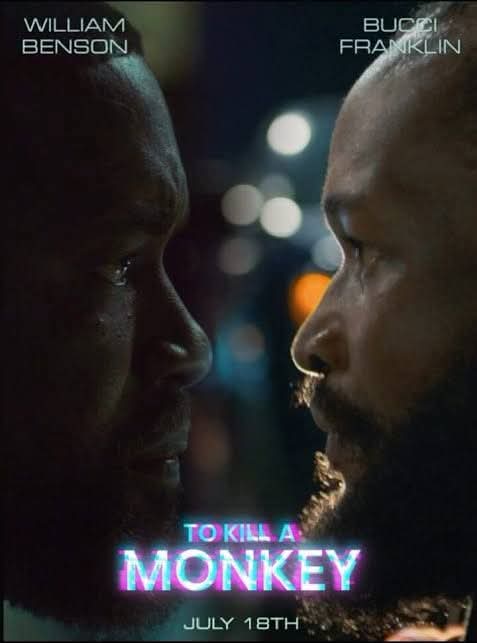
MOVIE REVIEW: To Kill a Monkey
By Zikora Ibeh
You know a movie is good when it holds a clear and full-length mirror against the society that made it. When it lays bare the contradictions we carry around daily. When the villain becomes too tragic and charming, that viewers cry when he dies despite the ruins he left behind. That is what the brilliant Kemi Adetiba did with To Kill a Monkey. She created a social autopsy with “society” as the body on the table.
The story follows Efemini, a struggling tech genius with a past in internet fraud. He is married with a pregnant wife and twins on the way, and is trying to live honestly. But in a society where decency does not feed mouths, what good is dignity and potential when hunger and humiliation have become your best friends?
For Efe, a life of integrity becomes a gamble he keeps losing. His life is already hard, but things take a sharper turn when he reconnects with Oboz-Da-Boss under an ironically desperate circumstance.
Oboz is everything Efe is not. He is wild and a jarring caricature of “I get money, who you be?”. A former campus cultist turned yahoo kingpin, Oboz is excessively loud, raw, brash, flashy, rich, feared and dangerously impulsive! Yet there is also a complexity to him that forces viewers into moral contortions. You want to hate him, but his Benin-pidgin accent, crude swag, and mannerisms in the movie makes you laugh, nod, recoil, and lean in. More importantly, he is the only person who offers Efe a path out of penury.
The two men go way back. Just like the story of the good Samaritan in the bible, Efe once saved Oboz’s life in a near-death situation. Now Oboz, flush with cash wants to return the favour by offering him a lucrative role in his criminal empire – a job that promises to shame poverty and set Efe and his family up for life.
But Efe says no. He still believes honesty is the best policy and there must be a way to make plenty money in this life without playing dirty or using his tech skills for bad and betraying what is left of his conscience and dignity.
The relationship between the two men becomes a tension point between class mobility and ethical ruin. And it is here the film sharpens its claws and performs a brutal inquiry into what values mean in a society where poverty criminalises a person, and wealth, no matter how it is acquired, sanctifies another.
The movie further urges its viewers to consider morality not as a constant but as a living fragile thing that must be watered like a plant. Otherwise, it withers into compromise. And that is exactly what happens to Efe.
He initially says no to join Oboz’s shady business but in a rat-race world, values don’t feed families. When your wife stares at you with acute hunger in her shrunken eyes and your new-born twins won’t stop crying because their mother’s breasts cannot produce milk, the only thing louder than your honest principles is your failure.
And so, the man who once said no returned to Oboz-da-Boss to say yes because values without reward cannot put food on the table.
Once inside Oboz’s world, things move fast, and the story takes bigger shape. Money flows, power grows, and a brotherhood is sealed. The two men become “brotherly” a crude but tender representation of their kinship. But Oboz’s violent unpredictability and unchecked power trips soon begin to push Efe to the edge.
Oboz is not just loud, he is mythic. A man who has convinced himself of invincibility and that his madness, when paired with money, becomes genius. He trusts no one, listens to nobody and insists on walking through fire with his chest bare.
Efe becomes the rational one as expected, the conscience Oboz claims to respect but never truly hears. And even though their partnership thrives, the cracks are clear. Oboz makes enemies faster than his money can bury them. One such enemy, an old-timer named Teacher – cold ruthless, and from a bygone order – returns to demand a share of the booming yahoo business powered by Efe’s tech prowess.
Efe wants peace. He begs Oboz for them to just settle Teacher and move on. But Oboz, driven by pride, cannot retreat. He brutishly escalates the fight, opening doors that cannot be closed, and making threats his crew, family and network will have to die for.
In an attempt to salvage an already rotten situation, Efe reaches out to Teacher to negotiate terms of survival. But Teacher has already taken a decision to kill Oboz for escalating the fight beyond irredeemable limits.
It is on account of this that Teacher places before Efe the difficult choice to either give up his business partner or watch his family and friends wiped out in painful ways, including himself.
To make things worse, Efe soon realises in all this drama that Oboz is more of a brute than he thought. His friend, a married man and so-called brotherly had been sleeping with his (Efe’s) daughter, to the extent of even getting her pregnant.
When confronted, Oboz does not apologise. Instead, he mocks Efe and dares him to be angry. He tells him in the filthiest way possible, “I made you. I can even put your own pr*ck inside your daughter if I want to.”
At this point, something in Efe breaks and he cuts ties with Oboz. From then, the moral question for him became whether to stay loyal to a madman and lose everything, or sever the cord, save what he could and live with the guilt afterwards. He chooses the latter and sets his erratic partner up for death by calling for a meeting under the guise of reconciliation.
Oboz, finally softened by time, agrees eagerly to a reconciliation meeting, hoping to make amends and restore his brotherhood with Efe to pre-conflict state. To further show good faith, Oboz dismisses his guard-boys as soon as he arrives at the meeting venue. But what he did not know was that his enemies were already in place and immediately he opened that flank, Teacher’s gang struck!
In those final moments, we see the tenderness of the bond shared between Efe and Oboz, the history, the pain, the love twisted by power. When the bullets start flying, Oboz, in a scene that redeems him only in sentiment, shields Efe. He stands in front of him, telling the gunmen they would kill him first before they touch his brother.
It was only when he turned to see Efe stepping away that the truth settled, that he realised he would die alone without his soldiers or “brotherly” waging battle on his account. .
But the tragedy does not end there. Even in death, Oboz’s shadow lingers. Teacher now demands from Efe, full loyalty or fresh blood.
The family Efe sacrificed himself is now dysfunctional. His wife wants out. His daughter, pregnant with Oboz’s child, spits nothing but hatred at him. Aside these crushing realities, law enforcement is already on his trail seeking to unravel him and his connection to the notorious yahoo enterprise.
The End!
There are no heroes in this film, only survivors.
Kemi Adetiba gave us no moral pedestal to climb. Every character the movie portrayed was flawed in their own way. But one thing the movie succeeds at telling us is that the values we claim to hold dear are only as strong as the societal conditions that allow them to flourish.
The brutal state of society makes human values negotiable, and morality, circumstantial. And sometimes, survival is the only thing left for one to hold on to.
P.S.: On a scale of 10, To Kill a Monkey easily pulls an 8. The missing 2 points are for a few narrative hiccups and inconsistencies but honestly, the highs more than make up for them. All the actors and actresses in this movie ate their roles.
Zikora Ibeh, a prolific writer and researcher, works with CAPPA as Assistant Director