Lagos State Task Force: Violations, corrupt enforcement, and drift toward violent breakdown
By Okechukwu Nwanguma
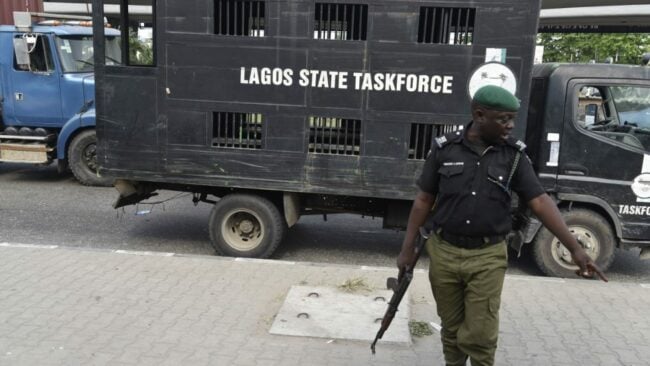
In Lagos, the crisis around the operations of the Lagos State Task Force has entered a dangerous new phase. What was once a policy debate about urban order and road safety has metastasised into a broader confrontation over abuse of power, erosion of rights, and the legitimacy of law enforcement itself.
RULAAC’s field report (yet to be unveiled) already established the structural roots of the conflict – economic desperation, transport deficits, and inconsistent regulation. But recent developments involving the Lagos State Task Force and the Nigeria Police Force now provide real-time evidence that the problem is deepening, not abating.
From Transport Policy to Rights Violations
The allegations of assault and illegal detention of lawyers by a police task force unit led by CSP Adetayo Akerele mark a troubling escalation. According to reports, legal practitioners – officers of the court – were violently arrested while performing their professional duties and detained for hours under intimidating conditions.
If lawyers can be treated in such a manner, what protections exist for ordinary okada riders, many of whom lack the social capital, legal awareness, or institutional backing to challenge abuse?
This incident reinforces a central finding of RULAAC’s report: enforcement has drifted from regulation into repression.
Manufactured Offences and Extortion Claims
Equally disturbing is the viral video alleging that task force operatives staged a traffic offence – forcing a motorist into a one-way violation – apparently to justify extortion. While the police have commendably ordered an investigation, the incident has triggered a wave of public testimonies recounting similar experiences.
This aligns almost perfectly with RULAAC’s report’s conclusion that enforcement is often driven by pecuniary motives rather than public safety objectives. When law enforcement agents are perceived to be manufacturing offences, the rule of law itself is inverted – citizens are no longer protected by the law but preyed upon through it.
Institutional Response: Between Accountability and Denial
The response from authorities has been mixed, reflecting the tension between damage control and genuine accountability.
On one hand, the reported summoning of CSP Akerele by the Inspector-General of Police, Olatunji Rilwan Disu, signals recognition at the highest level that these allegations cannot be ignored. It suggests an institutional awareness that unchecked misconduct is corrosive to public trust.
On the other hand, the Lagos State Task Force has issued a categorical denial of extortion allegations, describing them as malicious and defamatory, while defending the integrity of its operations and leadership.
This duality – official denial alongside internal investigation – captures the broader dilemma of policing in Nigeria: a system struggling to reconcile its public image with lived realities on the ground.
Okada Riders: Caught in the Crossfire
For okada riders, these developments are not abstract controversies – they are daily realities. RULAAC’s report shows that many riders are willing to comply with restrictions, yet still face harassment, arbitrary seizures, and financial exploitation.
The consequences are severe:
– Economic ruin: Confiscated motorcycles – often acquired through hire purchase – translate into debt and destitution.
– Psychological trauma: Constant fear of arrest, extortion, or violence.
– Escalating hostility: Each unlawful encounter deepens resentment, increasing the likelihood of violent confrontation.
In this context, clashes between riders and law enforcement are less about criminal defiance and more about accumulated grievance.
A Broader Security Risk
The situation is further complicated by the influx of migrants fleeing insecurity in northern Nigeria and parts of West Africa. Many enter the okada economy as a survival strategy, creating a volatile mix of economic competition, identity tension, and security anxiety.
Without deliberate policy intervention, this dynamic risks amplifying existing conflicts. What begins as a transport enforcement issue could spiral into a wider urban security crisis.
The Collapse of Trust
Perhaps the most dangerous outcome of these overlapping crises is the erosion of trust. When citizens begin to see law enforcement as arbitrary, corrupt, or predatory, compliance gives way to resistance.
The reported assault on lawyers, allegations of evidence fabrication, and widespread claims of extortion all contribute to a narrative that the system is rigged against the very people it is meant to serve.
No society can sustain order under such conditions.
The Urgent Need for Reset
Lagos stands at a critical juncture. Continuing along the current path – marked by bans, brute enforcement, and institutional opacity – will only deepen instability.
A meaningful reset must include:
1. Independent investigation of recent allegations: Including the reported assault on lawyers and the viral extortion video.
2. Accountability for misconduct: Visible disciplinary action where wrongdoing is established.
3. Clear enforcement protocols: To eliminate discretion that enables abuse.
4. Data transparency: Public reporting on arrests, impoundments, and prosecutions.
5. Inclusive policy reform: Engaging okada riders, civil society, and transport experts.
6. Economic alternatives: Providing viable pathways for riders displaced by restrictions.
Conclusion: A City on Edge
RULAAC’s report (to be launched soon) warned of a “keg of gunpowder.” Recent events suggest that the fuse is already burning.
The Task Force crisis in Lagos is no longer just about motorcycles. It is about governance, justice, and the fragile relationship between the state and its citizens.
If urgent, credible, and transparent action is not taken, the clashes we see today may well become the conflagration we fear tomorrow.
Nwanguma is the Executive Director of Rule of Law and Accountability Advocacy Centre (RULAAC). He writes from Lagos