


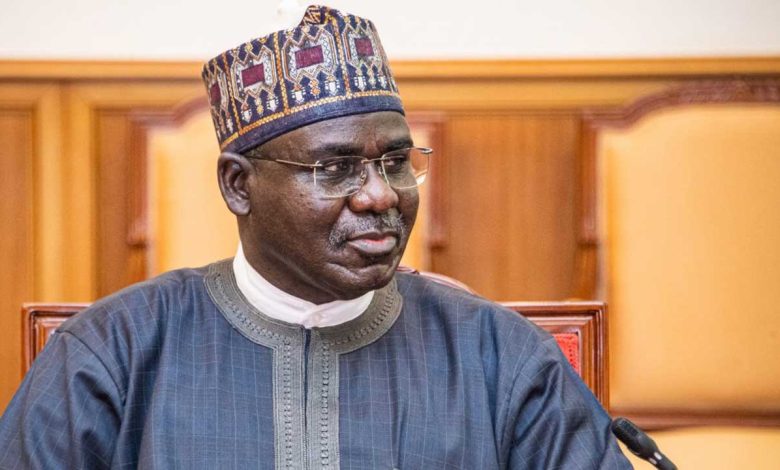
Insurgency is people’s war, not just military’s — Buratai
By Jeffrey Agbo
Former Chief of Army Staff, Gen. Tukur Yusuf Buratai (rtd.), has reiterated that Nigeria’s battle against insurgency will remain unresolved unless citizens understand that security is a collective duty, not one borne by the military alone.
Buratai made the remarks on Saturday during the 18th Annual International Security Conference and Induction Ceremony of the Institute of Security, Nigeria, held at the University of Lagos’ Faculty of Social Sciences Auditorium Complex.
Speaking with journalists on the sidelines, the former Army boss said many Nigerians still misinterpret the nature of insurgency, stressing that extremist threats are rooted within local communities and cannot be eliminated solely through armed operations.
“But what most people fail to understand is that insurgency is the people’s war. It’s not only the military in the people’s war,” he said. “You’d be surprised that amongst us here, there may be one or two bandits or Boko Haram members.”
Reflecting on his tenure leading counter-terrorism missions during the height of the Boko Haram conflict, Buratai said Nigeria experienced notable security progress between 2015 and 2021, especially in reclaiming territories previously under insurgent occupation.
“You know how we built up from 2009 up to 2015, isn’t it? Was there any change between 2015 to probably 2021 or 2024? Was there any improvement? Yeah, you should acknowledge that,” he stated.
“All those roadblocks were removed. All those local governments that were under the Boko Haram terrorist group before 2015 have been recovered. Substantial degrading of Boko Haram was done between 2015 and 2021. The military is still what it used to be – professional.”
Delivering a keynote address titled Leadership, Strategy, and National Security Management, Buratai underscored the synergy between capable leadership and effective security outcomes. Citing his 2022 book Thoughts and Principles on Leadership, he argued that strategic plans amount to little without leaders who can bring them to life.
“A well-developed strategy is essential, but it is nothing without leaders who can implement it. Leaders at all levels must promote transparency, encourage citizen participation, and be rational enough to anticipate future challenges,” Buratai said.
He added that the government already has robust legal and operational tools to tackle terrorism—including defence policies, the Anti-Terrorism Prevention Act, and other frameworks—but insisted they must be applied consistently and comprehensively.
“The government has all the documentation, the transcripts, the strategy, the defence policy, and the Anti-Terrorism Prevention Act. They are all there to deal with this situation. But it must be comprehensive, consistent, and sustained. There must be support, training and retraining, and recruitment across the police, military, intelligence agencies, DSS, and others,” he said.
Buratai also noted that grassroots institutions and community participation play vital roles in strengthening the country’s security system.
“We must have community resilience and community support. Local government administrations must be empowered. It is really not a one-off solution,” he added.

, has reiterated that Nigeria’s battle against insurgency will remain unresolved)