



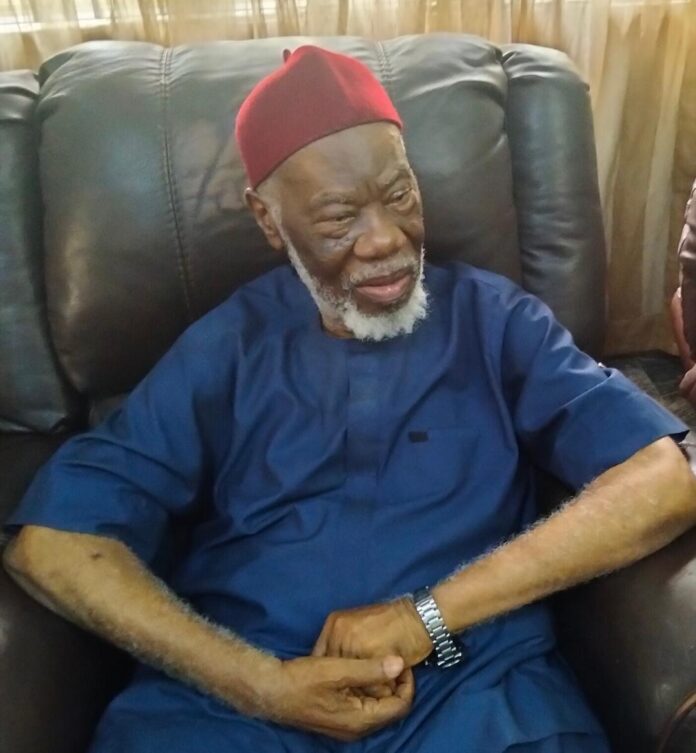
In this concluding part of the Uma Eleazu interview, the elderstatesman, who was named John Jones, talks about growing up, his first encounter with Dr. Nnamdi Azikiwe and how he met his wife. he recalls how ‘my father-in-law objected to my taking his daughter out for a dance.’ He spoke to TheNiche trio of Ikechukwu Amaechi, Emeka Alex-Duru and Eugene Onyeji
What was growing up like and to what extent did it shape the man, Uma Eleazu?
What shaped my life is my upbringing in the village. My father was a catechist in the Methodist Church and you know catechists are not at the top of the church hierarchy. In fact, a catechist is the lowest in the church system also one of those who became teachers after the missionaries came to Ohafia. So, his textbook in life was the Bible. My mother also was among the first females allowed to go to school and she said she went to school in 1914. She was born around 1902. My father was born may be some years before the turn of the century. We date his birth around 1890 or thereabout. And both of them were strict missionaries. I was brought up on the Bible. The second textbook I had was Igbo Bible. The first one was what was known as Igbo Prima where you are first introduced to syllables and after which you begin to combine the syllables into words. And from there you begin to read three-word sentences, five-word sentences and so on. Sometimes, the punishment they will give me is to go and cram part of the Psalms. And I know quite a number of the Psalms in Igbo.
There was one in particular, my mother used to say, onye ume ngwu (lazy person), go and see what ants do and it is in the Bible (Proverbs 6:6-8) – “Go to the ant, thou sluggard; consider her ways, and be wise: Which having no guide, overseer, or ruler, Provideth her meat in the summer, and gathereth her food in the harvest.”
I used to think it was punishment when they said I should cram that. But as I was growing up when I was doing biology, you really watch ants what they do. They don’t appoint princes or presidents, they don’t appoint kings but whenever they are going, they are in a straight line. One may jump the other but they keep going, they match on. If you kill one of them, some others will come around and carry it. When you look at these things, what is the wisdom of watching ants, how they move, any kind of ants?
Why were you expelled as a primary school teacher?
One learnt discipline, principles from what the Bible was teaching. My father always insisted, don’t forget the word of God wherever you are going. When I was terminated as a teacher, I was teaching somewhere in Ohafia and my headmaster, the one who bought the newspaper we were reading, they said I was hoping to go to college but my handwriting was bad. So I must learn how the mission said everybody should write. They were leaving the cursive and we were supposed to learn joint script where the letter h will have a little tail which joins a and so on. The type my father wrote was cursive, till he died was the original, very decorated. But in our time, they were teaching us the one that was called joint script.
So, he gave me punishment to cut grass and I rebelled. I said no, I cannot cut grass, I am a teacher, and grass cutting is for school boys. So, he reported me to the white man and they said I was insubordinate. That was my first time of hearing the word, insubordination. I was dismissed. I went to Umuahia to see my father. And he was surprised seeing me because it was not even half of the term and I told him they had sacked me. He asked whether it was the white man or black man and I said it was the white man. He said, the white man wrote a letter to say your appointment had been terminated? I said yes. The next day, he took his bicycle and said, let us go. From Umuahia where he was teaching, he rode the bicycle, carrying me at the back to Ohafia to go and see the white man.
So, we got to their manager’s place – that is what we used to call it – and my father started speaking all the English he knew, telling him how he used to carry bell on his head for the church in my village from Calabar. The bell was usually imported all the way from Scotland and they will bring it down to Calabar by boat. He also told the white man how they moulded the blocks with which they built the church in Ohafia.
After he spoke, the white man, a Scottish, asked him, where is your son and he said I was outside, he said call him. When I came in, he said, I didn’t know this story and for your work for the mission, I am going to cancel the termination and send him back. But tell your son to always obey his superiors. So, one grew up with that principle – obedience.
But that happened again
Yes! When I went to the Teachers Training College, I was rusticated again with other people for strike and I went back and my father said, what is it again. The first question he asked me was: did you know it was a rule and I said yes and he said, then it is disobedience and I cannot defend you. Eventually, I did another thing. At this time, I was at the teacher Training to get my High Elementary Certificate, the qualification that you need to be a school master. And I went and took GCE and when I came back, the principal said, you took an oversea examination and I said yes. But he said the rule of the mission is that nobody who is being trained as a teacher should take oversea examination.
Why?
Because when they pass they leave the mission. So, I was rusticated again. This time from the Teacher Training College. I went to Umuahia to see my father and he said, have you closed school and I said no, I have been fired from the college. He said owu gini kwa (what is it again?). And when I told him, he said, did you know it was a rule? I said, well, we were hearing that they made that kind of… He said no, no, did you know it was a rule and I said yes. He said it was disobedience and he told me that the first order in heaven is obedience. When you disobey, there is a consequence. So, if they have sacked you, pray that you should pass the examination. But if you don’t pass, well whatever you like, do to yourself. And I left and came to Lagos. When the result came out, all the tutors in that college that took the examination – A-Level – with me failed. I was the only one who passed and I got four papers in one sitting and I got a letter from London University that I have been exempted from what they called “Inter-BSc.” I did that at home. I didn’t go to secondary school, only two years at teacher training.
What happened after that?
So, I came to Lagos. My brother, God bless him, was a reporter with the West African Pilot. He used to be in Sabo, Yaba. So, I asked him if there was a way I could see Zik and he said he doesn’t come to the office until about 3pm. In that place, one Blackson, who used to be his General Manager, Lagos City College was there and the head office of the West African Pilot was in Sabo. That was where Zik did all his fighting – both whites and blacks – publishing his newspaper. And my brother was one of the reporters with one Nelson Otta. MCK Ajuluchukwu used to write Titbits here and there by Monger and I used to collect those things and read them. Cyprian Ekwensi was writing. So, when I told my brother I wanted to see Zik, he said, well, you know he is a very busy person, but that he will ask Blackson to see if he can allow me to see him before he settles down.
So, we waited until he came. For me, it was like going to see God because everything I knew about Zik came from reading his speeches, memorizing some of them. It is not now that a small governor will walk in and everyone will stand up. No one stood up when he walked in. I just saw someone wearing agbada walk past. And my brother who was spying from where he was went and informed Blackson, who said it was okay, let him settle down.
READ ALSO: No political unity in Nigeria without economic integration – Uma Eleazu interview (2)
At 95, I am still a young man – Uma Eleazu interview (1)
How corruption forced me out of Nigeria’s oil industry – Uma Eleazu
When he settled down and they called me in, that was how I was just looking at him, tongue tied. After greeting him, he said, young man they said you want to see me. I couldn’t say anything. I became tongue-tied. I couldn’t say a word and he said again, they said you want to see me, I said yes sir but kept mopping at him. He asked me if there was anything I wanted, I said no, just seeing him in person was enough for me. I told him that I have been reading his writings and even memorizing some. He asked when I started reading him and I told him the first thing he said at the burial of Herbert Macaulay – before us lies the open grave. I recited that speech and told him that was the beginning of my journey with him. He laughed and said, young man, I didn’t write it. It was a poem by Claude Mckay. So, study hard, you will make it.
But I was so satisfied just seeing Azikiwe, standing in front of him and he allowed me to say a word. The next time I saw him was after so many years. I had come back from abroad then and went to see him at Nsukka. Why I went to see him this time was to plead with him to have a good library for all his writings because I have been to the Library of Congress. Let somebody collect all his writings in one place so that those of us who like what he used to write will be able to access them. I told him that I was not asking him to give me because those on sale, I have bought all of them. He just smiled and told me: you have a very good idea. I have already employed a librarian to do a catalogue of even the articles. He said it would soon come out. That was the second and last time that I ever met Zik.
The tragedy of our situation is that we no longer have people we can look up to today as I looked up to Zik. So asked earlier about what I regret, probably, if I had continued in politics, maybe, I would have had followers but I don’t regret the decision I had already made at the time. That was not the life I wanted to live in politics.
What about your nuclear family? How did you meet your wife?
Because of the problems I had with headmasters, I was named John at baptism and my father added Jones. So, all through primary school, I was known as John Jones and I used to be handsome and girls liked me. There was no question about it. But for me, liking girls was not a priority. Some will make handkerchiefs in those days and draw flowers on it to fancy it and hide it to give it to someone to give me. I will just put it in my pocket and that was all. I was not interested. Reading was my priority. Since I didn’t go to secondary school, how do I catch up? So, I had to sit down and study. I wasn’t listening to anyone.
How did you end up schooling abroad?
By the time I knew I would make it to overseas, when I got that exemption from Inter-BSc, I now started looking for a way of going. Good a thing, our people were now in government. This was in the late 1950s and Zik was saying, give scholarships. Almost every other month, they publish names of people who had been interviewed and given scholarships to go overseas and I benefited from that. In 1958, I got scholarship to go and study economics abroad. But I don’t know what they did within the ministry and they sent me to Fourah Bay College in Sierra Leone where they were studying economics. There was no economics in University College Ibadan then. Some of my mates, those who wanted to do history or engineering were sent to either Ibadan or ABU, which was not a university then. It was an intermediate institution – College of Arts, Science and technology – before you go to the university. Some of us who had something higher they sent to Fourah Bay and immediately completed my Inter-BSc and got a BA in two years and I said I was not going back to Nigeria, I must have an Honours degree, that was what we read in the newspaper about my scholarship – BSc Honours in Economics.
So, I came back and reported to Aja Nwachukwu, who was then Minister of Education and I told him I was sent to Fourah Bay, I didn’t plan to go there, I wanted to go to London and he said, of course. So, he approved and I was sent to England to go and get a degree in Economics. Since, Fourah Bay was attached to Durham University, I went to Durham and they said I should go to Kings College Newcastle where they had Economics Department. So, I went there, finished and came back to Nigeria.
I went back to where I was working in the Ministry of Labour as a Labour Officer and from there I went to University of Nigeria Nsukka to teach. Then UNN was looking for lecturers and if you have a good Honours degree, you can come and teach. So, I was recruited as an Assistant Lecturer. I went there and one man from my village, called Dr Kalu Ezra, he was one of those that my community contributed money and sent him to America to go and study. Do you know that was what Town Unions used to do in Alaigbo. So, at that time Mbonu Ojike, Nwafor Orizu, KO Mbadiwe were going from town to town, encouraging people to look for their children who are brainy and send them overseas. And Mbadiwe and Orizu established what they called Horizontal Education. You enroll there and they will find a university for you in the US. That was how Kalu Ezra, Prof Eme Awa and one Ukoha Igwe – three of them – Ohafia Improvement Union collected money and sent them to the US to go and study. Contributions were made and I remember when contributions were being made in the case of Kalu Ezera, one woman said, if we succeed in this life in sending an Asaga son (Asaga is my particular village in Ohafia) to go to the white man’s land, that she will contribute six pence. An old woman and she brought her six pence and put in there and everyone clapped for her. Who does that now?
So, this Kalu Ezera was the person who helped me to get into Nsukka as Assistant Lecturer under Babs Fafunwa who was already a professor by then. After two years at Nsukka, I got a fellowship to go to the US but I said, this time around, I don’t want to flirt around. I have to get a wife.
Did you know her or it was an arrangee marriage?
I knew her as a small girl, the daughter of a headmaster. And I said I was going to marry a headmaster’s daughter because of all the trouble they gave to me. I said they will see trouble because I will go to his house and marry his daughter. So, when I came back, the one that I had in mind, someone else had married her. But I saw this one, a daughter of another headmaster, and I said this is the girl I will marry. I just saw her once. I didn’t know her. So, I told them that I have seen the girl I want to marry. My cousin said, oh, if it is Mr. Anya, we will take you there but almost all the headmasters knew me by the name, John Jones.
So, I dressed my best. On every Christmas Eve, Ohafia youths then would have a dance, real ball dance. The one that was done with gramophone. And having been to England, I learnt how to dance waltz at the Student Union where we danced every Saturday. So, when I walked in to the floor, and made the foxtrot move, all the girls knew that somebody from England had come in. So, as the music was playing, I will just walk to the girls and say, excuse me dance. And the girl will follow you.
So, that particular dance, I have not seen this my wife in any of the previous dances, and I went to the father. She has two sisters. And I greeted him and he said, John Jones. I said, sir. He said, what can I do for you? I told him that I wanted him to allow his daughter to follow me and go and dance. He said that is not how things are done. In the night? I said yes. I told him I would take care of her and bring her back safely. He said nope! This is a strict headmaster. He refused.
I had already told her to tell her father that I was coming and they told him Uma Eleazu and he said he didn’t know who they were talking about. So, when I walked in and he called John Jones and I answered but told him that my name now was Uma Eleazu, my Igbo name and I no longer answer English name. He looked at me and laughed and didn’t allow me to take the daughter to the dance. I was dressed in full savoy robe. Savoy Robe is where they make the best suit in London and I had two of my suits made there.
So, I scratched my head and told myself that I had to change tactics. I was driving a car called Wolseley. Then it is either you buy Austin Cambridge or Wolseley but Wolseley was more portable than Austin Cambridge. And mine was maroon colour. And the father’s house is by the road before you go anywhere else, a small road that a car cannot pass. You must get there before you get to anywhere else. So, I decided to go and visit the village and I drove the car and parked it in front of the house and then trekked to the village. So, they all came out asking for who parked the car but nobody agreed seeing who parked the car. But all of them came out admiring the car and I made sure I spent more than an hour inside the village, vising my maternal relations.
So, when I came out, lo and behold, it was this troublesome John Jones. So, I went back to greet her dad. This time around, he asked me whether I was the person who parked the car and I said yes. And I told him that I went into the village looking for some people with whom I planned visiting his house to give him drinks. That we were looking for something in his House.
Then, after some time, my other uncles from the village arrived with drinks. They had to go and buy drinks and everything that is used for first visit. So I had to wait in his house until they came. By this time, I have not even asked the girl out. So, when my uncles arrived, they told him that the other day you came to our village and took a girl. Now we have come to take your first daughter.
He asked his daughter if she knew me and she said she had seen me before and what did I tell her, she said I never told her anything.
Like I said, I didn’t even ask her out but when the parents took her in and said, this is what this person is saying, what do you have to say and the girl said she has agreed. So, it was like love at first sight. We got married December 1964 and we have been living together for 61 years and our union is blessed with one boy and six girls – seven children. And ten grandchildren and still counting.
- Concluded




)