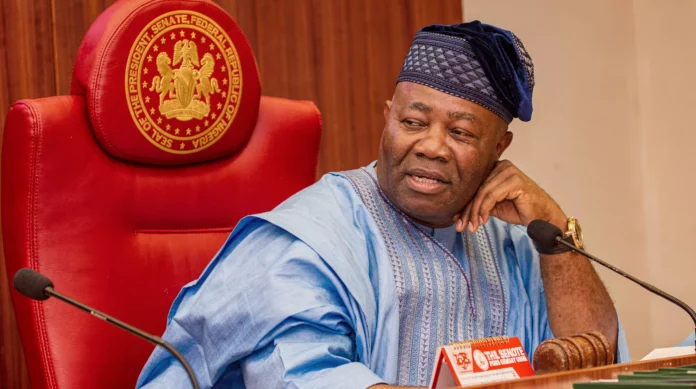
Beyond the noise: Godswill Akpabio and the architecture of stability – When history eventually asks what Senator Godswill Akpabio will be remembered for, the answer may not lie in the headlines of his era. It will lie in structure. His enduring contribution is the consolidation of legislative stability — transforming the Senate from a potential theatre of obstruction into a nucleus of collaborative policymaking… In a polity often pulled apart by centrifugal pressures, Akpabio has chosen to function as a centripetal force — holding the center not through coercion, but through deliberate and strategic harmony. And in doing so, he has supplied what a nation in transition requires most: stability — the firm foundation upon which a more secure future can be built.
By Eseme Eyiboh
Nigerian politics is not for the faint-hearted. It is noisy, dramatic, and often unforgiving. In a space where rumours travel faster than facts and headlines are written before the full story is known, substance can easily be drowned out. Real governance — the slow, patient work of building consensus, following procedure, and making tough decisions — rarely makes for exciting news.
The tenure of Senate President Godswill Akpabio has unfolded in that same charged atmosphere. It has drawn criticism, sparked debate, and generated its share of controversy — some sincere and rooted in genuine concern, some exaggerated for effect. That is the terrain of public life in Nigeria: intense, watchful, and rarely quiet.
Yet to evaluate this leadership solely through the prism of passing storms is to overlook the structure rising beneath the scaffolding. It is to confuse the weather with the architecture. Akpabio’s defining legacy will not be found in the daily churn of sensationalism, but in something far more consequential and far less clamorous: the deliberate stabilization of the legislature and its purposeful alignment with the executive in service of national progress.
Perhaps the most critical — and least celebrated — achievement of the current Senate is the restoration of constructive collaboration between the arms of government. After years in which legislative-executive friction often stalled governance in cycles of ego and brinkmanship, Akpabio has presided over a quiet but decisive shift.
What has emerged is a more mature, problem-solving partnership anchored in the understanding that Nigeria’s challenges transcend partisan divides. Under his stewardship, the 10th Senate has fostered an atmosphere in which policymaking rises above inherited animosities, enabling a focused pursuit of national interest.
Stability has been the oxygen of this Senate. It explains the timely consideration of executive communications, the passage of complex reform bills, and ministerial screenings that have been firm without being obstructionist.
From the presiding officer’s chair, this coherence has given government a more unified voice. In a federation as intricate and delicately balanced as Nigeria, coherence is not optional; it is essential. By prioritizing unity of purpose, Akpabio has repositioned the Senate from a potential arena of paralysis to a functioning engine of reform.
The most visible dividend of this stabilized framework is legislative output. The figures speak for themselves. In two years, the Senate has introduced over 844 bills, passed more than 90, and seen over 58 receive presidential assent under President Bola Ahmed Tinubu.
This pace — noticeably faster than that of recent assemblies — reflects what many observers describe as Akpabio’s leadership style: one that values efficiency, transparency, and measurable results over political theatrics.
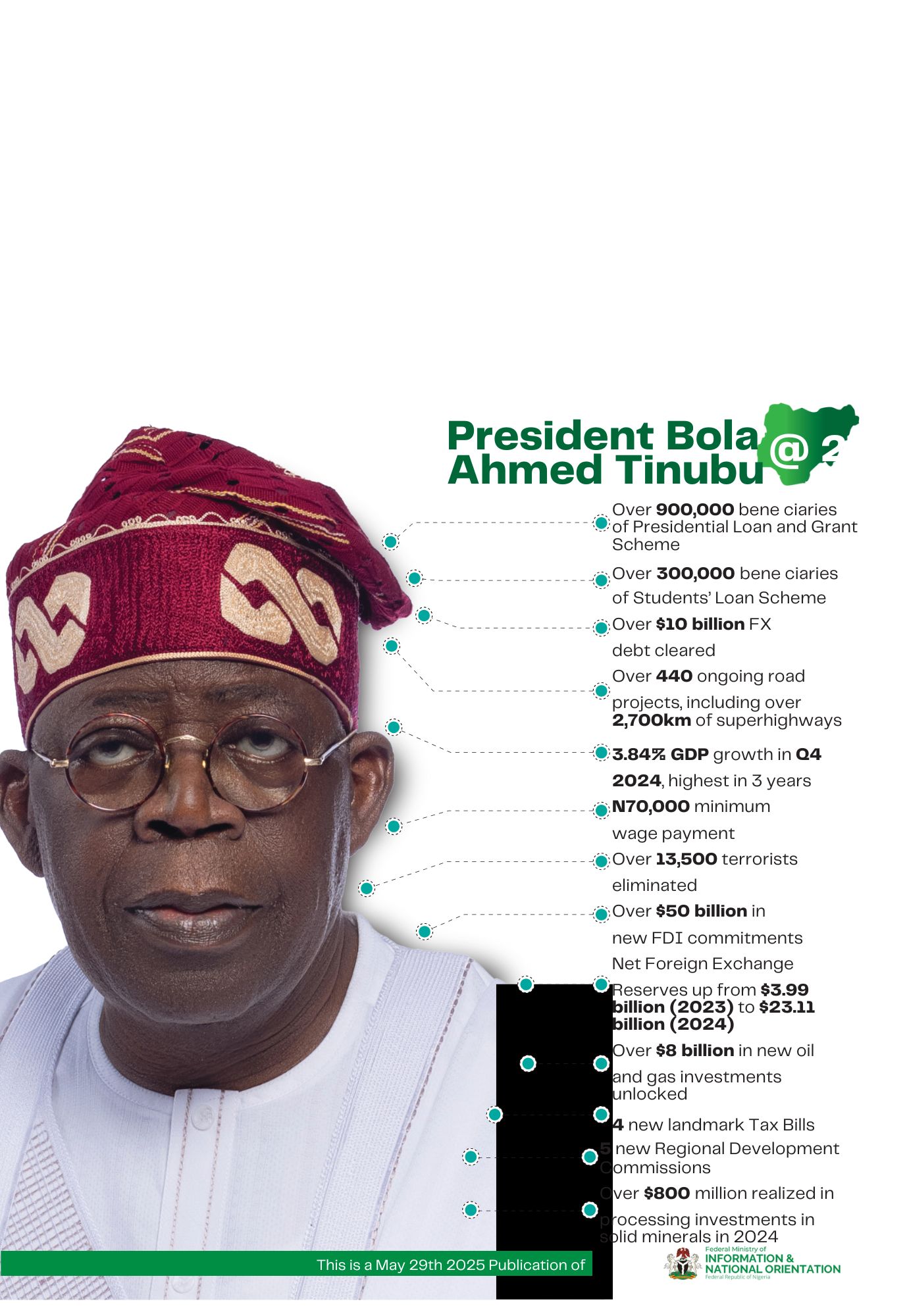
Consider the Minimum Wage Act, a reform with a distinctly human impact. The law more than doubled the national minimum wage from ₦30,000 to ₦70,000 and exempted minimum wage earners from personal income tax. This was not an abstract fiscal adjustment; it was direct relief for millions of households navigating economic pressure.
Complementing this reform is a suite of tax legislation, including the Nigeria Tax Bill and the Nigeria Tax Administration Bill. Together, they represent a structural recalibration of Nigeria’s fiscal framework. By streamlining administration, responsibly broadening the tax base, and introducing targeted relief measures, these reforms have encouraged healthier fiscal competition among states and strengthened revenue generation. Nigeria’s GDP expansion from ₦314.02 trillion in 2023 to ₦372.8 trillion in 2024 stands as one indicator — among many complex factors — of renewed economic momentum supported by legislative-executive synergy.
Beyond macroeconomic indicators, Akpabio’s legislative vision reflects a keen appreciation of Nigeria’s geopolitical realities. His focus has not been confined to national aggregates. Under his leadership, the Senate has established five Regional Development Commissions covering the South East, South West, South South, North West, and North Central zones. These commissions are designed to reduce bureaucratic bottlenecks and accelerate infrastructure and social investment in regions long accustomed to delay.
This is development with strategic intent. It signals inclusion and reassures every zone that it is not peripheral to the national project.
Equally significant is the Local Government Financial Autonomy Act, which strengthens local councils’ control over their resources. By decentralizing both power and accountability — from Kaura Namoda to Urue Offong/Oruko — the law reduces dependency and narrows the space in which petty corruption thrives.
In the sphere of human capital development, the Students Loans Act stands out. Through the Nigerian Education Loan Fund, it provides zero-interest loans to students, directly addressing one of the most persistent barriers to social mobility. It is an investment in Nigeria’s most renewable asset: the intellect and ambition of its youth.
Akpabio’s influence has also extended beyond national borders. His leadership roles in international parliamentary forums have contributed to strengthening Nigeria’s voice in global conversations on climate resilience, migration, and development. At home, he has confronted controversy with openness rather than evasion. Allegations of budget padding were addressed in plenary debate, reinforcing institutional credibility.
His support for the removal of fuel subsidies — politically risky yet economically consequential — further demonstrates a willingness to endure short-term discomfort in pursuit of long-term stability. It reflects political courage anchored in conviction.
This posture is consistent with a career marked more by continuity than reinvention. From Governor transforming infrastructure in Akwa Ibom, to Minister of Niger Delta Affairs prioritizing regional development, to Senate President stabilizing the national legislature, the thread is unmistakable. It is this consistency that has led many to regard him as among the most effective Senate Presidents in Nigeria’s political history. The claim is not one of perfection, but of performance — an operational legislature that works, visibly and persistently.
When history eventually asks what Senator Godswill Akpabio will be remembered for, the answer may not lie in the headlines of his era. It will lie in structure. His enduring contribution is the consolidation of legislative stability — transforming the Senate from a potential theatre of obstruction into a nucleus of collaborative policymaking.
That achievement is the platform upon which all else rests. It explains why bills move, why reforms gain traction, and why noise can gradually be shaped into governance. In a polity often pulled apart by centrifugal pressures, Akpabio has chosen to function as a centripetal force — holding the center not through coercion, but through deliberate and strategic harmony.
And in doing so, he has supplied what a nation in transition requires most: stability — the firm foundation upon which a more secure future can be built.
- Rt. Hon. Eseme Eyiboh, mnipr, is the Special Adviser, Media/Publicity, and official Spokesperson to the President of the Senate.