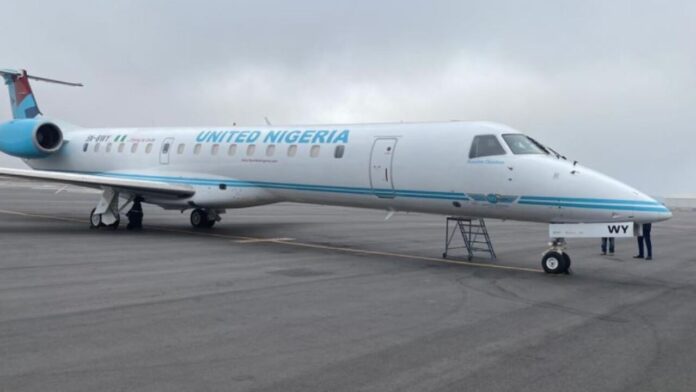
Today, 12 February 2026, United Nigeria Airlines marks five years since its inaugural commercial flight — a journey defined by resilience, cautious growth, and an unyielding commitment to connectivity. Founded in 2020, the airline swiftly secured its Air Operator’s Certificate from the Nigerian Civil Aviation Authority (NCAA) and commenced operations on 12 February 2021 with a maiden flight from Lagos to Enugu. It was a symbolic take-off: linking Nigeria’s commercial capital to the South-East at a moment when the industry was still finding its feet after the pandemic.
By Fred Chukwuelobe
“How time flies” is a tired cliché. But at United Nigeria Airlines (UNA), time has not only flown, the airline is flying too. In just five years, it has continued to connect cities across Nigeria and extending its reach into the West African sub-region, reuniting families, easing business travel, and quietly proving that indigenous airlines can endure.
Five years is a lifetime in Nigerian aviation. Airlines are launched with fanfare and folded with little ceremony, crushed by jet fuel costs, forex scarcity, dilapidated infrastructure, and regulatory bottlenecks. That United Nigeria Airlines is marking five steady years in the skies is therefore more than a corporate milestone; it is a statement of grit — and a quiet rebuke to the cynicism that says homegrown carriers cannot go the distance.

Founded in the aftermath of COVID-19, UNA entered the market when global aviation was in retreat. Many carriers were downsizing; some never recovered. Yet, five years on, United Nigeria Airlines is still here — connecting Nigerian cities, and now stretching its wings into the West African sub-region. In Nigerian aviation, survival is not luck; it is competence. UNA has left little doubt about its capacity to deliver on its mission and vision.
READ ALSO:
Obi hails Okonkwo, as United Nigeria Airlines begins operations
Today, 12 February 2026, United Nigeria Airlines marks five years since its inaugural commercial flight — a journey defined by resilience, cautious growth, and an unyielding commitment to connectivity. Founded in 2020, the airline swiftly secured its Air Operator’s Certificate from the Nigerian Civil Aviation Authority (NCAA) and commenced operations on 12 February 2021 with a maiden flight from Lagos to Enugu. It was a symbolic take-off: linking Nigeria’s commercial capital to the South-East at a moment when the industry was still finding its feet after the pandemic.
With its corporate headquarters in Enugu, and operational hubs in Abuja, Anambra, Lagos, Port Harcourt, Yenagoa, Owerri, Asaba, Osubi and Kano, Sokoto, Ilorin, Ekiti, Katsina, and Benin, UNA launched with a simple but powerful vision captured in its motto, “Flying to Unite.” In a country where distance, bad roads and insecurity fracture economic and social life, aviation is not a luxury; it is infrastructure. United Nigeria’s growing route network has helped shrink those distances and reopen corridors of commerce and kinship.
Over the past half-decade, the airline’s growth has been steady, calculated and disciplined:
• What began as a purely domestic operation has grown into regional connectivity. In late 2025, UNA inaugurated direct flights from Lagos and Abuja to Accra, Ghana, marking its first international service and a defining step in its regional expansion strategy.
• From an initial small fleet of Embraer aircraft, the airline has strengthened its operational capacity. In January 2026, it welcomed its second CRJ-900, improving flexibility and reliability across its network.
• United Nigeria Airlines has earned commendation from industry bodies, including the International Air Transport Association (IATA), for adherence to international safety and operational standards.
• Locally, the airline has been recognised as an Outstanding Indigenous Airline, with plaudits for customer service and enterprise.
In its early years, the airline airlifted hundreds of thousands of passengers while steadily expanding routes and frequencies. By its third anniversary, it had transported close to one million travellers and created direct and indirect jobs across the aviation ecosystem — pilots, engineers, cabin crew, ground handlers, caterers and support services. The ripple effects of a functioning indigenous airline extend far beyond airport terminals; they touch skills development, local enterprise and national capacity.
As it marks five years, United Nigeria Airlines is not resting on its laurels. Continued investments in fleet expansion, including plans to add Boeing 737-800 aircraft, signal ambition to deepen domestic coverage and scale regional and international operations. If realised and well-managed, such expansion could further strengthen Nigeria’s aviation infrastructure and improve connectivity within West Africa.
According to the Chairman/CEO, Prof. Obiora Okonkwo, OFR, the coming years will focus on consolidation, service quality and sustainable growth, building an airline that Nigerians can rely on, not just admire from afar. United Nigeria Airlines currently operates a mixed fleet of four Airbus A320s, two CRJ900s, one Embraer E190 and three E145 regional jets. Expansion is already underway, with six Boeing 737-800 aircraft slated to join the growing fleet.
Speaking on the growing fleet, the airline’s Chief Operating Officer, Mazi Osita Okonkwo, said this fleet build-up is part of a deliberate medium- to long-term growth strategy that will ultimately see United Nigeria Airlines spread its wings beyond Nigeria and West Africa — with planned international services to Europe, including London, and onward to the United States.
The anniversary is also being marked with passenger-focused initiatives. United Nigeria Airlines will unveil HARMONY, its inflight magazine; launch UNITY REWARDS, its loyalty and frequent-flyer programme; and roll out the UNA Foundation, signalling a desire to institutionalise customer engagement and corporate social responsibility. These gestures matter. Airlines do not survive on aircraft alone; they survive on trust.

In five short years, United Nigeria Airlines has grown from a hopeful startup into a respected player in Nigeria’s aviation sector. Its journey underscores a larger truth: indigenous enterprise, when disciplined and competently run, can survive, and even thrive, in one of Nigeria’s toughest industries.
As “Flying to Unite” becomes more than a slogan, as it becomes a lived experience for thousands of travellers, United Nigeria Airlines looks ahead to the next chapter: connecting communities, enabling commerce, and quietly helping to knit Nigeria and its neighbours closer together, one flight at a time.
Here’s to five hearty cheers for United Nigeria Airlines as it celebrates this milestone and continues flying to unite.
Congratulations to the management and staff.
Fred Chukwuelobe, a public affairs analyst, wrote from Lagos