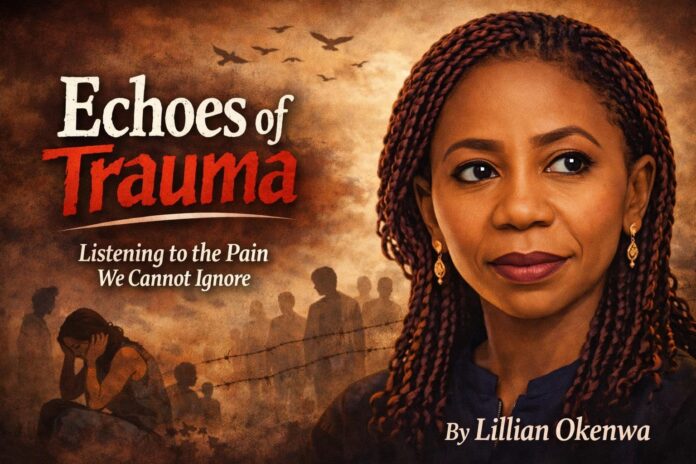
Echoes of trauma: The cost of looking away
By Lillian Okenwa
Even the rich know it. The quiet, unsettling fear that defines present-day Nigeria.
Their children study abroad. Their lives are built elsewhere. Many of those entrusted with fixing our schools, our roads, our economy, our laws have secured comfort beyond our borders. Their families live in systems that work, in societies shaped by accountability, structure, and foresight. Yet here at home, the same sense of urgency is absent.
And so, Nigerians continue to grapple, day after day, with insecurity, economic hardship, and the struggle for basic existence, wondering why those who benefit from functioning systems elsewhere cannot replicate even fragments of that reality here.
Across the country, people are no longer just citizens. They are becoming commodities. Taken from their homes, from roads that have long been abandoned to decay, from communities left exposed. If the roads do not claim them, then armed men will. Kidnappers who demand ransoms that families cannot afford, or worse, who reduce human life to something expendable.
Villages are emptied. Towns are scarred. Lives once rooted in dignity are displaced into uncertainty. The proud homeowner now stands in line, waiting for aid in overcrowded camps, dependent on gestures that should never replace governance.
And yet, we say there is a government.
Where are the leaders?
Their families may be safe, far removed from this daily reality, but distance does not erase consequence. It only delays it.
When the President visited Jos, he remained at the airport. It was described as strategy. Logistics. Security. But pain does not exist at a distance. Devastation cannot be understood from behind guarded walls. Jos, like Benue, Kaduna, Kwara, and so many other places, continues to bleed in ways that words struggle to capture.
For how long will this continue?
Do we lack the capacity to fix what is broken, or have we simply grown accustomed to looking away? What will it take to stop this slow unravelling of a nation? And somewhere beneath all of this, a quieter question lingers. Is there still hope?
The truth is, what we are witnessing today did not begin today. It is the result of years of neglect, of issues ignored, dismissed, or postponed. Now they stand before us, undeniable and consuming. Those who believe they are insulated, who think distance or privilege offers protection, may need to pause and reconsider.
Because nothing festers in isolation forever.
A society that fails its children is already writing its future. A child who is guided becomes a citizen who builds. But a child who is abandoned, unheard, and unseen may grow into the very instability we now fear.
What we ignore today does not disappear. It returns, louder, closer, and far more difficult to confront.
Until we learn to face what we have long avoided, the echoes will not fade.
- Okenwa, a journalist, lawyer and Publisher of Law & Society Magazine, could be reached on lillianokenwa@gmail.com