Christian genocide, what genocide: It will be expedient to return to the Biafra Genocide conundrum, examine it with sincerity, and in good conscience consider it along with the new and contemporary issues facing us today. The intentional rush to obliterate the history of the Biafra Genocide, by laboriously posturing the new Christian Genocide in Nigeria now as being the only site of moral and religious injustice, is hopeless and lacking in equity and authenticity. We must not lose sight of the possibility that exists in our collective remembrance, reckoning and treatment of our past histories of hidden tragedies in the Biafra Genocide and our other ignominious dealings. We must all make ourselves tools and instruments for the repair of our past ugliness as we confront the cataclysmic killings that have encircled our land today.
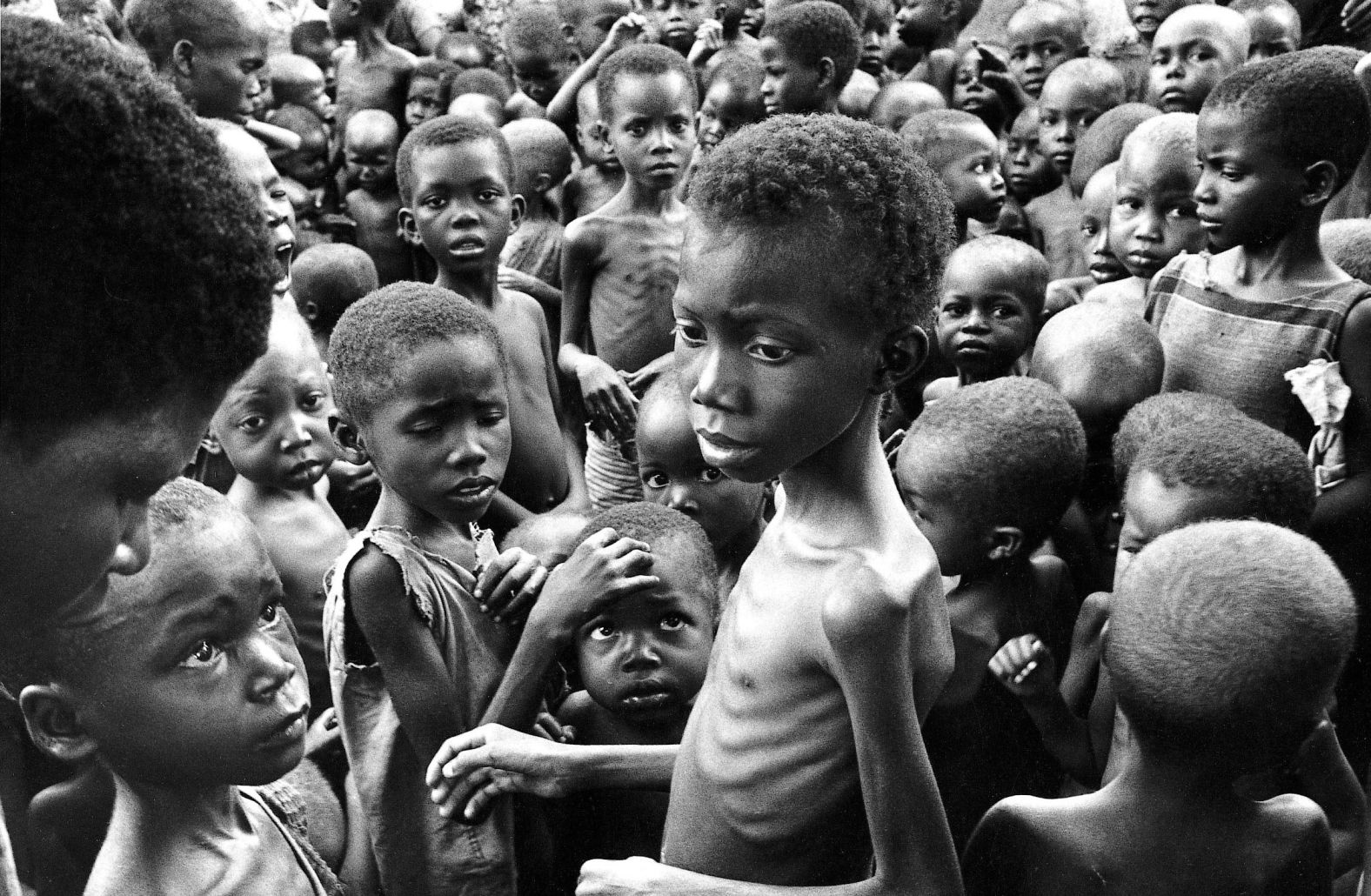
A group of emaciated children photographed in 1970. During the war, the Biafran government reported that Nigeria was using hunger as a weapon to win, and sought aid from the outside world. Nigeria led multiple blockades preventing relief materials from getting into Biafra. As a result, thousands of people starved. Romano Cagnoni/Hulton Archive/Getty Images
By Okey Anueyiagu
Nigeria’s political landscape is constantly inundated with a variety of absurdities, with the latest being the buzz about the tag of Nigeria as the destination for Christian Genocide. Many local and foreign interests have been accused by the Nigerian government of orchestrating this narrative of genocide against Christians as a deliberate and malicious ploy to destabilize the country. The chorus of this allegation is growing, and is presenting credible evidence to the veracity of these dangerous misdeeds.
The strategic imperative for those making this allegation, is emboldened by Nigeria’s propensity for committing these forms of corrosive sins that have been embedded in their DNA since the genocide against the Igbo in the 1966 to 1970 crisis. Struggle as we do to extricate us from these truths, the stories of Nigeria have been defined by wickedness, anarchy and deaths. Our unwillingness to adequately address our evil past is the contrived elephant in the room.
It is not too difficult to contemplate who or what promotes the obnoxious perpetuation of this harmful cycle of orgies of killings in our country. It is just frightening to continue to witness the historical animalistic behavior of our country men and women, and the never-ending cycle of genocidal tendencies.
To not recognize the origins of these killings in our land, and its deleterious consequences, and to not acknowledge that the violence that has emanated from these killers has become systematic, transcending common sense and reasoning, is dangerous. What is obvious is that we have collectively invested in conflicts that have made armed mobilization and killings practical and as accepted sources and means of conducting our politics and securing our religious, ethnic and primodial dominance. In this term, killing of citizens be they Christians or others, has become an occupation, and a means of livelihood.
Prior to the new allegation of Christian genocide, the worst of the bloodletting took place when millions of Igbo people and some citizens of the former Eastern Nigeria were brutally murdered in the pogroms of Northern Nigeria and in the other parts of the country, and subsequently, in the genocidal war in Biafra. Therefore, to talk about the new Christian genocide, we must leap back to the heinous stories of our sordid past.
Even as our country has conspired to silence or even distort the history of the genocide perpetrated largely against the Igbo, I have found some space and time in my lone voice, to immerse myself in the history of the horrors that have been hidden in our land, and that which the world pretends to have forgotten. My stories about the magnitude of our past horrors and the genocide inherent in them, can be found in my book: “Biafra, The Horrors of War, The Story of a Child Soldier.”
As we bemoan the killings of Christians and others in our country today, we must spare some time to reflect on the genocidal killings of well over three million Igbo and other Easterners who were mostly innocent children and helpless women. I am gravely worried that those sordid events of our past are indignantly being banished from our history and memories. We must never allow the malevolence of this violence and its obliteration to continue happening.
The ruthless genocide against the Igbo and other minority members of Eastern Nigeria, left a boundless deep bestiality, that has scarred the victims, both the dead and the living forever. Evidently, wherever the murderous Nigerian civilian-mobs and their supporting military bloodthirsty savages went, they left streams of blood and endless agonies on their trail. A lot of foreign media gave eye-witness accounts of the genocidal atrocities of the period: THE NEW YORK REVIEW, December 21, 1967: ‘in some areas outside the East… Ibos were killed by local people with at least the acquiescence of the federal forces… 1000 Ibo civilians perished in Benin in this way’.
Giwa Amu a former Solicitor General of the defunct Mid-West region, was quoted: ‘Benin was the capital of the Mid-Western region with a high concentration of Asaba born technocrats, bureaucrats, and professionals who met their untimely end at the hands of federal troops and other accomplices… For record purposes, however, let me state fearlessly that I saw hundreds of unarmed civilians being shot at sight when Federal troops arrived to liberate the city…There appeared a fleeting period of lunacy in which Mid-westerners gladly identified Asaba people to be shot down by federal troops on the so called liberation day in Benin…It was the first Black on Black genocide in post-independence Africa.’
From Warri, Sapele and Agbor, gory tales of brazen acts of mass murder were told, of how federal troops killed or stood by while mobs killed more than 5000 Ibos… (New York Times, January 10, 1968). Nigerian soldiers moved into Asaba and firmly seized the city, and at the command of Colonel Murtala Mohammed, assisted by Major Ibrahim Taiwo, the troops herded in all the men and boys they could find—all of them innocent, unarmed and defenceless, and in a most atrocious manner, brutally slaughtered about 700 of these innocent Igbo people. The only crime was their tribe.
The London Observer of January 21, 1968, reported this heinous mass murder with the following difficult words: ‘The greatest single massacre occurred in the Ibo town of Asaba where seven hundred Ibo male were lined up and shot dead.’
Monsignor Georges, a special emissary of His Holiness, Pope Paul VI, to Asaba, on an on the-spot assessment of the genocide, spoke to the French Newspaper, Le monde, on the 5th of April, 1968: ‘There has been genocide, for example on the occasion of the 1966 massacres…Two areas have suffered badly…First, the regions between the town of Benin and Asaba where only widows and orphans remain, Federal troops having for unknown reasons massacred all the men. According to eyewitnesses of that massacre, the Nigerian commander ordered the execution of every Igbo male over the age of ten years.’
The genocide continued unabated with the horrible massacre of thousands of Biafran civilians by Nigerian troops as they entered Aba, These killings alarmed the French Press Agency reporter, Susan Masid, who stated in her accounts of the Aba massacres as follows: ‘Young Ibos, with terrifying eyes and trembling lips told journalists in Aba that in the villages, Nigerian troops came from behind, shooting and firing everywhere, shooting everybody who was running, firing into the homes.’
Col. Benjamin Adekunle, the taciturn Nigerian commander pronounced these wicked words: ‘I want to see no Red Cross, no Caritas; no World Council of Churches, no Pope, no missionary and no UN delegation. I want to prevent even one Igbo from having even one piece to eat before their capitulation. We shoot at everything that moves and when our troops march into the centre of Igbo territory, we shoot at everything even at things that do not move…’
READ ALSO: The backlash of truth
His barbaric words seriously rankled the international community. The West German government thereafter decried Adekunle’s savagery and sent a vehement protest to the Nigerian government on August 19, 1968.
At Owaza and Ozuaka, 2,000 and 300 persons were respectively massacred by Nigerian soldiers who crossed the Imo River. On the same day, 17th August 1968, Nigerian troops also indiscriminately and with careless abandon, shot at inmates of some refugee camps at Awka, killing 375 of them.
The New York Times of January 18, 1968 reported that when Nigerian troops captured the ancient city of Calabar, they deliberately and meticulously sought out the Igbo dwelling therein, massacring about 2,000 innocent civilians, in a hideous bid to annihilate the Igbo in Calabar.
When Nigerian rampaging and murderous troops entered Ikot-Ekpene, an eight-year-old orphan, Emmanuel Effiong, narrated how his parents were forcefully carried away to an undisclosed location. He was lucky to escape into the bush and hide with some other orphans, until their rescue by Biafran troops after the town was rid of Nigerian soldiers. The young lad never saw his parents again.
Nigerian troops, on entry into Ikot-Ekpene, an Eastern Nigeria quiet town, sought out and massacred everything that had breath. None was spared—neither man, woman, nor child. This was the testimony of a 70-year-old lady witness, Madam Okure, who saw the Nigerian troops tie up and shoot to death all of her children. This report was corroborated by Professor Heely, an Irish priest and an eye-witness, in his narrative to the French News Agency.
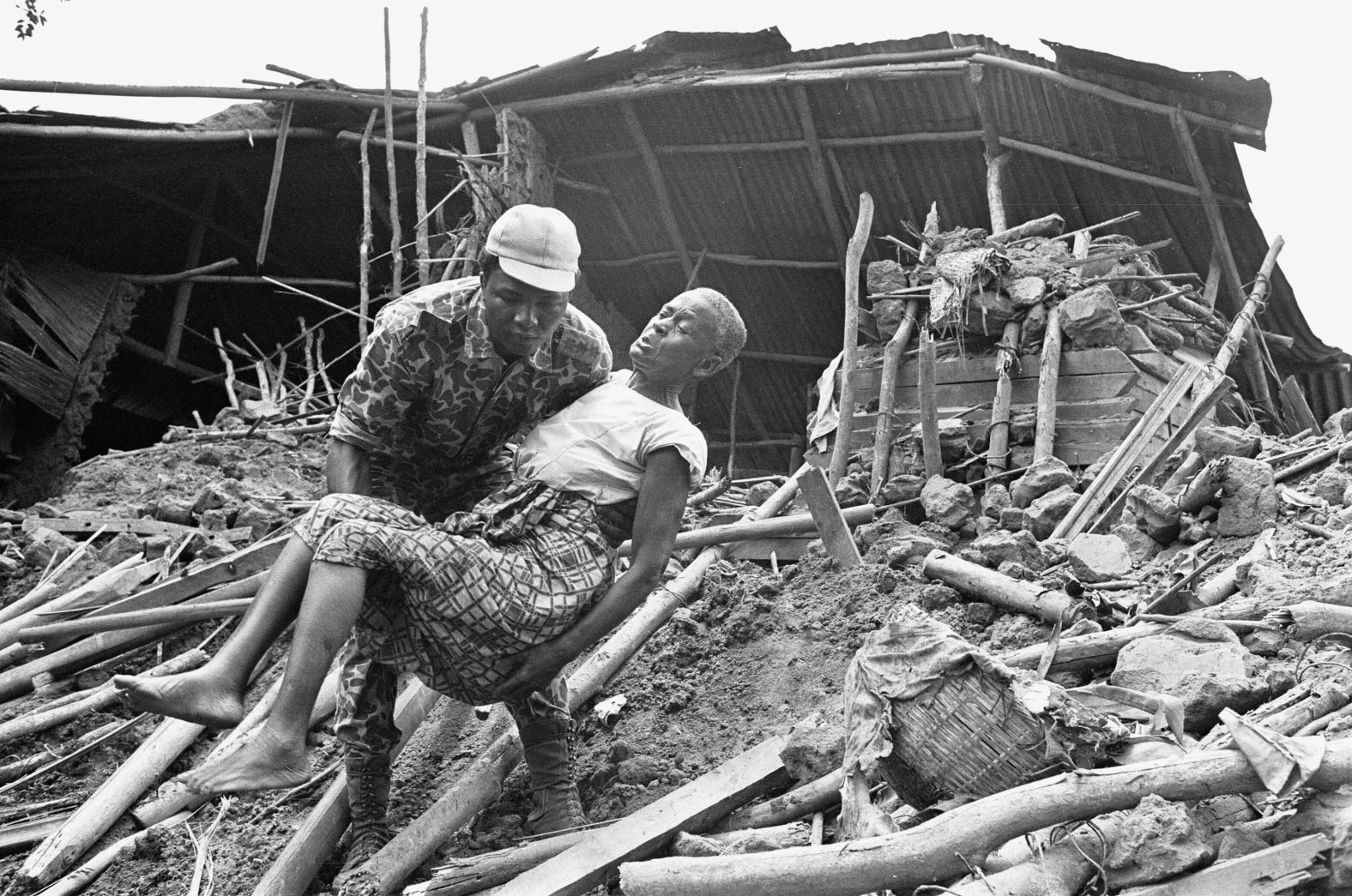
A Biafran soldier carries an elderly woman from the wreckage of her home following an artillery bombardment by the Nigerian army in June 1968. Ron Burton/Mirrorpix/Getty Images
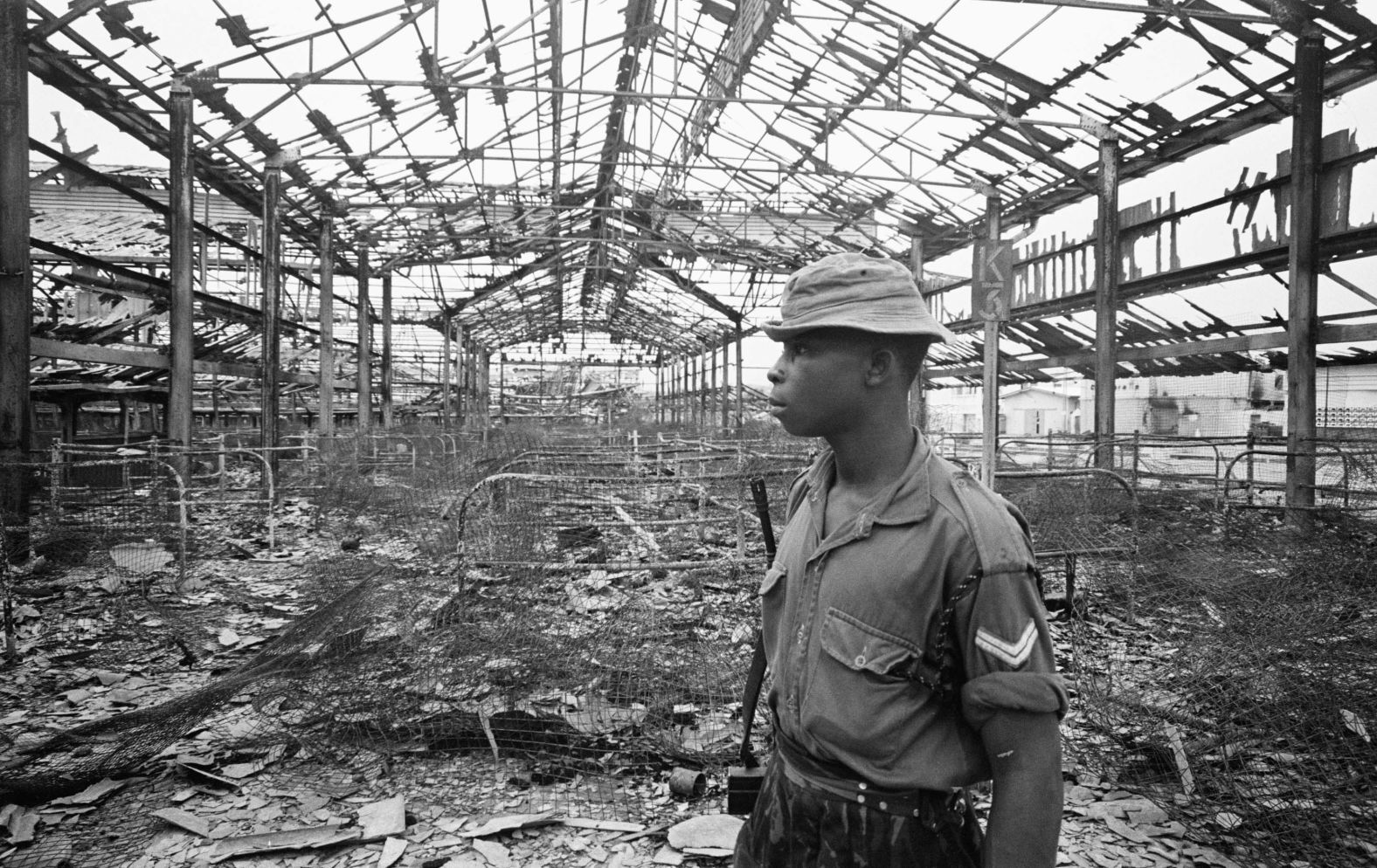
A soldier in the ruins of the Onitsha market after it was gutted during fighting in the city on July 16, 1968. Ron Burton/Mirrorpix/Getty Images
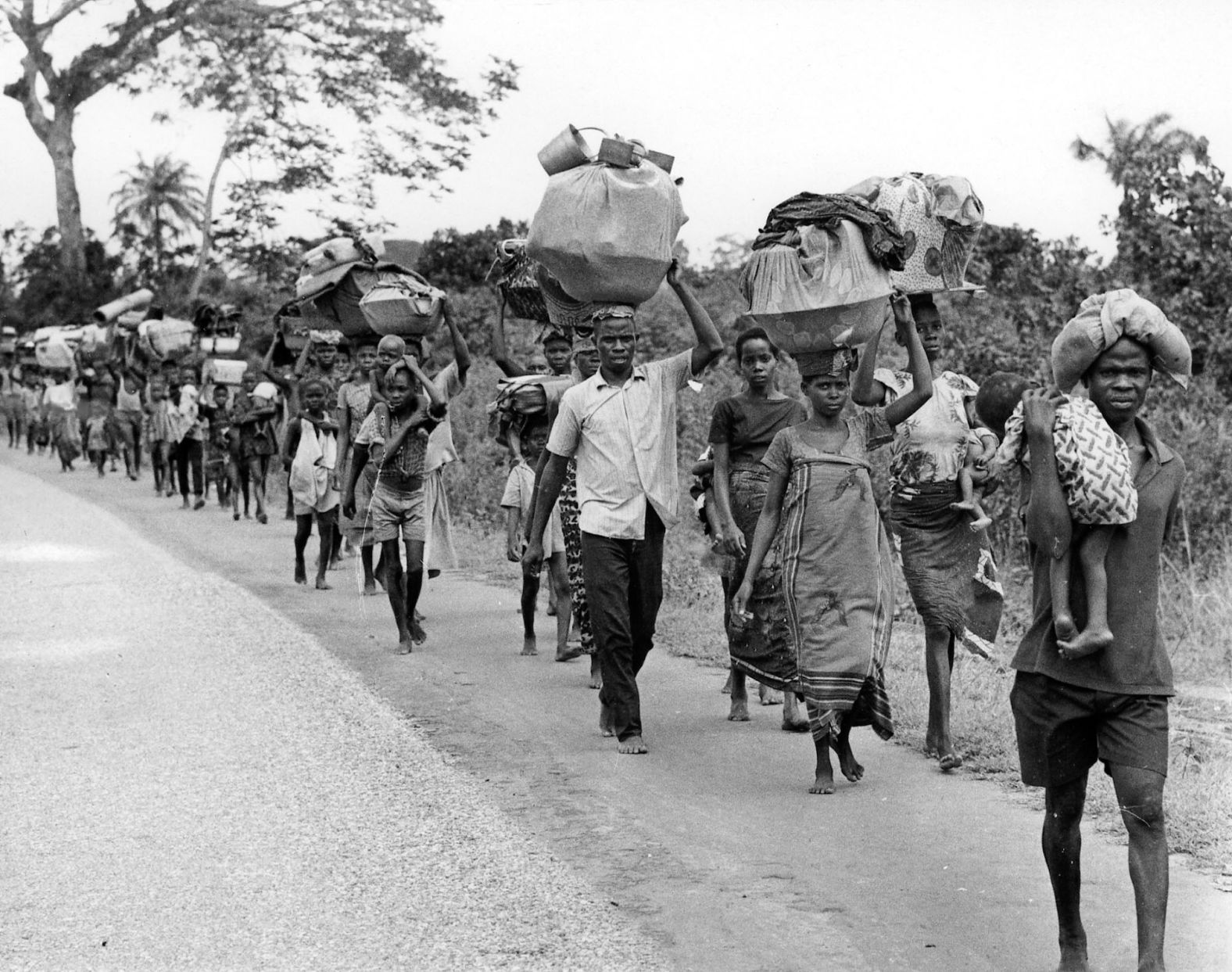
Refugees flee the fighting in July 1968. Estimates of the number of dead from fighting, disease and starvation during the 30-month civil war are estimated at between 1 and 3 million. Kurt Strumpf/Associated Press
The callous and senseless murder of many Biafran civilians at Ogwe near Aba, on 27th August, 1968, by one Lieutenant Macaulay Lamurde, a Nigerian army officer, was witnessed by British Television crew members. Although Lieutenant Macaulay was later executed by Brigadier Adekunle, it was really not for the murder of Biafran civilians, but for a personal grouse Adekunle had against him. The video of the cold-blooded murder of an Igbo civilian named Kanu by Lamurde has been trending on social media.
In continuation of the genocide against the Igbo by Nigeria, 47 civilian men from Afiammanya in Udi, for their blunt refusal to be coerced into putting together and spearheading a sham demonstration endorsing ‘One Nigeria’, were arraigned and brutally executed by Nigerian troops, on September 10, 1968.
Nigeria, strongly backed by the British government of Harold Wilson, besieged Biafra on land, air and sea. Their foot soldiers visited Biafra with the most atrocious acts of bestiality. They gave Biafrans no respite from the air, as their Russian fighter/bomber planes manned by Egyptian pilots daily rained bombs on civilians; strafed homes, places of worship, markets, medical facilities, refugee camps and relief centres. These heartless pilots deliberately picked civilian targets killing as many as they desired.
In a February 1968 BBC interview broadcast, Bruce Loudon narrated the experience of Dr. Philip, a medical doctor at the Itu Joint Hospital, established several decades earlier by the Presbyterian Church—how despite the bold Red Cross insignia painted conspicuously on the roof top, Nigerian fighter-bombers severely bombed and strafed the hospital; reducing it to rubble, leaving many patients dead, and many more grievously wounded. This was pure Genocide.
With the mounting enormous civilian casualties and indisputable evidences of the indiscriminate bombing of the civilian population of Biafra, Joseph Palmer, the Assistant Secretary of State for African affairs in the Nixon administration, demanded from Nigeria’s Information Minister, Anthony Enahoro, why markets in Biafra were constantly being targeted and bombed by Nigerian war planes. Anthony Enahoro’s response reflected his inner personality—a man with a callous indifference to the sufferings of others and a hardened person without conscience. Enahoro’s heartless response came thus: “If food was so scarce in Biafra…why were Biafra’s market places so crowded?” Anthony Enahoro was also quoted in the Daily Mirror, London of June 13, 1968: “There are various ways of fighting a war. You might starve your enemy into submission or you might kill him in the battle field.”
Yakubu Gowon, in his interview with Tom Burns in the Tablet, London, on December 7, 1968, said as follows: “Food is the means to resistance. It is ammunition in this sense and the mercy flights into rebel territory are looked upon as tantamount to gun running.”
Sadly, the deepest cut on Biafra was delivered by Obafemi Awolowo when he made that unforgettable utterance reported in the Financial Times, London, June 26, 1969, and Daily Telegraph, London. June 27, 1969, that drove a deep dagger: “All is fair in war, and starvation is one of the weapons of war. I do not see why we should feed our enemies fat in order for them to fight us harder.”
The inexhaustible litany of the mountain of a well-organized, well-planned and well-executed evidence of genocidal acts perpetrated by the other Nigerian tribes, its leadership, using soldiers, is very long. Their single-minded agenda was to completely annihilate the Igbo by all means necessary and possible.
We must recall the British Prime Minister Harold Wilson, who without any grain of compassion in him, projected his genocidal intention towards Biafra and her people, particularly the Igbo, when he told the United States of America’s State Department coordinator for relief to Biafra, Clyde Ferguson: “…If a million Ibos had to die to preserve the unity of Nigeria, well, that was not a price too high to pay.” (Dan Jacobs: Brutality of Nations)
The wicked and brutish Harold Wilson kept supplying Nigeria with the most sophisticated, lethal arms and ammunition, and would let in Bibles and second-hand clothing materials to Biafra. He was the sardonic King of Genocide, and the purveyor of death. See reports below: “…about 700,000 haggard bundles of human flotsam waiting hopelessly for a meal outside the camps…was the reminder of an estimated four and a half to five million displaced persons…the kwashiorkor scourge…a million and half children…suffer(d) from it during January; that put the forecast death toll at another 300,000 children…More than the pogroms of 1966, more than the war casualties, more than the terror bombings, it was the experience of watching helplessly their children waste away and die that gave birth to… a deep and unrelenting loathing…It is a feeling that will one day reap a bitter harvest unless…”
Americans for Biafran Relief (ABR), in the New York Times of 10th July, 1969, brought to the notice of the world, the hitherto unthinkable dimensions perpetrators of genocide against Biafra had descended to. They lamented that: “The war in Biafra has brought out a ‘sophisticated’ aspect of human nature that must make God sick…This ‘noble’ war has killed more children than soldiers.”
This statement made by Baroness Asquith, the Lady Helen Violet Bonham Carter in the British House of Lords, remains a strong and veritable testimony to the horrendous genocidal criminality perpetrated against Biafra by Nigeria: “Thanks to the miracle of television. We see history happening before our eyes. We see no Igbo propaganda; we see the facts. One word now describes the policy of the Nigerian military government towards secessionist Biafra: genocide. It is ugly and extreme but it is the only word which fits Nigeria’s decision to stop the International Committee of the Red Cross, and other relief agencies, from flying food to Biafra…”
It was estimated that over 3 million people were starved to death in Biafra. Children below the age of five constituted 70% of the dead. [Dan Jacobs: 1987]. Dan Jacobs’ properly researched findings did indicate.
Wole Soyinka, commenting on the plight of the Igbo in Nigeria, emphatically stated: “…When a people have been subjected to a degree of inhuman violation for which there is no other word but genocide, they have the right to seek an identity apart from their aggressors.” Soyinka 2006: 101)
The Pogrom, the Holocaust and the Genocide against the Igbo and the other members of the defunct Eastern Nigeria, were dreadful and brought on scars that are still raw well over 50 years after the war. The gravity of the adverse effects can only be imagined.
These atrocities were subdued by the Nigerian victors – the perpetrators of the genocide, and in collaboration with their foreign partners-in-crime, deprived the vanquished the liberties of properly telling their stories. This fact is buttressed by the well-known deliberate action of the Nigerian government in banning the teaching of the subject of history in our schools. This action is just a fraction of the genocide’s broader devastation, with its deadly ripples transcending time and cascading through decades and generations.
As we debate the current allegation of Christian genocide, we must consider also the remarkable manner by which the Igbo and the other Easterners that suffered worse genocide obtained the facility to forgive and regain equanimity in the wake of these unspeakable atrocities and dehumanizing scars inflicted on them. They must be commended for being able to activate wholesome forgiving spirits and dispositions after enduring egregious cruel acts and aggravated malice and hatred without reciprocating in kind. To ask them to forgive and forget, and to begin to deliberate about new trends of genocide, is completely uncharitable, unkind, unreasonable and cruel.
Today, as we ponder the issues of Genocide in our country, the genesis of it is important, but what may be more important, is examining and determining its prevalence and sustenance through decades. Our political actors have incentivized the people to use religious and ethnic conflicts to cause division and mayhem. The result becomes the inevitable increase in the per capita killing rate across all the strata of the society.
It is a familiar observation that Christians, Muslims and others are killed on a regular basis in Nigeria, but what may not be clear, is the proportionality and the intentionality of these killings. However, in Biafra, the killings and deaths were genocidal – they were intentional and the sinister motives were not questionable. In Biafra, there was no doubt about the familiarity of the festering carnage as a requisite form of the destruction and obliteration of the sanctity of the Igbo lives and existence as human beings created by God.
The killings and deaths in Biafra became a global epidemic metastasizing into belligerent contraptions, and presented a genocide never seen since the Jewish holocaust. Now, it appears that we have become immune to the suffering of those who perished in Biafra, and are jumping into a new form of genocide.
Many unanswered questions arise after as we discuss the present allegation of Christian Genocide in Nigeria. Who were the people who perpetrated the Biafra Genocide? Were they Muslims killing Igbo Christians? Or were they Nigerian Christians killing Igbo and Eastern Christians? Why have we conveniently forgotten the Biafra Genocide? Are the lives of the Eastern Nigerians not important? Were they not Christian enough? Why did the world keep quiet then, as Biafrans were being killed?
I am gravely perturbed as should others that people are being targeted because of their religion, tribe and any other considerations. These long-lingering persistent killings have been ignored, and the deadly longevity of these killings, mars the mythology that most of us use in explaining away the evils of Biafra. It will be expedient to return to the Biafra Genocide conundrum, examine it with sincerity, and in good conscience consider it along with the new and contemporary issues facing us today.
Finally, the intentional rush to obliterate the history of the Biafra Genocide, by laboriously posturing the new Christian Genocide in Nigeria now as being the only site of moral and religious injustice, is hopeless and lacking in equity and authenticity. We must not lose sight of the possibility that exists in our collective remembrance, reckoning and treatment of our past histories of hidden tragedies in the Biafra Genocide and our other ignominious dealings. We must all make ourselves tools and instruments for the repair of our past ugliness as we confront the cataclysmic killings that have encircled our land today.
I feel a deep sense of despair and detest the notion of a new dawn in which we humans would live in absolute harmony. The hope that this utopia engenders has justified the bloodiest genocidal exterminations in our checkered history.
- Okey Anueyiagu, a Professor of Political Economy, is the author of: Biafra, The Horrors of War, The Story of A Child Soldier