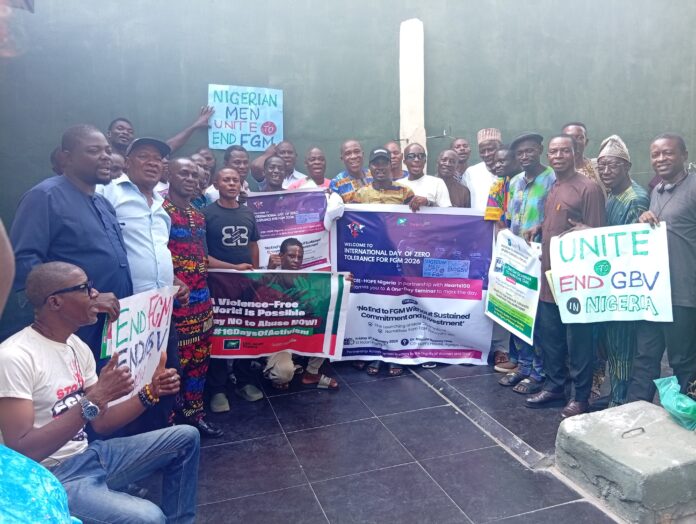
CEE-HOPE engages men in fight against gender-based violence, calls for support to end menace
By Ishaya Ibrahim
A non-governmental organisation, the Centre for Children’s Health Education, Orientation and Protection (CEE-HOPE), has extended its campaign against gender-based violence (GBV) to men, urging them to become active allies in ending the scourge.
At a one-day workshop held in Lagos to mark the International Day of Zero Tolerance for Female Genital Mutilation (FGM) which is observed annually on February 6, CEE-HOPE mobilised community leaders, Muslim and Christian clerics to raise awareness about the dangers of GBV and the pivotal role men can play in eradicating it.
One of the speakers, Pastor Patrick Olusegun Tinka, encouraged religious leaders to leverage their platforms to educate the public on rejecting GBV, which manifests as physical abuse, emotional trauma, sexual violence, and economic deprivation.
At its core, he said, GBV violates human dignity and the right to live free from fear.
“Gender-based violence silences voices, scars bodies, and breaks spirits. It happens in homes, schools, workplaces and communities, often hidden behind smiles, fear, and shame. And every time we look away, we become silent partners in the pain,” the pastor said.
He added: “No tradition, belief or religion justifies abuse. Strength is not proven by dominance. True strength is shown in protection. True leadership is shown in respect. True humanity is shown in compassion.”
CEE-HOPE’s Executive Director, Betty Abah, lamented that FGM still persists in many Nigerian communities, where some cultures subject pregnant women to the practice under the false belief that without clitoral cutting, they would die during childbirth.
She described FGM as a crime against humanity that must be rejected due to its severe health and life-threatening risks, including uncontrolled bleeding, infections, prolonged labour, and maternal/infant mortality.
A mother of three, Bridget Simon, shared her personal story at the event. She recalled being circumcised at age 12 in her native Ebonyi State community. When her younger sister underwent the same procedure, she bled to death. Simon thanked CEE-HOPE for speaking out against the harmful practice.
The Chief Imam of Ajegunle community mosque, Abdulyekini Abdulsalam, stated that Islam opposes gender-based violence, including female circumcision. He noted that when Prophet Abraham circumcised his son, he did not extend the practice to his daughters.
A clergyman, Reverend Israel Ajayi, urged CEE-HOPE to include tribal markings in its campaign, describing the practice as a form of facial mutilation that should also be addressed.
The disability community was also represented at the event, with their spokesperson urging greater awareness of the scourge within their community.