



Buhari and Nigeria’s crass elite class
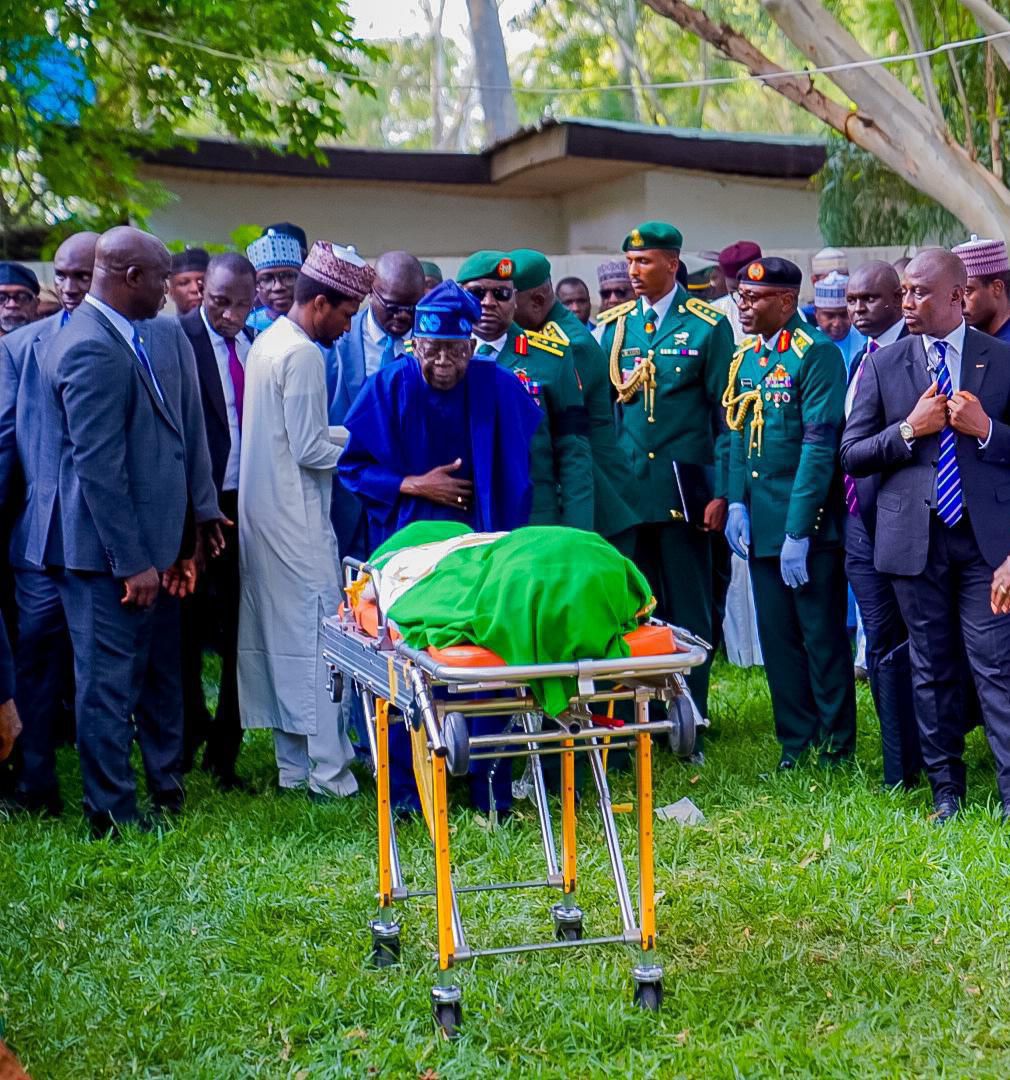
Tinubu pays his last respects to Buhari in Daura before his burial on Tuesday
By Ikechukwu Amaechi
Nigerian elites are a hypocritical and sanctimonious lot, a trait that has become even more evident since the death of President Muhammadu Buhari in a London hospital on Sunday, July 13. Many of them have lied against the man, literally, by clothing him in borrowed robes, all in an attempt to avoid being accused of speaking ill of the dead.
But how can speaking the truth be tantamount to badmouthing or saying bad things about those who have died? If a man was evil while alive, how can that fact be sugarcoated without lying against his spirit?
Now, I am not saying that Buhari was evil, but it is evident from the indifference of a majority of Nigerians to the news of his death that there was no love lost between them and the two-term president who just left office two years ago. The people just couldn’t care less and that speaks volumes. If only those in power today will learn. Sadly, they won’t because they are impervious to reason.
But the elites are, nevertheless, falling over themselves, deploying all manner of adjectives in eulogising the man, even when in doing so, they lie against him, almost to the point of defamation. How on earth could anyone claim that Buhari loved Nigeria deeply? Does that love extend to those that inhabit the area he sadistically labelled a “dot in a circle?” Definitely not!
But it is a sheer waste of time flogging a dead horse. While Buhari was alive, I wrote tons of articles lamenting his leadership style not because I hated him but because I desired a change. But he was a man set in his ways. Now that he is dead, the inevitable judgment of history will follow, even as he remains, in the words of Prof Anthony Kila “a promise unkept.”
Suffice it to say that, on Tuesday, Femi Adesina, Buhari’s spokesperson, said his principal could have died a long time ago if he had relied on Nigerian hospitals.
“If he had said ‘I will do my medicals in Nigeria’ just as a show off or something, he could have long been dead because there may not be the expertise needed in the country. But he needed to be alive to be able to lead the country to a point when we will have that expertise,” Adesina said on Channels Television.
He was probably correct. But the flip side of his argument is the fact that the dearth of medical expertise is a direct consequence of government’s inability to invest in the health sector, which led to the exodus of the country’s medical experts. And in the 65 years of Nigeria’s independence, Buhari was on the saddle for nine years and eight months – 20 months as military head of state and eight years as civilian president. In all those years, he did nothing to improve the health sector, not to talk of leading the country to the point when we would have the requisite expertise.
Ironically, when these Nigerian leaders travel abroad on medical tourism, they are, in most cases, treated by the same doctors and nurses who fled abroad in search of not only wealth but professional fulfilment because of the shenanigans of leaders like Buhari.
Few years ago, a Nigerian governor lost his mother at the MD Anderson Cancer Centre in Houston, Texas. Unbeknown to him, some of the best medical personnel in that medical facility, including nurses who looked after his mother were Nigerians. That came at a huge cost, of course, to his State, money that could have been deployed in building standard hospitals back home.
It is telling that even as Buhari was on his death bed in London, former military head of state, General Abdulsalami Abubakar, and Alhaji Mamman Daura, his all-powerful nephew, were also on medical tourism in the UK. In fact, General Abubakar said he was admitted in the same hospital where Buhari died, as if that was something to be proud of.
In justifying Buhari’s unprecedented appetite for medical tourism, Adesina said he always had his medicals in London even when he was not in office. Buhari, he said, “needed to be alive to be able to lead the country to a point when we will have that expertise.”
What Adesina didn’t say but which was obviously at the back of his mind is that it would have been inexplicable, in fact a shame, for a “big man” like Buhari to have died at home in a country where dying abroad has become a status symbol. It is a shame, all pretensions to the contrary notwithstanding, that as a military head of state for 20 months and civilian president for eight years, Buhari failed to build a world class medical facility that could handle his medical challenges at home.
READ ALSO: Qingdao, city of wine, tea, leisure and high-tech
All the money he invested in his personal health abroad – tax payers’ money – running into billions of Naira, could have built world class medical facilities in Nigeria. In 2017 alone, he spent 152 days getting medical treatment in the United Kingdom, including the 103-day stretch from May 7 to August 19, 2017. And the cost of parking his presidential jet in London during the three-month spell was estimated at £360,000. That was about 0.07% of the country’s N304 billion budget allocation for health that year.
Yet, here was a president whose administration vowed not to encourage government officials to seek medical care abroad.
Those who argue that citizens have the inalienable right to seek medical attention from wherever miss the point. If Buhari was a private citizen using his personal resources to finance his medical tourism, no eyebrows would have been raised. But here was a man who leveraged his high office as president and used state resources which could have been used in building hospitals at home to take care of his personal health abroad.
If the humongous state resources spent on medical tourism by political office holders are deployed in building hospitals here, Nigeria will cease being a glorified burial ground and Nigerian medical personnel who fled abroad because of untenable working conditions at home will return with their expertise. A 2011 report estimated that nine sub-Saharan African countries – including Nigeria and Kenya – had lost $2.17 billion worth of investment in their domestically educated doctors migrating to Australia, Canada, UK, and the U.S. Of course, that figure is much higher today.
Is it any wonder then why, according to the UN World Population Prospects 2025 report, Nigeria has the lowest life expectancy in the world. With an average life expectancy of just 54.8 years – 54.5 for males and 55.1 for females – Nigeria ranks below countries like Chad, South Sudan, and the Central African Republic.
Truth be told, there is absolutely no dignity in a president – serving or former – dying in a foreign hospital because he or she could not get quality healthcare at home. If anything, providing medical care to a president at home is not only a matter of national pride and prestige, but also demonstrates confidence in a country’s healthcare system. That, in itself, is a morale booster. Thus, the former South African President, Nelson Mandela, died in South Africa. It would have been inconceivable that Madiba was flown abroad to die in a foreign hospital.
No country worth its sovereignty would subscribe to that indignity because besides the issue of prestige and national pride, it is also a matter of national security because treating an ailing president at home helps in securing sensitive information related to the leader’s health, which could be exploited by adversaries or used to destabilise the country.
But rather than follow the examples of South Africa, European, North American and Asian nations, Nigeria, the self-acclaimed giant of Africa, is following in the footsteps of other banana republics that litter the continent where the death of a leader in Europe and America is celebrated as a badge of honour.
Sadly, nothing is about to change because President Bola Tinubu is in lockstep with his predecessor, the only difference being that the destination has changed. While Buhari preferred the UK, Tinubu has found his own medical haven in France. And how these leaders pretend not to know that the efficient health systems in Europe and Asia, which they patronise only exist because they were developed and consistently maintained through political commitment and visionary leadership almost beggars belief.
The big shame is that as long as Nigerian leaders’ appetite for foreign hospitals remain insatiate, the hope for better health infrastructure at home will remain forlorn. Preventable diseases will continue to kill vulnerable men, women and children and patients will continue to sleep on hospital floors after travelling long distances to access medical facilities that are no better than glorified mortuaries. And that is one of late President Muhammadu Buhari’s enduring legacies of shame.
Nothing will change even with Buhari’s death because Nigeria is burdened with a crass elite class – insensitive, obtuse and imperceptive. President Tinubu, Buhari’s alter ego, will probably jet out to France before the end of the month on another “working visit,” the administration’s euphemism for medical tourism. A shame!

