Budget of “Economic Consolidation”: Aiyedatiwa lays ₦492.8bn 2026 plan before Ondo Assembly
By Julius Alabi, Akure
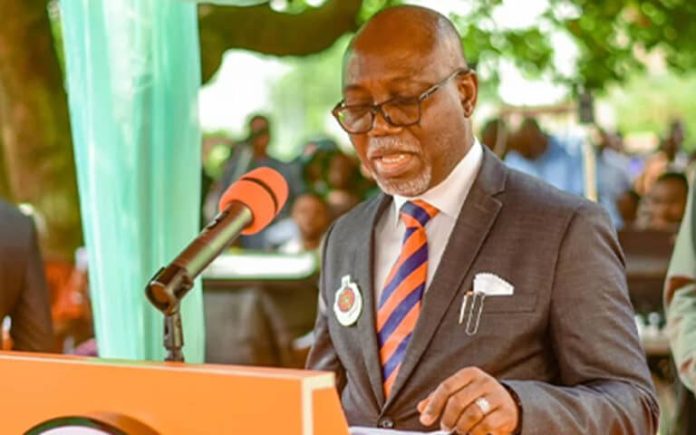
Ondo State governor, Hon. Lucky Orimisan Aiyedatiwa, on Monday presented a ₦492.796 billion budget for the 2026 fiscal year to the state House of Assembly, signalling what he described as a decisive shift from post-crisis stabilisation to long-term economic consolidation.
The proposal dubbed the Budget of Economic Consolidation allocates 57.22% to capital expenditure and 42.78% to recurrent costs, underscoring the administration’s renewed focus on infrastructure expansion, revenue reforms and human capital development.
Addressing lawmakers during the presentation in Akure, the state capital Aiyedatiwa said the new fiscal blueprint was shaped by lessons from the turbulent 2025 cycle.
Last year’s budget, originally pegged at ₦698.659bn, was revised downward to ₦489.998bn following what he described as “significant shortfalls” in expected donor inflows. Only about half of projected external support materialised, dragging performance in water projects, job-creation schemes and other critical sectors.
Even so, the governor maintained that the state achieved “remarkable progress through prudent management of lean resources,” listing gains in education, health, energy, agriculture, ICT and social protection.
Aiyedatiwa highlighted sweeping reforms across the education sector, including the recruitment of 2,100 teachers and additional hires in health, legal and forest services.
The government, he said, paid ₦633.9m in WAEC fees for 23,048 students and fully covered NABTEB registration for all public-school candidates. Scholarships and bursaries totalling ₦350m reached over 11,000 students, while OSOPADEC released ₦286.7m to beneficiaries in the Ilaje and Ese-Odo areas.
He noted the rehabilitation or construction of 134 primary and 60 secondary schools, alongside major upgrades in technical colleges. At OAUSTECH, academic programmes expanded from three to seven faculties, buoyed by a partnership with the Caribbean Maritime University of Jamaica that birthed a new School of Maritime Studies and Logistics in Igbokoda.
In healthcare, the governor pointed to the expansion of the Orange Health Insurance Scheme, a Pharma-grade upgrade of the State Drug Store, deployment of Truscan anti-counterfeit devices and the refurbishment of 102 primary health centres under the World Bank supported IMPACT programme, an effort costing over ₦7.2bn.
More than 60 kilometres of urban and intercity roads are currently under construction or rehabilitation, Aiyedatiwa said, with a further 386 kilometres improved under RAAMP. Flagship dualisation works among them Oke-Aro–Idanre, Akungba–Ikare and the 27.5km Okitipupa–Igbokoda roads continue to record “significant progress,” while the Onyearugbulem–Shagari–Irese Flyover is nearing completion.
Multi-billion-naira projects across four southern Loga government areas, Okitipupa, Ilaje, Irele and Ese-Odo—have collectively reached a valuation of ₦96.805bn.
Water supply upgrades, ongoing work at the Owena Multipurpose Dam, expanded solar mini-grids in 30 rural communities, revival of the Omotosho 2×15MW power plant and the rollout of O’Datiwa prepaid meters also featured prominently in the governor’s list of achievements. New generation and distribution licences have been issued to private developers through the State Electricity Bureau.
Aiyedatiwa said 10,550 households now receive bimonthly ₦20,000 transfers under OD-CARES, while almost 20,000 residents earn monthly stipends through public works. Some 1,863 small businesses have benefited from grants of up to ₦600,000.
On pensions, the governor reported the payment of ₦2.396bn in gratuities for 2016–2017, in addition to earlier disbursements to Local government and primary school retirees. A monthly ₦180m provision is now in place to sustain payments.
He also announced the reinstatement of the School Shuttle Scheme suspended since 2020 with a ₦701m allocation for both land and riverine transport.
Looking ahead, the governor warned that global economic strains, changes to Nigeria’s VAT-sharing formula and expanded tax exemptions for small businesses could squeeze the state’s finances in 2026. Nevertheless, he said his administration will intensify participatory budgeting and pursue eight strategic priorities, including food security, infrastructure expansion, improved IGR mobilisation and strengthened social protection.
“This budget is designed to consolidate the gains of our 2025 Budget of Recovery,” he told lawmakers, assuring them that no ongoing project would be abandoned.
Aiyedatiwa thanked the Assembly for what he called a harmonious working relationship and urged members to give the Appropriation Bill “the same careful consideration” shown in previous years.
The presentation was attended by Deputy Governor Olayide Adelami, members of the executive council, all 26 lawmakers, former legislators and other political stakeholders.