



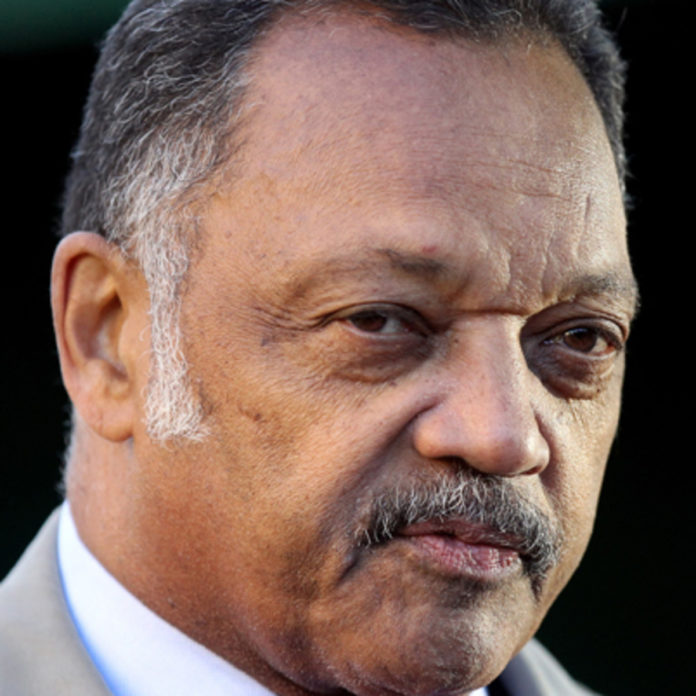
U.S. towering icon of civil rights, Jesse Jackson, dies at 84
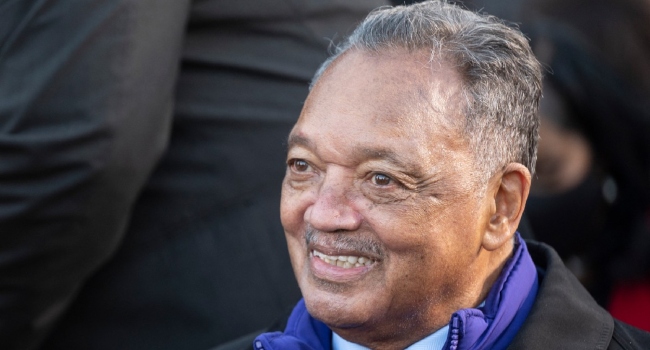
Reverend Jesse Jackson listens as President Joe Biden speaks about the constitutional right to vote at the Atlanta University Center Consortium in Atlanta, Georgia on January 11, 2022. Photo by JIM WATSON / AFP
The Rev. Jesse Jackson, a towering civil rights icon who battled alongside Martin Luther King Jr., negotiated global hostage releases, and shamed corporations for their lack of corporate diversity and failure to support voting rights, has died. He was 84.
Jackson was hospitalized on November 12, 2025, following a lengthy battle with the progressive neuromuscular disease – progressive supranuclear palsy, a condition similar to Parkinson’s disease. He was a Presidential Medal of Freedom recipient, a Democratic presidential candidate and one of the world’s best-known Black activists.
“It is with profound sadness that we announce the passing of Civil Rights leader and founder of the Rainbow PUSH Coalition, the Honorable Reverend Jesse Louis Jackson, Sr.,” said a statement from the organization on Instagram. “He died peacefully on Tuesday morning, surrounded by his family.”
Despite the illness that softened his voice and weakened his steps, he had continued to advocate for civil rights, and was arrested twice in 2021 over his objection to the Senate filibuster rule. That same year he and his wife Jacqueline were hospitalized with COVID-19 complications at a Chicago hospital.
“His longevity is part of the story,” said Rashad Robinson, the former president of the seven-million-member online justice organization Color of Change. “This is someone who had so many chances to do something else. And this is what he chose to do with his life.”
Jackson’s death comes amidst a rising tide of white nationalism and voting-rights access issues, and follows the loss of other civil rights icons, including former Rep. John Lewis, who died in 2020.
The making of a Civil Rights icon
Born in Greenville, South Carolina, Jackson’s rise to prominence began after he and seven other men were arrested in 1960 ‒ he was 18 at the time ‒ for protesting segregatation at their town’s public library. He then joined King burgeoning civil rights fight, and was just feet away when King was assassinated in 1968.
Jackson founded what would ultimately become the Rainbow/PUSH Coalition, and ran for president as a Democrat in 1984 and 1988, energizing and registering millions of Black voters.
“As we continue in the struggle for human rights, remember that God will see us through, even in our midnight moments,” Jackson said in 2017 as he announced his neuromuscular disease diagnosis.
Civil rights leader Rev. Jesse Jackson pays respects over the casket of George Floyd prior to the start of the George Floyd family memorial service in the Frank J. Lindquist sanctuary at North Central University in Minneapolis, Minn. on June 4, 2020.
Civil rights leader Rev. Jesse Jackson pays respects over the casket of George Floyd prior to the start of the George Floyd family memorial service in the Frank J. Lindquist sanctuary at North Central University in Minneapolis, Minn. on June 4, 2020.
Jackson visited Minneapolis in 2021 to support protesters awaiting the verdict in the trial of Derek Chauvin, the former police officer who was days later convicted of killing a Black man, George Floyd. While there, he also attended services for Daunte Wright, a Black man who was shot and killed by a police officer during a protest against police violence in a nearby suburb. Speaking in a subdued voice, Jackson reminded the young activists leading a protest march that their cause was just.
Born in fall 1941 to a teen mother and her married neighbor, Jackson was adopted by the man his mother married, and he considered both to be his fathers. He attended a segregated high school and played football in college, dropping out a few credits short of his master’s degree in divinity in 1966 to join the civil rights movement full-time.
By 1965, he’d marched with King and others from Selma to Montgomery to push for Black voting rights, and by 1967 was running operations for King’s Southern Christian Leadership Conference in Chicago, the city that would become his home.
Under Jackson, the SCLC’s Operation Breadbasket used boycotts and public attention to pressure companies to hire more Black workers. Jackson ultimately earned his divinity degree after being ordained a minister in 1968.
In 1983, shortly before announcing his run for president, Jackson traveled to Syria to negotiate the release of an American pilot shot down over Lebanon, and the next summer, negotiated the release of 22 Americans and 26 political prisoners from Cuba after meeting with former dictator Fidel Castro.
His successes bolstered his presidential campaign, although he lost the primary to Walter Mondale, who went on to lose to Ronald Regan. Jackson ran again for president in 1988, putting on a strong showing but ultimately falling to Mike Dukakis, who eventually lost to George H.W. Bush.
After that second loss, Jackson shelved his own political aspirations but continued his efforts for civil rights and justice.
In 1990, Jackson opposed the pending invasion of Iraq and negotiated the release of hundreds of people who Iraqi dictator Saddam Hussein had threatened to use as human shields, and then in 1999 won the release of three U.S. POWs during the Kosovo War.
‘There certainly would have been no Barack Obama … no Bill Clinton either’
Robinson, the former president of Color of Change, remembers listening and watching as his family members made their first political donations after listening to one of Jackson’s presidential campaign speeches.
“I didn’t understand everything he said, but I understood what it meant,” said Robinson, who later wrote a college paper on Jackson’s campaigns. “He was such a possibility model. There are so many people who are in politics today who would not be where they are today thanks to Jesse Jackson. There certainly would be no Barack Obama if there was no Jesse Jackson. And there would have been no Bill Clinton either.”
In 2000, Clinton awarded Jackson the Presidential Medal of Freedom, citing his decades of work to make the world a better place.
“It’s hard to imagine how we could have come as far as we have without the creative power, the keen intellect, the loving heart, and the relentless passion of Jesse Lewis Jackson,” Clinton said.
Trahern Crews, who helped found the Black Lives Matter-Minnesota chapter, said he grew up with Jackson’s “I am Somebody” recitations ringing in his ears. Jackson often led crowds in a call-and-answer chant that usually included variations on “I may be poor … but I am … Somebody. I may be young … but I am … Somebody.”
“That allowed future generations to stand up and follow and his footsteps and declare Black Lives Matter and recognize our humanity,” Crews said. “When we go back and watch videos of Rev. Jesse Jackson marching and fighting for housing rights, voting rights, ending housing discrimination and said ‘I am Somebody,’ that encouraged activists of today to stand up and fight against 400 years of racist policies in the United States.”
- USA TODAY


