


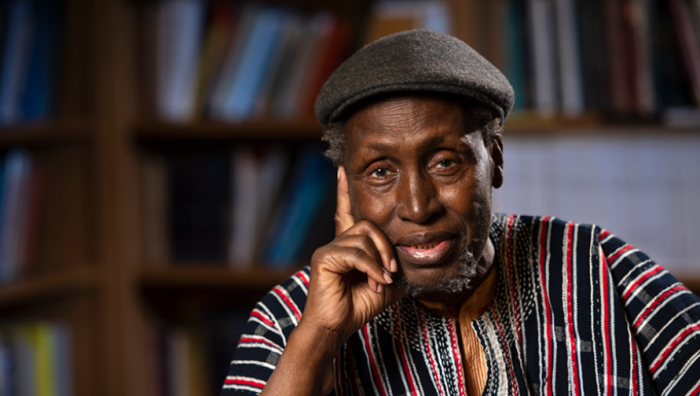
Internationally acclaimed author and Kenyan literary icon, Ngũgĩ wa Thiong’o has died. He was aged 87.
By Emma Ogbuehi
Internationally acclaimed author and Kenyan literary icon, Ngũgĩ wa Thiong’o has died. He was aged 87.
His daughter, fellow writer Wanjiku wa Ngugi, confirmed his passing in a Facebook post on Wednesday, May 28, 2025.
She said, “It is with a heavy heart that we announce the passing of our dad, Ngũgĩ wa Thiong’o this Wednesday morning, 28th May 2025. He lived a full life, and fought a good fight. As was his last wish, let’s celebrate his life and work. Rîa ratha na rîa thŭa. Tŭrî aira!
“The family’s spokesperson Nducu Wa Ngugi will announce details of his celebration of life soon.”
Born on January 5, 1938, in rural Kenya, Ngũgĩ wa Thiong’o rose to global prominence for his powerful storytelling, political activism, and commitment to African languages and identity. He authored numerous influential novels, essays, and plays that explored colonialism, post-colonial struggles, cultural heritage, and social justice.
READ ALSO:
Chinua Achebe, Nobel Prize and African Literature
Among his most celebrated works are:
Weep Not, Child (1964) – the first English-language novel by a Kenyan author.
The River Between (1965) – a tale of tradition versus change.
A Grain of Wheat (1967) – a powerful novel set during Kenya’s independence movement.
Petals of Blood (1977) – a fierce critique of corruption in post-independence Kenya.
Devil on the Cross (1980) – originally written in Kikuyu as a political act of resistance. Matigari ma Njiruungi (1986), translated into English as Matigari by Wangui wa Goro in 1989, Mũrogi wa Kagogo (Wizard of the Crow, 2006), and The Perfect Nine: The Epic of Gĩkũyũ and Mũmbi (2020).
He also published short-story collections, including A Meeting in the Dark (1974), Secret Lives, and Other Stories (1976, 1992), and Minutes of Glory and Other Stories (2019).
His plays include The Black Hermit (1963), This Time Tomorrow (a collection of three plays, including the title play, “The Rebels,” “The Wound in the Heart,” and “This Time Tomorrow”) (1970), The Trial of Dedan Kimathi (1976), co-written with Micere Githae Mugo and Njaka, Ngaahika Ndeenda: Ithaako ria ngerekano (I Will Marry When I Want) (1977, 1982), co-written with Ngũgĩ wa Mirii, and Mother, Sing For Me (1986).
His memoirs comprise Detained: A Writer’s Prison Diary (1981), Dreams in a Time of War: a Childhood Memoir (2010), In the House of the Interpreter: A Memoir (2012), Birth of a Dream Weaver: A Memoir of a Writer’s Awakening (2016), and Wrestling with the Devil: A Prison Memoir (2018).
Other non-fiction works include Homecoming: Essays on African and Caribbean Literature, Culture and Politics (1972), Education for a National Culture (1981), Barrel of a Pen: Resistance to Repression in Neo-Colonial Kenya (1983), Writing against Neo-Colonialism (1986), Decolonising the Mind: The Politics of Language in African Literature (1986), Moving the Centre: The Struggle for Cultural Freedoms (1993), Penpoints, Gunpoints and Dreams: The Performance of Literature and Power in Post-Colonial Africa (1998), Something Torn and New: An African Renaissance (2009), Globalectics: Theory and the Politics of Knowing (2012), Secure the Base: Making Africa Visible in the Globe (2016), and The Language of Languages (2023).
For children, he wrote Njamba Nene and the Flying Bus (translated by Wangui wa Goro) (Njamba Nene na Mbaathi i Mathagu, 1986), Njamba Nene and the Cruel Chief (translated by Wangui wa Goro) (Njamba Nene na Chibu King’ang’i, 1988), Njamba Nene’s Pistol (Bathitoora ya Njamba Nene, 1990), and The Upright Revolution, Or Why Humans Walk Upright (2019).
Ngũgĩ’s outspoken criticism of government oppression led to his imprisonment without trial in 1977. After his release, he went into self-imposed exile and continued his literary and academic work abroad.
He taught at top universities including Yale University and the University of California, Irvine, where he served as a Professor of English and Comparative Literature.
Throughout his life, Ngũgĩ wa Thiong’o remained a staunch advocate for decolonising African literature and elevating indigenous languages in global discourse.
Messages of support and respect quickly poured in for the celebrated author, whose decision to stop writing in English and start using only his native Kikuyu made him a powerful symbol of post-colonial African identity.
“My condolences to the family and friends professor Ngugi wa Thiongo, a renowned literary giant and scholar, a son of the soil and great patriot whose footprints are indelible,” wrote Martha Karua, an opposition leader in Kenya, on X.
Amnesty International, which named him a prisoner of conscience, before a global campaign secured his release from Kamiti Maximum Security Prison in December 1978, also paid tribute to the fallen author.
“Thank you Mwalimu (teacher) for your freedom writing,” wrote Amnesty International’s Kenya branch on X on Wednesday.
“Having already earned his place in Kenyan history, he transitions from mortality to immortality,” it said.

