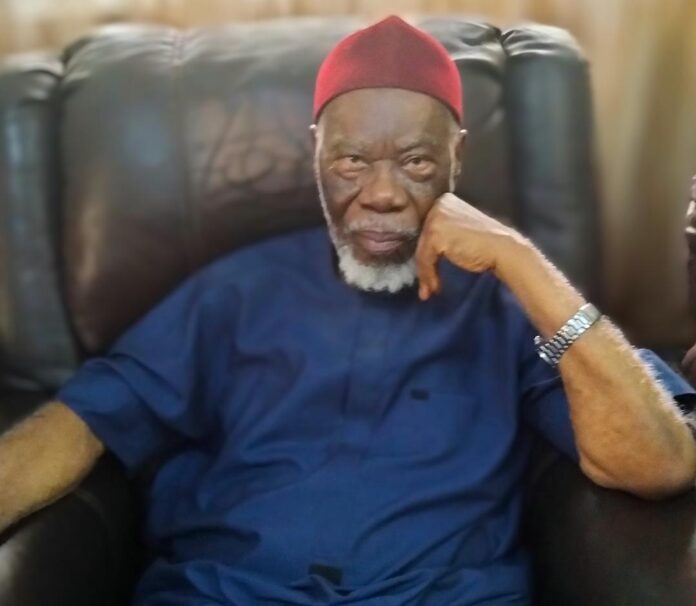
In this first part of the three-part interview with Dr. Uma Eleazu, he insists that at 95, he still remains a young man relatively speaking even as he talks about his regrets and how transactional politics is destroying democracy in Nigeria. He spoke to TheNiche trio of Ikechukwu Amaechi, Emeka Alex-Duru and Eugene Onyeji.
You will be 95 years on June 16. How do you feel at 95?
There is this saying that you are as young as you feel. So, I feel 95. I am still a young man, relatively speaking.
Any regrets in life so far?
When I was approaching 70 in 1999, people were thinking that I should come out again and run for president because I had tried in 1992/1993 during General Ibrahim Babangida’s transition. And I said, no, I am approaching 70 years now, I better allow younger people to try their luck. But looking back and seeing what is happening, I now feel that probably I should have contributed a little bit more. If not as president, at least in the Senate. That is the only thing I regret – not participating at that time when we needed to bring up the new class of politicians. I thought I could do that by writing and people reading the newspapers and so on, but it didn’t work that way.
You contested the presidential primaries in 1993 under the Social Democratic Party (SDP). What was your experience then? Looking at what is happening now, would you say anything has changed?
It was a good learning curve for me on at least what the people that I met in Abia State and Jos during the national convention thought about politics. In other words, the ordinary person’s view about politics, which was way outside the principles and ideals that should be used if one is going to participate in a democratic kind of government. And it made me to ask, are we as a people on the right path when I saw the influence of money in politics. And I knew that with the kind of attitude people had towards politics as a transaction, it is going to destroy democracy.
It wasn’t just that, I found that so many people who were in politics really didn’t understand the basic principles implied in the constitution that they were going to use to run the country. In fact, most people had not even read the constitution itself. What they knew about politics was just get contract and get some money because under the military, everything was about getting contract. Who do you know? If you know the right people, you will get big contract but if you don’t know the right people, you will get a small one. But then you have to go to the civil servants also and make sure you get their buy-in. So, this was just the attitude of politicians. Most of them had had military contracts and they were close to the soldiers. In fact, some of them were worried if the politicians would behave like the military officers that they already knew, and many were afraid that they were going to lose out when the military handed over and some of them spoke as if they didn’t want the military to leave because of what they can get through them.
So, after I crashed out in 1993, I still went to Jos, of course, I was still the leader from Abia State. So, I took all the people who were elected on our platform to the Jos convention and because they knew my attitude to what was going on, when they come, they say, “Nnanyi Ukwu, we know you don’t like this sort of thing, but can you excuse us?” So, I will step aside from the hotel and wait for them to get what they wanted to get and I warned them at that time that at this rate, even people running for the governorship in our state, will give you money at the beginning and that will be the end of it. And after that they can rape you politically and you won’t be able to do anything because they now have power in their hands to do whatever they like with the money that will come from Abuja.
And that was exactly what happened in my State, Abia where for 24 years in this dispensation, we had just transactional leaders. In four years starting from 1999, we had about four Senate presidents from the Southeast. Why? Because of transactional politics. So, that was my experience and I decided that I didn’t want to join again. I don’t think I can survive with this kind of people in politics. I better try and do something more useful to help my community and others.
Can you say that the trend you saw then that discouraged you has changed?
It has gotten worse because the first set who entered in 1999, if you take the constitution and look at it, in fact I have been trying to get a copy of what they call the 1999 Constitution as amended, and I don’t have it. What I have is the 1999 Constitution. But listening from outside and reading the news, you find out that the initial amendments that they made were just so self-serving, especially those who were in the Senate. So, they amended the 1999 constitution to suit themselves. So, there is hardly any politician who will mention the 1999 constitution without saying as amended.
I said okay, I am not going to be referring to this one that as soon as it was published, they gave me a copy as one of those who were in the Constitution Debate Committee. That was after Abacha dropped dead and Abdulsalami Abubakar took over. If you remember well, he organised a National Constitution Debate Coordinating Committee and we were supposed to take the 1979 constitution, the draft of the Abacha constitution to the various zones for debate.
Problem no one, the people in the zones had not seen the Abacha draft constitution and most of them didn’t have the 1979 Constitution. As usual people wrote memos to say this is where we stand. I was asked to lead a team to the South-South geo-political zone. And they all just wanted to talk about resource control. They didn’t want to see any other agenda. We were there, there was one old man then, I didn’t know him, he just sat in the front and he didn’t say much. At the end, it was not a debate per se, it was a talk shop, and then he told Barrister Solomon Asemota, who was a member of the committee, to call me. I came to where he was and greeted him.
And he said, “Young man, you may not know me, my name is Harold Dappa-Biriye.” And I knew the name – he was a politician, former chairman of the Niger Delta Congress known for his advocacy of minority rights in Nigeria – but I never met him before then. And he said, when you go back, tell Nikki Toby that he should remember that he is an Ijaw man and that if they don’t return derived revenue at least 50 per cent to them, there will be trouble. Nikki Toby was the chairman.
I said, is that all? He said yes. “Just deliver my message to him. Tell him that I, Harold Dappa-Biriye, said so.” When I visited him at home, the library and documents, he was an old man at the time as I am now, and he showed me agreements signed by either his father or grandfather and Queen Victoria or somebody signed on behalf of Queen Victoria granting them 10 miles into the littoral space. He said, “Up to 10 miles still belongs to my family.” Anyway, I delivered his message to Justice Nikki Toby but I won’t tell you his reaction. So, as politics was getting hot, I knew we were going to have some problems. But that was not what stopped me, it was the role of money in politics. I just didn’t like the idea and I was not in a position to borrow and there was no place to steal money. So, honestly, that is what stopped me because I didn’t want to play the money politics. When I remember what our old people had told us, what their values were in politics …
What were those values?
Some of them they didn’t tell us directly. It is what they wrote. And the man that I admired so much when I was a young man was Dr. Nnamdi Azikiwe.
Why did you admire him?
From his writings. In 1947, I was a young teacher in a bush school. And we had this headmaster who goes to where the white man lived in Ohafia to bring salaries at the end of the month. When he is coming back, he will buy West African Pilot and of course, when he finishes reading, we, the small people can also read and he reads that particular edition until the next time he goes for salary and he will buy another one. I read in the newspaper about “show the light and the people will find the way.” And it was also that same year that I read the speech Zik made at the graveside of Herbert Macaulay. In fact, all the poems he quoted, I thought that he wrote them. So, I said, this man, wherever he goes, you are my model of a politician. Till he died, he was my model. But these days, if I ask you, if you were to go into politics, which Nigerian politician is your role model, who will you say?
My role models in politics – Dr. Michael Okpara and Chief Sam Mbakwe – are also dead.
Why? Because of what they said or what they did. Today, of all our politicians in Igbo land, let me not talk about the whole of Nigeria, who do you think that the young men growing up, like your own children, which of the politicians can you tell them to learn that man’s habit and use it because it will help you in life? It is difficult to say. People choose the leader they want to follow because of certain aspects of his life – his behaviour, the way he speaks, his values, and you find that Zik went to the U.S. at the time that the Jim Crow laws were in effect and black people were being oppressed really and they were just raising their heads. And the speeches he was making was about freedom, liberty, which when he came back, he continued even in his writings.
I used to try to hide that West African pilot that our head teacher will bring to the village school so that no other person will read that part of Azikiwe’s speeches. I even crammed part of that speech at Herbert Macaulay’s burial – “Before us lies the open grave.” Even the way he spoke, some of us young people liked to speak like him. That is mentorship. He was my model.
How can we get it right now?
Well, I don’t think I have any particular silver bullet that will remedy the situation we are in now. It is only education and that is why when they tried to ban the teaching of history in Nigeria, I got so sad and not just teaching history, until I went down to the village to find out what education has become. In my own state, teachers don’t teach anymore. And I don’t think it is peculiar to Abia State. In almost all the states in the South. Why? Because the powers that be in politics don’t want to pay the teachers and because nobody wants to be hungry, the teachers look for others things to do.
The other day, I was reading an article in TheNiche, somebody was writing about former INEC Chairman Attahiru Jega, thinking that when he uses professors in conducting elections, there will be credibility. But in the 2019 elections, two professors were jailed. And I think two or three others may be jailed over the 2023 elections. So, the problem is deep but it is only by education, reorientation of the people that they will begin once again to learn about the values of what democracy is about – the freedom of the individuals, and the bottom line is the rule of law. You can have everything but if there is no rule of law, where do you go to have an arbiter when you have to challenge something? So, all the things that were built into the 1979 Constitution and we were thinking that look at what happened in the first republic and the trouble in the West was not between Igbo and Yoruba. It was not between Hausa and Yoruba. It was not ethnic. The problem in the Western region was all Yoruba.
READ ALSO: How corruption forced me out of Nigeria’s oil industry – Uma Eleazu
Sometimes, people blame ethnicity. No! There was something more than that – greed! People think that they have to be in politics and wield power and have the public purse alone. They don’t want to share. So, you ignore things like public trust, integrity, responsibility of the individuals, and once we lose sight of those values which made our people come together, and Zik was able to say, okay, we don’t mind, if we can only build unity in this country. That was why he was not particularly anxious to become Prime Minister of Nigeria.
I don’t know if you know that. And even when he was being shunted aside to represent the Queen honorific and he became the Governor General when Richardson was leaving, and they said okay, the only thing we can give him and here was the man whose political party had the highest number of votes in the 1959 election. Go and check it. So, if there was going to be a coalition, if NCNC and Action Group had gone into a coalition, they would have formed a government according to the British Constitution and the Constitution that we eventually had in 1960. But Zik said no, that he wanted the North to be part of Nigeria. He wanted them to come in even if it meant letting them appoint the Prime Minister. That was how Sir Tafawa Balewa who was in the hierarchy of the North not really up there but Sardauna said, send him. So, they sent Tafawa Balewa to Lagos while he, Sardauna, the potentate of the North preferred to be Premier in the North than to come down and be Prime Minister of Nigeria. And Zik said, at least if people are coming, they would want to see the Prime Minister and the Governor General who is now head of state. That was why he accepted to be Governor General.
So, there is some kind of humility that leaders must have – their own natural ability and humility in handling power. I don’t think Zik except when he was the premier of Eastern Region really handled power the way it is being handled now. He allowed his lieutenants to do their job. He had strong and capable lieutenants like Dr. Okpara and he made sure that the Ministers in the East were widely distributed. This President of the Senate now, Godswill Akpabio, his uncle, Dr. I. U. Akpabio, was the Minister of Education/Internal Affairs in the Eastern Nigeria, a staunch member of the NCNC.
Now that you have mentioned the Western Region crisis of the 1960s, former military president Babangida in his memoirs said the January 15, 1966 coup was never an Igbo coup, what should Ndigbo do in the circumstance?
They were all young men when this thing – coup – happened. So, they were not thinking deeply. They were just doing soldier come, soldier go. They were trained to handle guns and your top man says go and shoot, kill and they go. So, if you reflect on that, you find that the issues of politics which their own leaders in the north were orchestrating, some of them didn’t even understand it. All they knew was that they were soldiers and our commander says do this, and they obey. Most of them knew that this was not an Igbo coup. They knew all along, even those who participated in it. This is what was happening in Western region and personally, I found out that Ahmadu Bello and the Premier of the Western Region Akintola were already planning a coup using Brigadier Maimalari or Ademelegun, who were also top officers at the time. Nzeogwu’s coup with Ademoyega was a pre-emptive strike to stop them from what they wanted to do, the coup that was being planned between Sardauna, Balewa and Akintola. But you read what others write and you find out that they don’t even mention it.
And this Igbo coup is something which should have been buried long ago. Most of those officers at the time from Gowon down, they knew it was not. But their leaders called them in and said go and finish all the Igbo officers. We don’t want them here and they did exactly what they were asked to do. This time not by their military leaders but the politicians who were planning how to rule Nigeria without the Igbos because they thought that it was only the Igbos alone that were their greatest obstacle. It is in my 2020 book, Nigeria as I see it. I am writing another book now. Hopefully, I will finish it.
You will finish it sir.
Thank you. God willing.
But can Ndigbo sue the Nigerian government over the injustice they have suffered since 1966 because of the alleged Igbo coup which has now been confirmed to be false?
That is something that needs to be planned. But I may say that it has been overtaken by events.
Why?
Immediately after the war or when civilians came in, the first meeting if I remember well that we had, this was not the old politicians but more or less, those of us who were somehow around the military rulers, younger generation, who were still chafing what happened to Ndigbo but we didn’t voice it, we used to meet in the house of one of us and say what do we do? We were in communication with Ojukwu and we thought that okay, now that we were returning to politics, I am talking about the period between 1977 and 1979, let us lie low and help them get into some kind of civilian rule because these young men who have killed, dealing with them will be difficult.
I am an Ohafia man and we were head hunters. When you come back, there was a kind of ritual, sacrifice that you will make and we do that so as to remove blood, literally, from the person’s eyes. Otherwise, the blood you have seen where you have gone to hunt human head will lead you to killing other people. So, we said, let us leave this thing, when politicians come in, these people that have guns, who have killed our people, we will know how to go to court. Reconstruction, Rehabilitation and Reconciliation, the 3Rs, none had been really done. When I was invited and I became head of what was called National Policy Development Centre, that team was an all Nigerian team and our chairman was Prof Babs Fafunwa and we used to try and think ahead of these military chaps.
So, we said first, on the constitutional side, that we need to craft a constitution that emphasizes inclusivity. We are still talking about it till today. Prof Ben Nwabueze, I doff my hat to him, he spent nights crafting what is in that constitution that we call Fundamental Objectives and Directive Principles in the Constitution. One man spent his time, and money looking for, I think he was teaching in East Africa during the war. The day Rotimi Williams read the first draft, he said what? This is something that we have to put in legal phraseology. And I think Nwabueze and Rotimi Williams drafted that Chapter 2 of the 1979 Constitution. We lifted that chapter into the 1999 Constitution. It is there. These are the principles that you follow when you are making state policy. It is all inclusive – freedom of the individual, freedom of the press, all the freedoms. In addition to that, how to apply it, that was how the phrase, Federal Character, came to be.
I wrote a paper on it before it was adopted. I defended my paper before the Constituent Assembly that approved the 1979 Constitution. On the basis of that, when they wanted to know what it is, they sent me to Sri Lanka to go and present a paper on Federal Character Principle in the Nigerian Constitution and how it can be applied in education in Sri Lanka. I went there. The paper I wrote is still in a book published in the U.S. I have a copy. And we have all these things which any well-meaning government will sit down, read it and this is the grand principles that guide you in making policies. And some of our politicians talk as if our Constitution does not say anything about inclusivity.
Do you agree with those who say that the problem with Nigeria is simply with the Constitution and if we have a new Constitution, we will have a new Nigeria?
I have argued elsewhere that our problem is not the Constitution because well-meaning politicians can use the same Constitution that we put together in 1999 and run this country well. It is a bad workman that quarrels with his tools. So, the problem is not the constitution. It is the people who are called upon to run our governments. They don’t want to do anything that is in the constitution. So, as the Psalmist asked, if the foundations be removed, what can the righteous do?
- To be continued tomorrow