



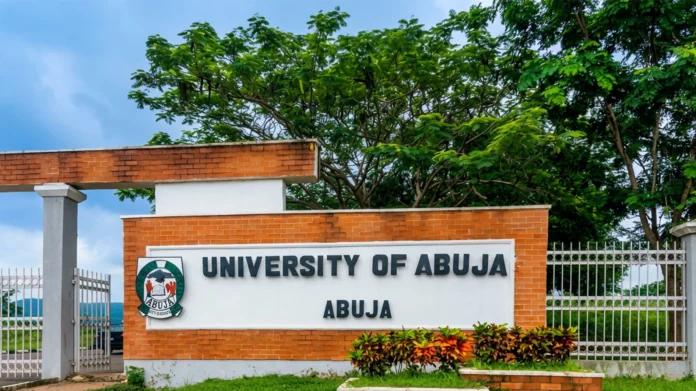
The Human Rights Writers Association of Nigeria (HURIWA) has strongly condemned what it described as an arbitrary, high-handed and seemingly primitive acquisition of land belonging to the University of Abuja by the Minister of the Federal Capital Territory, Nyesom Wike, under the questionable justification of an earlier recommendation allegedly approved by a former FCT minister.
HURIWA said in a statement on Tuesday issued by its National Coordinator, Comrade Emmanuel Onwubiko, that the controversy raises fundamental questions about the rule of law, the protection of public institutions, the limits of ministerial authority and the constitutional responsibilities of President Bola Tinubu.
The association considered it unacceptable that thousands of hectares originally allocated to a federal university could be taken away through administrative pronouncements without transparent evidence of compliance with the applicable laws and due process.
HURIWA particularly rejected the attempt by the FCTA to justify the controversial land reduction by invoking recommendations allegedly made by a joint committee in 2016 and approved by former FCT Minister, Mohammed Musa Bello.
The association asked: “If a former minister allegedly contemplated or recommended a land reduction that was never fully implemented, does that automatically confer unlimited authority on a succeeding minister to execute such a decision without establishing its legality?
“Can an administrative recommendation, no matter who approved it, override the statutory rights of a federal institution or dispense with the legal procedures governing the revocation and reallocation of land?
“A former minister’s approval is not a substitute for the law.”
HURIWA demanded that Wike publicly establish the precise legal authority under which he reduced the University of Abuja’s original landholding from 11,824 hectares to approximately 4,685 hectares.
“Did the minister obtain the necessary lawful authorisation from the President, acting as the constitutional authority over the Federal Capital Territory, in accordance with the Land Use Act and other applicable laws?
“Was the procedure for revocation of the university’s landholding followed? Were the relevant statutory requirements satisfied? Was the university formally notified, and were its institutional interests adequately protected?
“These are questions that cannot be answered by political statements, press releases or arguments about how many buildings could fit into the remaining hectares,” the group said.
HURIWA warned that Nigeria must not degenerate into a society where public officials exercise governmental powers as though public institutions and their assets were their personal inheritance.
“The University of Abuja was established in 1988 with a substantial land allocation of 11,824 hectares to accommodate its long-term academic, research and infrastructural development.
“That allocation was not an accidental gift to university officials. It was a strategic federal government provision for an institution located in the nation’s capital.
“The argument that the university has not developed every portion of its land after 38 years is particularly unconvincing.
“Universities are not commercial property developers whose success should be measured by the number of estates, shopping malls or buildings constructed on their land.
“They require space for future academic expansion, agricultural research, innovation centres, laboratories, student accommodation, staff housing, sports facilities, environmental conservation and other long-term institutional needs.
“The University of Ilorin reportedly occupies approximately 15,000 hectares, while Obafemi Awolowo University has about 13,000 hectares. Other federal universities also maintain extensive land reserves for their future development.
“Why should the University of Abuja be subjected to a different standard simply because of its location in the Federal Capital Territory?” the group asked.
HURIWA said it was particularly disturbed by the allegations made by the Academic Staff Union of Universities (ASUU), University of Abuja branch, that the minister proceeded to allocate portions of the disputed university land to companies and individuals on September 26, despite an interlocutory injunction reportedly issued by Justice F.E. Mesiri of the Maitama High Court on August 18, restraining encroachment on the property.
ASUU Chairman, Professor Sylvanus Ugoh, has described the alleged action as a disregard for the rule of law and warned that the union may no longer guarantee industrial harmony if the disputed allocations are not reversed.
HURIWA said it fully aligns with ASUU’s demand for the protection of the university’s property and insists that no public official should place himself above judicial authority.
“If the allegations of post-injunction allocations are established, the implications for constitutional governance and respect for judicial orders would be extremely serious,” it said.
The association therefore demanded that the FCT Minister respect the subsisting court proceedings and refrain from taking further actions capable of prejudicing the determination of the dispute.
HURIWA also said it found it troubling that the FCTA has shifted the burden of justification to the university community by challenging its unions to explain why the institution requires thousands of hectares.
“The burden should instead be on the government to demonstrate the legality, necessity and procedural validity of any decision to revoke or reallocate land already vested in a federal institution.
“The allegation that the university allocated 100 hectares to the EFCC without FCTA approval must also be independently investigated. If established, the university should explain the legal basis of that transaction.
“However, such an allegation cannot serve as a licence for arbitrary government action or justify the wholesale reduction of the institution’s landholding,” said the group.
TINUBU MUST NOT ABANDON UNIABUJA
HURIWA called on President Tinubu to intervene immediately and protect the University of Abuja from what appears to be an escalating struggle over its land assets.
“Under Section 299 of the 1999 Constitution, the Federal Capital Territory is administered under the constitutional framework applicable to a state, with the President exercising executive powers over the Territory. The President must therefore ensure that delegated governmental authority is exercised within the limits of the law.
“The President cannot remain indifferent while a major federal university and the FCT Administration engage in a bitter dispute over land originally allocated by the Federal Government,” it said.
HURIWA also demanded that the Minister of Education, the National Universities Commission and the National Assembly urgently examine the circumstances surrounding the reduction of the university’s landholding.
“The silence of the supervising authorities in the face of these allegations is deeply troubling.
“The University of Abuja is not the private estate of the FCT Minister. Neither is it an expendable institution whose future can be determined by administrative convenience or the commercial attractiveness of its surrounding land.
“It is a national institution belonging to the Nigerian federation and serving generations of Nigerians,” said the association.
HURIWA therefore demanded an immediate suspension of further allocations of the disputed land, full disclosure of all relevant government approvals, respect for the court proceedings and an independent investigation into the alleged transfer of portions of the university’s property to private interests.
“We warn that the conversion of university land into private commercial assets, if established, would represent a dangerous assault on public education, institutional autonomy and the rule of law.
“No minister should be so powerful that the protection of a federal university becomes dependent on his personal discretion.
“Nigeria must be governed by laws, not by the strength of political officeholders.
“The University of Abuja deserves protection, not dispossession. Its land must not become a prize in an administrative power struggle,” the group added.


 has strongly condemned what it described as an arbitrary, high-handed and seemingly primitive acquisition of land belonging to the University of Abuja by the Minister of the Federal Capital Territory, Nyesom Wike, under the questionable justification of an earlier recommendation allegedly approved by a former FCT minister.)