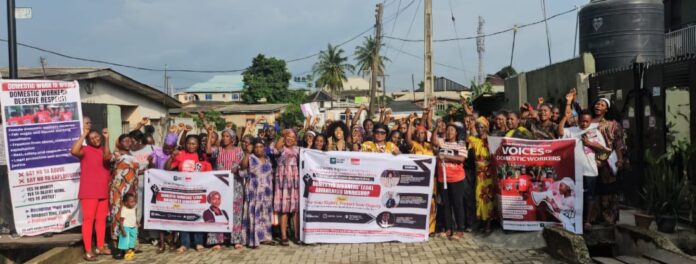
CEE-HOPE trains domestic workers in Lagos, Ogun on labour rights
By Ishaya Ibrahim
Blessing Iduma knows firsthand the exploitation and hardship many domestic workers endure. At the age of nine, her aunt brought her from Benue State to Lagos with the promise of enrolling her in school. But that promise was never fulfilled.
Blessing recalled: “She had a daughter that we were supposed to be going to school together. But she said she didn’t have the money to pay for me, that I should hawk cooked rice for her. So, I started hawking rice for her at the age of nine.”
Instead of going to school, Blessing’s childhood became a routine of hard labour. She hawked cooked rice during the day, sold vegetables at night and carried out household chores in between.
“I would hawk rice in the morning, in the afternoon she would cook again, I would still hawk it. Immediately I returned from hawking, she would send me to a farm to get vegetables which I would sell in the Igando market at night. Before I sleep, she would say ‘oya, go and fry garri.'”
Blessing was never enrolled in school. Any attempt to question her situation or ask about the promise of education was met with physical abuse.
Determined to escape the situation, she began secretly saving part of the money she made from hawking. When she had saved enough to cover her transport fare to Benue, she seized the opportunity to flee the house and return to her village.
Experiences like those of Blessing was the reason the Centre for Children’s Health Education, Orientation and Protection (CEE-HOPE) in collaboration with the Rosa Luxemburg Foundation West Africa, on Thursday trained domestic workers on their rights as employees.
The event: ‘Advancing Legal Awareness and Decent Work for Domestic Workers,’ was held in CEE-HOPE’s Lagos office with many domestic workers in attendance, while facilitation was provided by legal, labour and human rights experts.
CEE-HOPE’s founder Betty Abah says the training is targeted at vulnerabilities that domestic workers endure which employers exploit, part of which is underpayment, arbitrary terminations, indefinite working house and physical abuse.
Abah noted that building strong workers’ collective bargaining skilla is essential to transforming domestic labour from an isolated, vulnerable occupation into a respected and regulated profession.
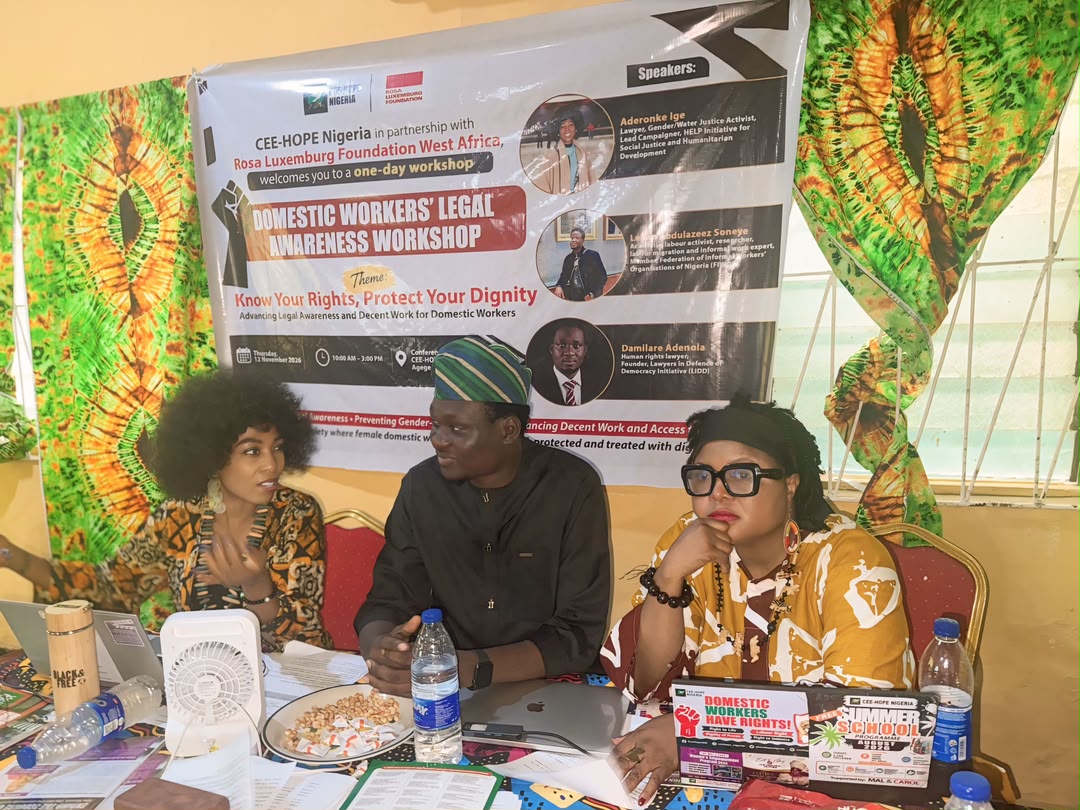
She stressed that the workshop forms a crucial cornerstone of CEE-HOPE’s broader advocacy to unionise domestic workers in Nigeria, working toward a society where domestic workers, both male and female, are recognised, protected, and treated with dignity.
Following the opening address, participants engaged with three key resource persons who broke down crucial legal frameworks and practical roadmaps for action.
Labour migration and informal work expert Lekan Abdulazeez Soneye made a presentation titled “Domestic Workers as Invisible Workers,” highlighting the grim realities of the sector.
“There are more than 4 million domestic workers in Nigeria who are poorly paid and in different forms of abuse,” Soneye stated
He further noted, “Even the labour institutions—such as the labour ministry, labour support organisations, and trade unions pay almost no attention to the existence and reality of domestic workers in Nigeria.”
Academic institutions and labour writers also find domestic workers’ issues less interesting as a labour field to concentrate on in Nigeria due to the invincibility of the work and lack of structural appearances.”
Soneye extensively detailed the framework of collective power, defining it as the capacity of individuals to identify their connection, mobilise themselves as united people, and take actions to achieve common goals and prosperity.
He outlined four core power resources: associational, structural, societal, and institutional power.
Painting a stark picture of working conditions, Soneye presented empirical data showing that decent work—defined as regulated work hours, job security, adequate pay, holidays, gender rights, and protection from abuse is almost entirely absent in Nigeria.
“In fact, only about 15% of domestic workers in Nigeria have a clearly defined and written contract with their employer, with a significant proportion of this 15% being defined on behalf of the workers, and only about 7% of them earn ₦50,000 or above,” Soneye revealed.
He said that statistics show 62% of domestic workers have experienced verbal abuse, 9% have experienced physical abuse, and 4% have experienced sexual abuse (all females), while only 9% of these cases were satisfactorily addressed.
To counter these systemic injustices, Soneye outlined legislative safeguards, noting that while the Nigerian Labour Act (1990 & 2004), the 1999 Constitution (Sections 17(3) and 40), the Anti-Trafficking Policy of 2003, the Employee Compensation Act of 2010, and the Labour Migration Policy of 2013 exist, the vital ILO Convention 189—adopted on June 16, 2011—has still not been ratified or implemented by the Nigerian government.
He highlighted that CEE-HOPE advocated for this policy including the inclusion of a provision for unionisation of domestic workers before the National Assembly in July 2024, culminating in November 2025 when the Bill for the Documentation and Protection of Domestic Workers was adopted, though it still leaves out ILO Convention 189 ratification. Soneye urged workers to build associational, societal, structural, and institutional power, noting that while outright strikes can be difficult due to job insecurity, provisions such as sick leave, family emergencies, or slowdowns can demonstrate economic value, and that public-oriented domestic services offer the best path to attaining decent work and union rights.
Adding legal depth to the sessions, Aderonke Ige, a prominent gender justice activist, lawyer, and lead campaigner at the HELP Initiative for Social Justice and Humanitarian Development, shared extensive field insights.
Drawing from her years of litigation and advocacy practice across Oyo, Ekiti, and Lagos states, Ige contrasted varying institutional responses to gender-based violence and workers’ rights violations.
She noted how states like Lagos and Ekiti made strides through dedicated frameworks such as public defender offices, domestic and sexual violence response centres, and sexual offender registries, while cautioning that grassroots enforcement gaps and cross-border jurisdictional hurdles still impede justice for vulnerable victims.
Rounding off, the expert panels, human rights lawyer and Founder of Lawyers in Defence of Democracy Initiative (LIDD), Damilare Adenola, elaborated on actionable strategies for accessing legal aid, reporting abusive employers, and leveraging civil society networks to enforce accountability.
Adenola emphasised that knowing constitutional rights and utilizing pro bono legal avenues are vital shields against employer impunity.
Abah concluded the session by urging the Domestic Workers to remain resolute in their pursuit of a structured and vibrant national union. She said the mobilisation has been largely in Lagos and Abuja with participation from nearby states such as Ogun and Nasarawa but said CEE-HOPE aims to broaden the scope to a nation-wide movement so that domestic workers unions can be part of the mainstream labour movement and thus lead to significant improved working conditions.