




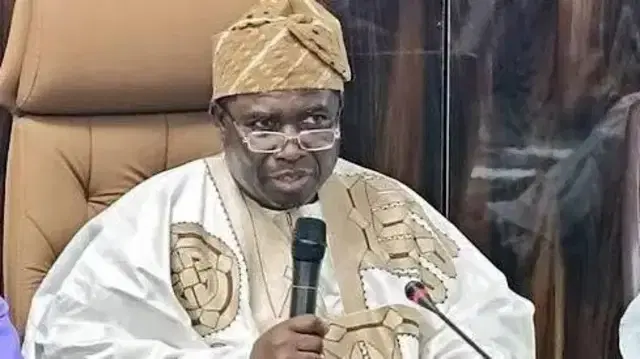
Chairman of the Independent National Electoral Commission (INEC), Prof Joash Amupitan, has said the commission will conduct a nationwide mock accreditation and voting exercise on November 28.
Amupitan said on Thursday during a dialogue at the Chatham House in London that INEC had addressed malfunctions of the bimodal voter accreditation system (BVAS) linked to extreme heat and storage conditions during the 2023 elections.
The dialogue was convened in partnership with the Kimpact Development Initiative (KDI) and themed, “Nigeria’s 2027 elections: democratic trajectory and regional stability beyond the ballot”.
According to a statement by his chief press secretary Adedayo Oketola, the INEC boss said Nigerians should trust his leadership to deliver free, fair, and credible general election in 2027.
“On the 28th of this month, we will conduct a mock accreditation and voting exercise across all states of the federation to simulate the presidential election and verify that we have gotten both accreditation and electronic result transmission right,” Amupitan said.
The INEC chairman highlighted the commission’s measurable operational improvements in recent off-cycle polls.
He added that INEC had introduced new technical safeguards to prevent a repeat of the controversies that marred the 2023 elections.
Amupitan said the commission had also procured additional devices and reduced the maximum number of voters assigned to each BVAS machine from 1,250 to 850.
He said polling units with more than 850 registered voters would be provided with multiple devices.
According to him, INEC’s post-2023 audit traced the most acute result-management failures to collation centres rather than polling units.
To eliminate discrepancies between polling unit figures and collation sheets, Amupitan said INEC had built strict validation safeguards into its system to prevent inaccurate results and figures indicating over-voting from being uploaded to the INEC result viewing portal (IReV).
“We found that the core problem of election result management and declaration in Nigeria is not even at the polling unit — it is at the collation centres,” he said.
“In 2023, there were instances of inaccurate results or results with over-voting being uploaded onto IReV. We have now devised a technical safeguard: if a result is not accurate at the polling unit, it will not go to IReV at all.
“The moment a result appears on IReV, citizens can trust what they see. By eliminating inconsistencies at the source, collation will become a transparent formality.”


, Prof Joash Amupitan, has said the commission will conduct a)