Nigeria, Ghana employers collaborate to strengthen fair recruitment systems for migrant workers
By Eberechi Obinagwam
Employers from Nigeria, Ghana and Kenya have called for stronger enforcement of labour migration regulations, improved public awareness and cross-border cooperation to protect migrant workers from exploitation, forced labour and human trafficking.
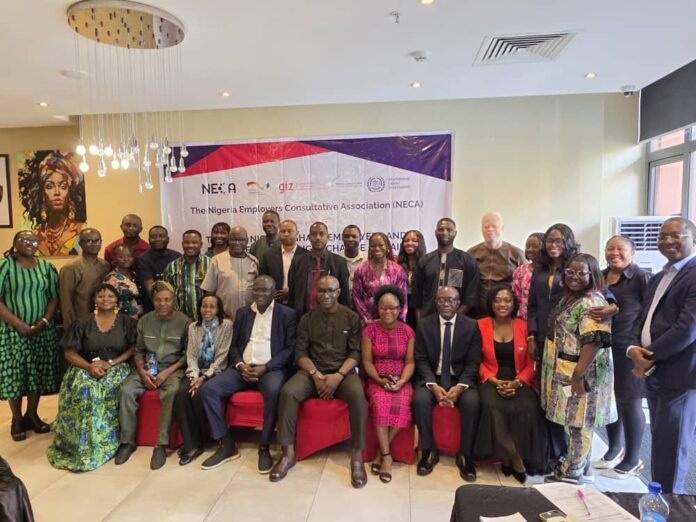
They made the call at a two-day Nigeria-Ghana Employers’ Learning Exchange on Fair Recruitment and Responsible Labour Mobility, organised by the Nigeria Employers’ Consultative Association (NECA) in collaboration with the International Labour Organisation (ILO) in Lagos.
The two-day programme, which ended on Thursday at Protea Hotel, Ikeja, Lagos had the theme, ‘From Policy to Practice: Strengthening Employers’ Capacity to Effectively Engage on Labour Migration Governance.
Speaking at the event, the Director-General of NECA, Adewale-Smatt Oyerinde said employers and private employment agencies had important responsibilities in ensuring that recruitment processes were transparent, lawful and respectful of workers’ rights.
The NECA DG who was represented by Assistant Director Learning and Development, Isabella Usen, said effective employer engagement in labour migration governance must go beyond participation in policy discussions to improved workplace practices, stronger compliance and meaningful contributions to policy implementation.
She also identified the proposed development of an Employer Fair Recruitment and Responsible Labour Mobility Checklist as one of the expected outcomes of the engagement.
According to her, the checklist would guide employers and recruiters on due diligence, transparency and workers’ protection before, during and after recruitment, including cross-border employment.
She said the engagement would also strengthen cooperation between Nigerian and Ghanaian employers’ organisations and provide opportunities for regional knowledge exchange.
Also speaking, Grace Orshio, ILO National Project Coordinator for the Action for Improving Labour Migration Governance in Nigeria project, raised concerns about unregulated recruitment agencies, warning that their activities could expose job seekers to human rights abuses, forced labour and human trafficking.
She said while some recruitment agencies were already familiar with fair recruitment principles, more attention was needed to address those operating outside regulatory frameworks.
“When people understand what fair recruitment is, then they understand when somebody is approaching them with a different perspective or with a different motive,” she said.
Orshio advocated increased public education and access to accurate information to help prospective migrant workers identify suspicious recruitment practices and report abuses.
She also called for bilateral labour migration agreements between countries to ensure that workers moving across borders enjoyed adequate protection.
Similarly, Joseph K. Amuah, Director of Industrial Relations at the Ghana Employers’ Association, called for deeper collaboration between NECA and its Ghanaian counterpart to address common challenges facing employers and workers.
He raised concerns about reported irregularities and illegal collection of money at border posts, saying professional conduct among officials was necessary to facilitate responsible labour mobility.
Amuah cited an initiative by the Ghana Airports Authority, which uses public announcements to warn travellers against giving money to officials and encourages them to report solicitation.
He suggested extending similar measures to road, sea and other border posts.
In a presentation titled Labour Migration Governance, Fair Recruitment and What Employers Have Learned Along the Way, Kingsley Laar, Economist and Research Officer at the Ghana Employers’ Association, highlighted migration patterns between Nigeria and Ghana and outlined lessons for strengthening labour migration governance, including better coordination, adequate funding, stronger regulation of recruiters and the inclusion of fair recruitment provisions in labour agreements.
Responding to the presentation, James Laar, Managing Director of L’aine HR, called for Nigeria and Ghana to harmonise their labour policies and processes to facilitate the movement of workers between both countries and strengthen regional integration.
He said Nigerians should not fear that Ghanaian workers would take their jobs, arguing that Nigeria’s larger market offered significant opportunities for workers from both countries.
Laar urged employers and labour organisations in Nigeria and Ghana to work towards harmonising their policies, noting that the arrangement could serve as a model for the wider Economic Community of West African States (ECOWAS).
“Then the larger ECOWAS can adapt it. I think that is better for us. That is the way to get harmonisation to the larger ECOWAS. We must have it,” he said.
A Kenyan consultant and recruiter, Margaret Wanjiru Mugwanja, emphasised the need to protect migrant workers before and after their departure.
She advocated the use of a monitoring tool to help employers, governments and recruitment agencies conduct due diligence on prospective employers and track workers’ welfare, including whether they receive their agreed salaries.
Mugwanja also stressed that migrant workers should not bear recruitment costs, noting that many prospective migrants wrongly believe they must pay to secure overseas employment.
“The training needs to start from the community level,” she said, advocating awareness programmes involving prospective migrants and their families.
She further called for pre-departure orientation to prepare workers for the laws, culture and working conditions of destination countries.
Melanie Belfiore, Technical Officer at the ILO’s Labour Migration Branch in Geneva, also highlighted the importance of ethical recruitment standards, citing the ILO’s 2023 Code of Conduct for Employers and Private Employment Agencies on the Fair and Ethical Recruitment of Migrant Workers in the Indian Ocean Region.
She said the code promotes transparency and accountability in recruitment, urging employers and agencies to comply with national laws and international labour standards and take proactive measures against fraudulent recruitment, forced labour and human trafficking.
Other stakeholders at the meeting identified weak enforcement of existing labour migration mechanisms, inadequate funding of relevant government agencies and insufficient political will as challenges affecting the effective protection of migrant workers.
They also called for harmonisation of existing mechanisms, improved information and education, sustained dialogue with other countries and the development of a national framework to guide workers, employers and recruitment agencies.
The engagement was expected to provide a basis for sustained collaboration among stakeholders, with proposed measures and commitments to strengthen fair recruitment and responsible labour mobility.