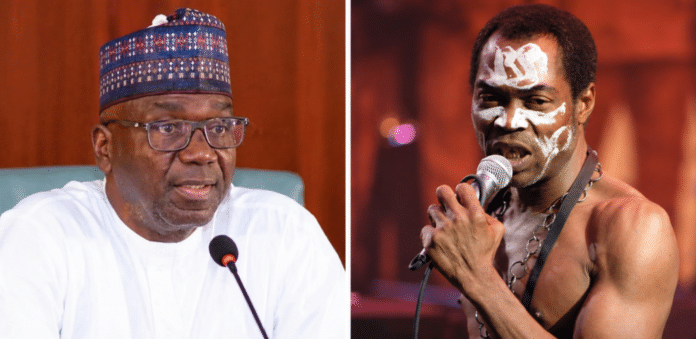
AbdulRazaq also claimed he attended Fela’s shrine alongside the current National Security Adviser, Nuhu Ribadu.
By Kehinde Okeowo
Kwara State Governor AbdulRahman AbdulRazaq has clarified that he did not attend late music legend Fela Anikulapo-Kuti’s shrine in the 1980s solely for entertainment, but also because of the Afrobeat pioneer’s advocacy for African identity and the Black race.
He made this known recently in Ilorin, the Kwara State capital, while declaring open an exhibition titled Fela Anikulapo-Kuti: A Retrospective at the Institute of Contemporary African Art and Film (ICAAF).
The exhibition, organised jointly by the Kwara State Government and Fela’s family, celebrates the late musician’s life, music, and enduring influence.
AbdulRazaq, who recalled attending the shrine in Lagos alongside the current National Security Adviser, Nuhu Ribadu, also admitted that he is an Afrobeat enthusiast and noted that it was the era in which Fela released the Zombie album.
ALSO READ: U.S. pastor shows up in church with second wife, says it’s biblical
The governor added that he had visited Fela’s shrine since the 1980s and admired the musician’s intelligence, activism, and ideas.
“In the late 80s, I used to go to the shrine with several notable people now, including the present NSA, Nuhu Ribadu, as well as our friends who were in the military then.
“We used to attend the shrine then because Fela is highly intelligent. It was during Fela’s Zombie album,” he said.
AbdulRazaq added that a former Inspector-General of Police from Katsina State, whose name he declined to disclose, also attended the shrine.
The Kwara governor described Fela as more than an entertainer, saying his music challenged established conventions and raised questions about power, freedom, identity, and justice.
“Fela’s legacy demonstrated the power of art to preserve collective memory, challenge established ideas, inspire courage, and contribute to social change,” he said.