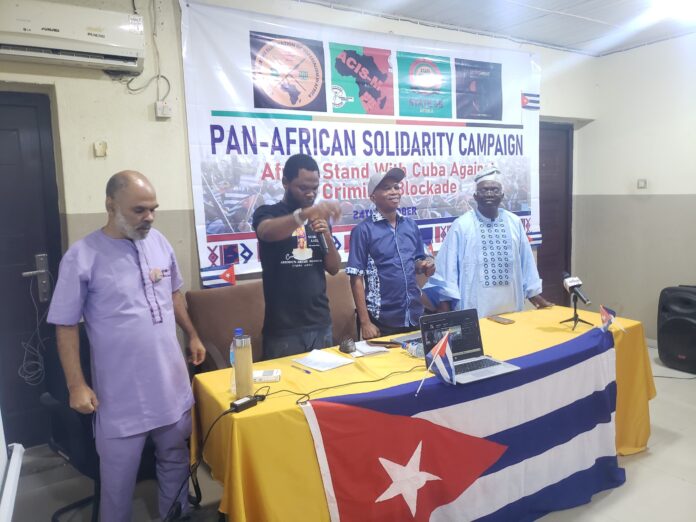
PERESSA condemns US blockade of Cuba, urges FG to mobilise African support
By Ishaya Ibrahim
National President of the Precision, Electrical and Related Equipment Senior Staff Association (PERESSA), Comrade Rufus Olusesan, has condemned the United States over its economic blockade of Cuba, describing it as the most inhuman in modern history,
Olusesan said the blockade is illegal. He made the assertion at an event organised by the Coalition for the Elimination of Imperialism in Africa to mark the International Month of Action in Solidarity with Cuba held on October 24, 2026.
The US under Donald Trump has doubled down on its 60 years economic blockade of Cuba, depriving the Carribbean Island country access to the most essential for survival, including food, medicine, fuel, technology, and banking
Olusesan said: “This blockade is illegal. It violates international law. It violates the United Nations Charter. For 31 consecutive years, the UN General Assembly has voted overwhelmingly to condemn it. Yet Washington persists.”
.
According to Olusesan, the restrictions have Cuba into a strait.
He said: “We stand with Cuba because we know what sanctions mean in a hospital ward, It means a cancer patient waiting for a drug that cannot arrive because the bank refuses to process payment to Cuba. It means a dialysis machine lying idle because spare parts are blocked. It means doctors forced to improvise because the empire has decided that suffering is a foreign policy tool.”
The PERESSA president highlighted Cuba’s contributions to global healthcare, particularly in Africa, noting that Cuban medical personnel had supported communities during health emergencies, including the Ebola outbreak in West Africa and the COVID 19 pandemic.
He said Cuba’s medical assistance to developing countries demonstrated the importance of international cooperation and solidarity, adding that the country’s experience offered lessons for nations seeking to strengthen public healthcare systems.
Olusesan further drew parallels between the US policy towards Cuba and what he described as neoliberal economic policies promoted by international financial institutions, including the International Monetary Fund and the World Bank, particularly regarding the privatisation of essential public services.
He maintained that opposition to the blockade should be viewed within the broader context of defending national sovereignty and the right of every country to determine its development priorities.
The union president outlined four demands, including the immediate lifting of the US economic, commercial and financial blockade against Cuba and the removal of the country from the US State Sponsors of Terrorism list.
He also called for respect for Cuba’s sovereignty and its right to determine its political and economic system without external coercion.
Olusesan urged the Nigerian government to sustain its historic relationship with Cuba by consistently supporting resolutions at the United Nations and the African Union calling for an end to the blockade.
He further asked Nigeria to mobilise other African countries to oppose the restrictions and strengthen diplomatic support for the Cuban people.
Beyond diplomatic action, the PERESSA president called on individuals, organisations and solidarity groups to provide financial and material assistance to Cuba, saying collective support was necessary to help the country cope with the effects of the restrictions.
“We must not abandon the Cuban people,” he said, urging participants to contribute to efforts aimed at supporting the country’s population during what he described as a critical period.
Addressing the Cuban people, Olusesan said their resilience in the face of hardship remained an inspiration to healthcare workers across Africa. He also acknowledged the contributions of Cuban doctors who had served in African communities during disease outbreaks and in rural health facilities.
“An injury to one is an injury to all. The blockade is alienation. Solidarity is our answer,” he said.