OWORAC rejects water privatisation, metering, warns it denies the poor access to life-saving water
By Ishaya Ibrahim
The Our Water, Our Right Africa Coalition (OWORAC) has rejected prepaid water metering systems and other forms of water commercialisation across Africa, warning that they could restrict access to only people who can afford to pay.
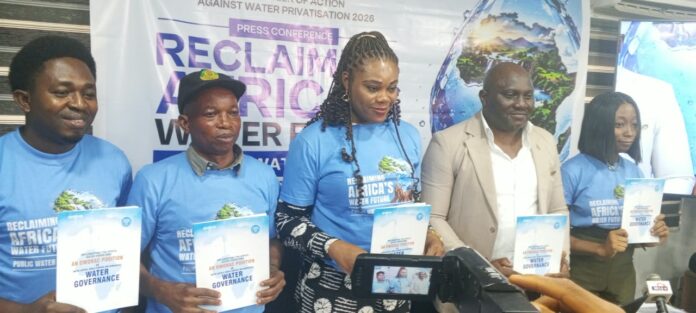
The coalition made its position known during the 2026 Africa Week of Action Against Privatisation, themed “Reclaiming Africa’s Future: Public Water for All,” where it called on African governments to strengthen publicly funded water systems and protect communities from profit driven water management.
The event, held in Lagos attracted activists across the globe who physically attended the event or joined virtually.
Reading the coalition’s press statement, Geoffrey Occansey of Water Citizens Network/Revenue Mobilisation Africa, Ghana, said OWORAC had developed a position paper titled Implementing the Africa Water Vision 2063: An OWORAC Coalition Position on Water Justice, Public Financing and Democratic Water Governance.
According to the statement, the document examines opportunities and gaps in implementing the Africa Water Vision 2063 and proposes measures to ensure water governance is anchored in human rights, adequate public financing, accountability and community participation.
The coalition urged African governments to prioritise universal access to safe, affordable and reliable water and sanitation, establish measurable national and regional financing commitments, and adequately fund public water institutions and utilities.
It also demanded transparency in water related contracts, financing arrangements, tariffs, allocations and expenditure, alongside meaningful participation by communities, workers, women and other affected groups in decisions concerning water resources.
OWORAC called on governments to reject privatisation, commercialisation, concessions, public private partnerships, outsourcing and prepaid water metering systems that transfer control or delivery of public water services to commercial interests.
Speaking at the event, Akinbode Oluwafemi, Executive Director of Corporate Accountability and Public Participation Africa (CAPPA), warned that commercial control of water was increasingly threatening people’s rights across the continent.
“Water is a human right. None of us can live without water,” Oluwafemi said, arguing that restricting access based on people’s ability to pay effectively denies poorer households their right to life.
He called on the African Union and national governments to formulate policies that protect citizens rather than prioritise corporate interests.
“Our government has a responsibility of providing clean, accessible water for domestic use,” he said, urging authorities to put the public interest ahead of corporations seeking profits from essential services.
Oluwafemi also expressed concern about shrinking civic space, saying governments should allow communities and civil society organisations to organise and challenge policies that threaten their access to water.
In Kenya, Amina Maina, National Coordinator of the Biodiversity and Biosafety Association of Kenya, raised concerns about the introduction of smart water meters, particularly their affordability, privacy implications and potential to increase costs for households and communities.
She explained that some systems require mobile payments and continuous monitoring, while installation and maintenance costs can be significantly higher than those of traditional mechanical meters.
Maina further warned that frequent collection of household water consumption data could expose users to privacy risks, while connectivity failures, cybersecurity vulnerabilities and specialised maintenance requirements could create additional challenges.
She questioned whether smart metering genuinely improves water management or simply introduces additional costs and controls over access to water.
From Senegal, Oumar Ba, General Secretary of the Autonomous Union of Water Workers of Senegal, described the country’s experience with private water management as evidence of the challenges associated with commercialisation.
Ba said multinational companies operating under Senegal’s privatised water management system generate profits while communities continue to face high bills, poor service quality and inadequate water supply, particularly during the summer months.
He also raised concerns about plans to introduce smart meters that could eventually support prepaid water systems, under which supply would automatically stop once a customer’s purchased allocation had been exhausted.
“This is a clear example of an inhuman form of capitalism taken to the extreme, one that treats water as a commodity rather than as a common good that is essential to life,” Ba said.
He called for publicly accountable water systems that adequately serve communities and protect workers’ rights.
Joseph Rahall, Executive Director of Green Scenery in Sierra Leone, also called for robustly funded and democratically controlled public water systems, warning that commercial interests could drive up tariffs and exclude vulnerable communities.
Meanwhile, Neil Gupta, Research Director at Corporate Accountability, said multinational water companies, including Veolia and Suez, had continued pursuing control of water systems across Africa, with backing from international institutions.
He cited concerns over unaffordable bills, labour abuses and environmental damage associated with privatisation.
Similarly, Comrade Rufus Olusesan, National President of the Precision, Electrical and Related Equipment Senior Staff Association, criticised water privatisation in Nigeria, citing inadequate access to piped water in Lagos despite substantial public spending on water infrastructure.
He argued that privatisation prioritises profit over public needs and urged the government to complete existing water projects, expand supply networks and establish democratic oversight involving communities, labour unions and civil society groups.
“Water is life. Let’s take it back now or never,” Olusesan said.
The coalition called for stronger solidarity among African water justice movements and urged governments to ensure that water remains a publicly accountable service accessible to everyone, regardless of income.
OWORAC maintained that Africa’s water future must be built on equitable access, democratic participation, transparency and adequately financed public institutions, rather than systems that make access to water dependent on people’s ability to pay.