



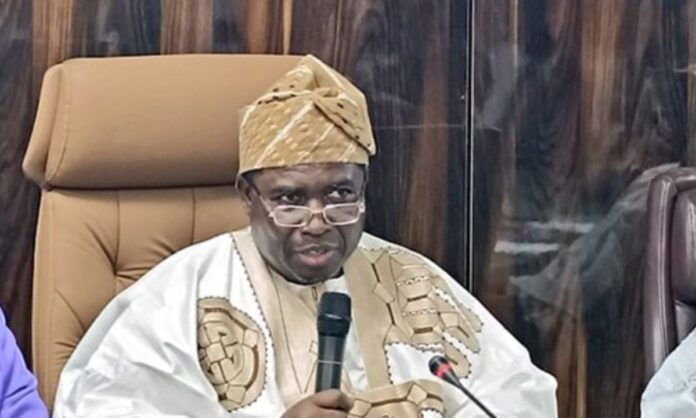
INEC chairman Amupitan vows zero tolerance for campaign violence, hate speech
The Independent National Electoral Commission (INEC) has warned political parties, candidates and campaign managers against violence, intimidation and hate speech ahead of the 2027 general elections.
INEC Chairman, Prof. Joash O. Amupitan, SAN, issued the warning on Monday in Abuja while delivering a keynote address at a strategic workshop for editors organised by the Nigerian Guild of Editors (NGE) in collaboration with the commission.
Amupitan said INEC would not allow political competition to degenerate into violence or inflammatory rhetoric as electioneering intensifies across the country.
“As electioneering intensifies across the country, I must sound a clear note of warning to all political parties, candidates, and campaign managers: INEC will not stand by and allow political competition to devolve into violence, intimidation, or inflammatory rhetoric,” he said.
“Democracy thrives on the clash of ideas, not the clash of weapons or the proliferation of hate speech.”
The INEC chairman said the commission, through the Inter-Agency Consultative Committee on Election Security (ICCES), had activated an early-warning framework to monitor political violence, thuggery and dangerous campaign rhetoric.
He warned that political parties or candidates found responsible for inciting violence, disrupting opponents’ rallies or using armed thugs would face sanctions.
“Through the Inter-Agency Consultative Committee on Election Security (ICCES), we have activated an early-warning tracking framework to log incidents of political violence, thuggery, and dangerous campaign rhetoric,” Amupitan said.
“Any political party or candidate implicated in inciting violence, disrupting rivals’ rallies, or deploying armed thugs will face direct statutory sanctions and swift prosecution.”
He added, “No political office in this country is worth the blood of a single Nigerian.”
Amupitan also urged editors and newsrooms to play a critical role in preventing misinformation and disinformation from destabilising the electoral process.
According to him, deepfakes, manipulated audio-visual content, coordinated fake news campaigns and premature declarations of results could trigger unrest, threaten electoral officials and undermine confidence in elections.
“When fake news spreads, it does not merely damage INEC’s reputation; it attacks the democratic fabric of our nation,” he said.
He called on editors to insist on rigorous fact-checking, reject sensationalised clickbait and verify unconfirmed reports through official channels before publication.
“Editors must insist on rigorous fact-checking, reject sensationalised clickbait, and cross-check unverified field rumours with our official channels before hitting the publish button,” he said.
The INEC chairman said the commission remained committed to working with the media and civil society organisations to strengthen public confidence in the electoral process.
He said INEC would provide editors with direct access to verify incidents, logistical updates and security reports in real time as part of a proposed three-point operational compact with the NGE.
The commission, he added, would also work with election security agencies to ensure accredited journalists and media workers receive unhindered access and security protection at polling units and collation centres.
Amupitan further disclosed that INEC and the NGE would establish a periodic feedback mechanism to review operational progress, address emerging concerns and maintain communication ahead of the 2027 elections.
“On our part, INEC remains an open book. We pledge to maintain a proactive relationship with the media and CSOs. We will provide timely information to prevent the vacuum that “fake news” often fills. Our doors are open for verification, for critique, and for collaboration,” he said.
The chairman said the commission had also taken steps to strengthen its technological systems and electoral preparations ahead of the 2027 polls.
He disclosed that the commission had acquired 57,000 new Bimodal Voter Accreditation System (BVAS) devices and introduced technological enhancements to strengthen accreditation and result transmission.
Amupitan said INEC had successfully completed eight of the 14 major statutory activities contained in its revised timetable for the 2027 general election and was advancing towards the ninth milestone.
He also announced that nationwide collection of Permanent Voters’ Cards (PVCs) would commence on Friday, October 9, 2026.
“More importantly, I am using this high-level forum of editors to officially remind the Nigerian public that the nationwide collection of Permanent Voters’ Cards (PVCs) will commence in exactly four days, on Friday, 9th October 2026,” he said.
According to him, Nigeria’s National Register of Voters now stands at over 103 million following the conclusion of the three-phase Continuous Voter Registration exercise and the final biometric cleanup.
Amupitan said the commission remained committed to conducting a free, fair, transparent and credible election, insisting that INEC had no preferred candidate or political party.
“As the Chairman of the Independent National Electoral Commission, my commitment to Nigeria is firm: our allegiance is to the Constitution and the law, and our sole obligation is to the Nigerian electorate,” he said.
“We have no preferred candidate, no preferred political party, and no agenda other than guaranteeing a free, fair, transparent, and credible election.”
The 2027 presidential and National Assembly elections are scheduled for January 16, 2027, while the governorship and State Houses of Assembly elections will hold on February 6, 2027.


 has warned political parties, candidates and campaign managers against)