



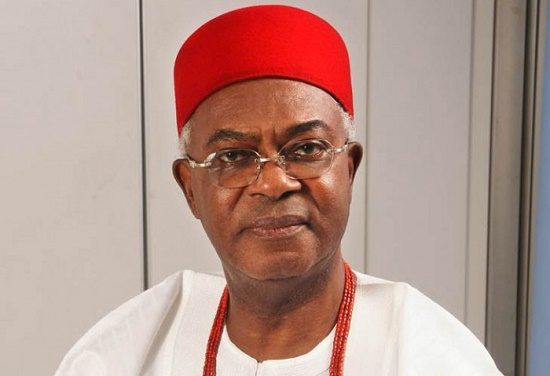
Obi of Onitsha: Editors must be ‘last man standing’ in defence of democracy
Obi of Onitsha, Igwe Nnaemeka Alfred Achebe, has urged Nigerian editors to remain the last line of defence for democracy, urging them to resist political pressure and prioritise truth over speed in reporting elections.
Achebe warned that artificial intelligence (AI)-generated disinformation poses a growing threat to Nigeria’s electoral process, saying the media must protect citizens from deception and ensure voters make informed decisions.
The traditional ruler made the call on Thursday while delivering the opening speech at the 2026 All Nigeria Editors Conference (ANEC) in Enugu State.
The conference, organised by the Nigerian Guild of Editors, has the theme, “The Ballot, the Media and the Task of Keeping Democracy Alive,” and the subtheme, “When Lies Look Real: Detecting and Debunking AI Disinformation Before, During and After Elections.”
Achebe urged journalists to uphold their professional responsibilities regardless of political interests, insisting that the media must remain committed to democracy even when politicians, electoral bodies and other institutions fail.
“Even if politicians, electoral body, institutions, and other things fail, you must be the ultimate last man standing in the task of defending democracy,” he said.
He described democracy as a process that required constant protection, warning that its survival could not be taken for granted.
“Democracy is not a monument we erect and then walk away from. It is more like a fire lit to keep the house warm. It must be tended, fed, protected from wind and rain, or it dies quietly in the night while everyone believes it still burns,” the monarch said.
Achebe said the media played a critical role in ensuring that citizens exercised their electoral rights based on accurate information rather than fabricated narratives.
“The ballot box, in this sense, is not an import grafted onto our soil. It is a modern vessel for an old African value, which states that legitimate power flows from the consent, the voice, and the informed judgment of the people,” he said.
“But consent is only be meaningful if it is informed. And this is where you, the editors of this nation, become not merely chroniclers of democracy but its guardians also.”
The monarch warned that AI technology had made it possible to create convincing fake videos, images and audio recordings capable of misleading voters and inflaming political tensions.
He said fabricated content could falsely portray political candidates and public officials as making statements or engaging in activities that never occurred.
“Today, falsehood can be manufactured by machines in seconds, with a persuasiveness that mimics truth so precisely that even trained eyes struggle to tell the difference,” Achebe said.
“A voice that sounds exactly like a governor can now say something that the governor never said. A video can show a candidate in a place he never was, an image can depict violence that never occurred, timed precisely to inflame passions on the eve of an election.”
According to him, the danger was already evident in Nigeria’s information environment, particularly on social media and messaging platforms.
“This is no longer a hypothetical danger for some distant future. It is here, now, in our elections, in our WhatsApp groups, on our social timelines,” he said.
Achebe noted that Nigeria’s social and community networks, which traditionally promote trust and cohesion, could also facilitate the rapid spread of disinformation.
He said people were often more willing to believe information received from relatives, neighbours and community groups than from unfamiliar sources.
“The same social fabric that has made resilience can now become the very medium through which falsehood spreads fastest, precisely because we trust the neighbour, the town union, the family WhatsApp group, more than we trust a stranger,” the monarch said.
The traditional ruler outlined three major responsibilities for editors in tackling AI-generated disinformation, identifying verification before speed, media literacy and professional courage as essential to protecting the public.
On verification, Achebe said journalists must resist the pressure to break news first at the expense of accuracy.
“In the old order, being first with the news was honour. In this new order, being first with a lie dressed as news is a betrayal of the public trust, however unintentional,” he said.
He urged editors to be cautious about information that appeared deliberately timed to influence public opinion, especially during election campaigns.
“You must become, individually and institutionally, sceptical of anything too perfectly damning, too conveniently timed to be shared before it is checked,” Achebe said.
“The discipline of pausing, of asking ‘how do I know this is true?’ must become as instinctive to rush to publish once was.”
On media literacy, he urged journalists to develop the technical knowledge required to identify manipulated content and educate citizens on how to recognise disinformation.
Achebe said editors must be able to detect signs such as unnatural synthetic voices, inconsistent shadows in fabricated images and coordinated online accounts spreading false information.
He stressed that journalists should extend such knowledge to ordinary Nigerians, including traders and students, to help them develop the ability to question suspicious information without becoming distrustful of everything.
“But detection alone is not enough. You must also become teachers, helping ordinary citizens, from the market woman in Onitsha to the undergraduate in Nsukka, to develop their own instincts for scepticism, without curdling that scepticism into a cynicism that trusts nothing at all,” he said.
“We must note that a citizenry that believes everything is as dangerous as one that believes nothing.”
The monarch also urged journalists to demonstrate courage by correcting false information irrespective of the political interests it serves.
He said media professionals must be prepared to debunk falsehoods even when doing so could disadvantage their preferred political parties or candidates.
“Debunking a lie that flatters your own political camp is far harder than debunking one that flatters your rival,” Achebe said.
“True journalistic integrity in this era will require you to correct falsehoods regardless of who benefits from them, before, during, and yes, after elections, when the temptation to let a convenient narrative stand unchallenged is often strongest.”
Achebe acknowledged the economic challenges, political intimidation and pressures facing Nigerian journalists, expressing confidence in the profession’s ability to confront the new threats to democracy.
He said the media had historically played a significant role in Nigeria’s development, including exposing colonial injustice, advancing independence and documenting the country’s challenges and achievements.
“I do not say these things to judge you, for I know the pressures under which Nigerian journalism operates, including the economic precarity, the political intimidation, the sheer velocity of the information environment you must navigate daily.
“I say them because I believe in you,” he said.
The monarch urged the conference to move beyond speeches and communiqués and develop practical measures to combat disinformation and protect the country’s democratic process.
“Let this conference, then, not just speeches and communiqués, but a genuine council of war against the erosion of truth in our public life,” Achebe said.
“Let Enugu, a city that has known its own share of history’s turbulence and resilience, be remembered as the place where Nigeria’s editors resolved to defend the ballot from the lie, and the citizen from deception dressed as fact.”
Achebe, who said he had witnessed Nigeria’s journey from independence through military rule to democratic governance, noted that the country’s democratic project remained unfinished and required the collective responsibility of citizens and institutions.
He also drew parallels between traditional governance in Igbo communities and democratic principles, saying consultation, dialogue and community participation had long been part of the region’s political traditions.
“In our Igbo tradition, the Obi does not rule by decree. He rules in council, in dialogue, in the constant testing of truth against the wisdom of elders and the voice of the people,” he said.
“Igbo democratic instinct is ancient. Even kingship here has always been checked by community, by consultation, by honest speech.”
The monarch thanked the Nigerian Guild of Editors for inviting him to chair the conference and commended journalists for their contributions to the country.
He also acknowledged the sacrifices and challenges faced by members of the media, praying for their continued success and safety.
Achebe concluded by urging editors to remain steadfast in defending democracy amid political campaigns, electioneering and partisanship.
He said the media must continue to uphold truth and protect the public interest, while wishing delegates safe journeys and renewed commitment to journalism.


