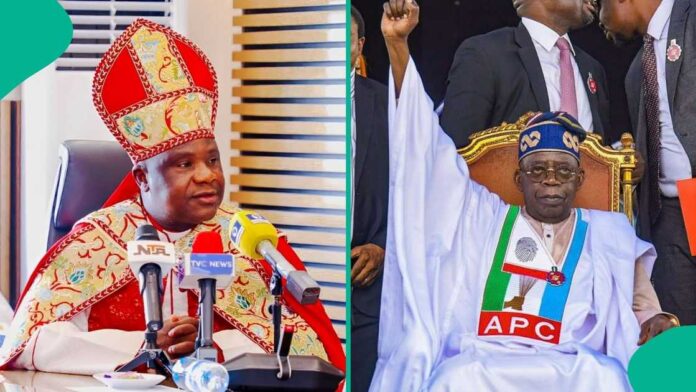
When the pulpit becomes political currency
By David Nzekwu
The most dangerous moment for a religious institution is not necessarily when political power attacks it. It may be when political power embraces it so warmly that the institution forgets why it exists. Persecution can clarify conviction; patronage often dissolves it. The church rarely loses its moral authority in one dramatic surrender. More often, it trades that authority away gradually – one invitation, one title, one endorsement and one photograph with power at a time.
That is why the decision of the Charismatic Bishops Conference of Nigeria to endorse President Bola Ahmed Tinubu for re-election in 2027 deserves more than partisan applause or outrage. At its 2026 synod at the National Christian Centre in Abuja, held alongside the International Communion of Charismatic Archbishops, Bishops and Apostles, the conference did not merely pray for the President or urge the government to govern justly. Its President-General, Archbishop Leonard Bature Kawas, declared that the bishops would stand with Tinubu even beyond 2027 and announced the conference’s support for a second term.
A president is entitled to seek re-election. Citizens and organisations are entitled to support him. Religious leaders do not surrender their civic rights when they enter the pulpit. Yet a profound difference exists between a cleric expressing a personal political preference and a gathering of bishops placing collective spiritual authority behind an officeholder. The first is citizenship. The second risks turning a blessing into a campaign instrument.
The reasons reportedly offered for the endorsement make the problem more troubling. The President was praised for supporting the emergence of Christian governors, for his party’s elevation of a born-again Christian and preacher to national leadership, and for the First Lady’s visible faith. These may carry symbolic meaning for some believers, but symbolism is not governance. The number of Christians close to power does not tell a struggling family whether food has become affordable. It does not tell a frightened community whether it is safer, a patient whether a hospital works, or a child whether a public school can provide a meaningful education.
Governments should be judged by what they do for citizens, not by the denominational identities of those admitted into their inner circles. Once religious representation becomes a substitute for public performance, faith is reduced to patronage and citizenship to sectarian arithmetic. The crucial questions disappear: Are Nigerians safer? Are institutions stronger? Is opportunity expanding? Is public money being used responsibly? In their place comes a smaller, more convenient question: Are people like us sufficiently close to power?
That is a poor question for democracy and an even poorer one for the church.
Max Weber’s idea of charismatic authority helps explain the attraction. Charismatic authority rests less on rules or institutions than on the exceptional qualities followers attribute to an individual. It can animate communities and inspire sacrifice, but it is also unstable and resistant to accountability. Nigeria’s religious and political cultures are deeply familiar with this form of power. The celebrated preacher commands loyalty through anointing, testimony and personal magnetism. The political leader commands it through spectacle, symbolism and the aura of indispensability.
When these two charismatic systems meet, they should not automatically validate each other. The pulpit ought to remind the podium that power is temporary, stewardship is measurable and every leader remains answerable to moral law and the people. Politics, for its part, should protect the freedom of religion without purchasing religious approval. In Abuja, however, the two forms of charisma appeared to enter a closed circuit: spiritual prestige offered political legitimacy, while political access offered religious leaders visibility and influence. The politician acquired a borrowed halo; the bishops gained proximity to the state.
The citizen, whose welfare should be central to both public morality and democratic debate, was pushed to the edge of the picture.
This is why the issue is not whether Christians may participate in politics. They should. Faith that says nothing about justice, poverty, violence, corruption, and human dignity is merely private sentiment dressed in sacred language. Nigeria needs religious leaders who can challenge cruelty, defend the vulnerable, demand honest government and help citizens resist hatred. The church does not need to be apolitical to be prophetic. But prophecy is not the same as partisanship, and access is not the same as influence.
A prophetic church speaks truth to power whether the occupant of office is friend or foe. A partisan church adjusts its moral vocabulary to protect its preferred candidate. A prophetic leader can pray for a president while questioning his policies. A partisan leader mistakes proximity for progress and ceremonial recognition for national renewal. The difference lies not in whether the church enters public life, but in what it carries into that life: an independent conscience or a negotiable endorsement.
The Christian tradition itself offers a demanding standard. Jesus rejected the conversion of spiritual mission into worldly domination, declaring that his kingdom was not of this world. The earliest Christian witness did not depend on imperial patronage for its authority. It spoke from a moral distance that made both service and rebuke possible. That distance was not withdrawal; it was freedom. It allowed the church to minister to rulers without becoming their ornament and to serve society without becoming captive to the state.
Once that distance collapses, accountability collapses with it. A church that has publicly invested its prestige in a political leader will struggle to confront that leader’s failures without admitting its own misjudgment. The endorsement creates a moral debt. Silence then becomes easier than criticism, flattery safer than truth. What begins as access ends as self-censorship.
The political class understands this bargain. It has learned that a religious platform can deliver what an ordinary rally cannot: the suggestion that political preference carries divine approval. The language of testimony replaces the discipline of evidence. Loyalty is presented as faithfulness. Dissent begins to look like disobedience. The voter is no longer merely asked to assess a candidate; he is subtly invited to regard the candidate as heaven’s choice.
That is unfair to voters, dangerous for politicians and corrosive to faith. No endorsement delivered at a synod can replace the verdict of citizens at the ballot box. No clerical title can exempt an administration from scrutiny. And no politician benefits in the long run from being surrounded by religious figures who bless more readily than they question. Leaders insulated from uncomfortable truth eventually become prisoners of praise.
The confusion that followed the Abuja event also reveals the fragility of religious representation. The Catholic Bishops’ Conference of Nigeria reportedly moved to distinguish itself from the similarly named charismatic body. The clarification mattered because public authority often depends on who can plausibly claim to speak for whom. Nigeria’s Christian population is vast and diverse. No conference, however grand its titles or extensive its claimed network, owns the political conscience of believers. Bishops may endorse; Christians may disagree. Spiritual office does not transfer the citizen’s vote.
Nor is this episode an isolated lapse. Religious intervention in Nigerian politics has long moved between moral advocacy, sectional calculation and outright political alignment. What appears different now is the openness of the exchange. Arguments once framed around national balance are increasingly expressed as an inventory of access gained and loyalty owed. When such conduct is cheered, televised and repeated, it hardens into a system. Future politicians learn that religious endorsement can be cultivated. Future clerics learn that collective blessing can purchase relevance.
Systems reproduce the incentives that sustain them. Soon, every government seeks its choir of clerical validators, while every ambitious religious platform seeks its route to the presidential villa. The public square becomes crowded with titles but empty of moral courage.
The cost is borne by ordinary Nigerians. Citizens already live with too many institutions governed by relationships rather than rules. They see contracts influenced by connections, justice delayed by status and opportunity rationed through proximity. If the church mirrors this culture instead of challenging it, it forfeits the very distinction on which its public credibility rests. A lobbying organisation may negotiate access. A church must answer to a higher obligation.
Nigeria still has religious leaders whose authority was earned through sacrifice, service and principled consistency. Their voices matter precisely because they are not easily recruited into anyone’s campaign. They understand that moral influence grows from independence, not intimacy with power. This is the moment for them to insist that the church’s public role is to illuminate conscience, not instruct ballots; to assess power, not adorn it; and to defend citizens, not secure privileged access for clerics.
The remedy is not silence. It is principled engagement. Religious bodies can publish non-partisan assessments of government performance. They can convene candidates for serious debate, educate voters, monitor elections, resist violence and advocate policies that protect human dignity. They can pray for leaders without campaigning for them and meet public officials without becoming their public-relations machinery. Most importantly, they can apply the same moral standard to every party and every officeholder.
The pulpit’s authority is strongest when no politician can take it for granted. Its blessing should comfort the afflicted, not decorate the powerful. Its voice should be free enough to commend what is right today and condemn what is wrong tomorrow, without consulting yesterday’s endorsement.
Political power is temporary. The church’s moral witness is meant to outlast every administration. To exchange that inheritance for proximity is a remarkably poor bargain. Once the pulpit turns charisma into political currency, it may discover that the transaction enriched the politician while impoverishing the church.
A blessing that can be bought is no longer a blessing. It is currency. And every currency loses value when those entrusted with it keep printing more.
- Dr. David Nzekwu, Guest Columnist, is a public affairs analyst and political commentator.
- Note: Dr. Dakuku Peterside returns to this column, LEADERSHIP NOTES, next week.