Imo LG Elections: When autonomy exists on paper but political control remains
By Okechukwu Nwanguma
I had just finished reading a report in THISDAY Newspaper titled “26 Months After Judgement, Governors Continue to Strangle LGs, Fuelling Insecurity,” in which my views on the continuing failure to achieve genuine local government autonomy in Nigeria were reflected. The report examined the troubling reality that, more than two years after the landmark Supreme Court judgment of July 2024, local governments remain substantially under the political and financial influence of state governors.
Barely minutes after reading the report, I received two materials concerning the forthcoming local government elections in my home state, Imo.
The timing and contents of those materials immediately struck me because they appeared to provide a practical illustration of some of the very concerns I had expressed to THISDAY.
The first was the announcement by the Imo State Independent Electoral Commission (ISIEC) confirming that elections into the 27 Local Government Area chairmanship positions and 305 ward councillorship seats would hold on September 26, 2026. ISIEC says the date follows a 360-day Notice of Election issued on September 18, 2025, although the public confirmation has come only about two weeks before polling.
The second was an apparently undated document from the Office of the Governor, signed by the Chief Political Adviser, announcing the Governor’s approval of the appointment of 27 Local Government Prosperity Coordinators and 305 Ward Prosperity Officers.
I was immediately prompted to put down my thoughts about what I consider the implications of these two developments when viewed against the wider crisis of local government autonomy in Nigeria.
The numbers immediately invite questions
Imo State has 27 local government areas and 305 electoral wards.
ISIEC is preparing to conduct elections for 27 chairmanship positions and 305 councillorship seats.
At about the same time, an official document from the political arm of the Governor’s office announces 27 Local Government Prosperity Coordinators and 305 Ward Prosperity Officers.
The numerical correspondence is exact.
That, by itself, is not evidence of electoral wrongdoing, and it would be irresponsible to make allegations unsupported by evidence.
But it is certainly sufficient to raise legitimate questions.
What exactly are the functions of these Prosperity Coordinators and Officers?
When were they appointed? Why is the document apparently undated?
Are they employees or political appointees of the state government and, if so, are their salaries and activities funded from public resources?
Why is a political structure emanating from the Governor’s office organised in precisely the same 27-LGA/305-ward configuration as the electoral structure over which ISIEC is about to conduct elections?
And, crucially, what role, if any, are these coordinators and officers expected to play before, during or after the September 26 local government elections?
The Imo State Government owes citizens straightforward answers.
This goes to the heart of the THISDAY report
The significance of these questions becomes clearer when placed against the issues raised in the THISDAY report.
The report records that, 26 months after the Supreme Court judgment, genuine local government autonomy remains elusive. NULGE told THISDAY that no local government currently receives its allocation directly from the Federation Account. Contributors to the report also identified the continuing influence of governors over local government finances, administration and elections as a fundamental obstacle to autonomy.
My position quoted in that report was that merely replacing caretaker chairmen with persons bearing the title of “elected chairman” does not necessarily produce democratic local government.
That remains my position.
There may be elected chairmen everywhere today, but the critical question is: how were they elected, and to whom are they ultimately accountable?
If a governor substantially controls the political machinery through which candidates emerge, while an electoral commission constituted at state level conducts elections that routinely deliver overwhelming victories to the governor’s party, we may have satisfied the outward requirement for elections without achieving genuine political autonomy.
The missing dimension of local government autonomy
Much of the national debate since the Supreme Court judgment has concentrated on money.
That is understandable. The July 2024 judgment was a historic intervention against the diversion and control of local government funds by state governments. The Supreme Court also reinforced the constitutional requirement for democratically elected councils.
But financial autonomy without political autonomy is inherently fragile.
Imagine that tomorrow every naira belonging to Imo’s 27 local governments begins travelling directly from the Federation Account into individual council accounts.
That would be progress.
But suppose the chairmen controlling those accounts owe their emergence primarily to the governor and the ruling political machinery rather than to genuinely competitive elections?
What meaningful autonomy would have been achieved?
We would simply have changed the route through which political control operates.
A local government chairman who owes his office to a political benefactor will find it extremely difficult to exercise genuine independence from that benefactor.
This is why I believe Nigeria must begin talking not only about financial autonomy, but also about electoral, political, administrative and institutional autonomy.
Elections must be more than ceremonies
This brings us back to Imo.
ISIEC says elections will hold on September 26. It also says the date was contained in an earlier 360-day notice. Nevertheless, the proximity of the latest public announcement to the election has generated legitimate questions about political-party preparations, candidate selection and the opportunity for meaningful campaigning.
The test of the election will therefore not simply be whether polling materials arrive or whether results are eventually announced.
The test is whether there is genuine competition.
Can opposition parties participate freely and effectively?
Can candidates campaign without intimidation?
Will security agencies maintain neutrality?
Will accredited observers and journalists have meaningful access?
Will votes be transparently counted and results declared at the appropriate levels?
Most importantly, will the people of Imo be able to look at the final results and reasonably conclude that they, rather than Government House or any political machinery, chose their chairmen and councillors?
The danger of democratic dependency
There is a fundamental contradiction in calling a local government autonomous when its chairman remains politically dependent on the governor.
That contradiction goes beyond Imo. It is a structural weakness in Nigeria’s federal democracy.
State governments cannot simultaneously exercise decisive influence over who becomes chairman and then tell Nigerians that those councils are autonomous simply because elections have been conducted.
Political dependency inevitably compromises financial independence.
A chairman whose political survival depends upon the governor is unlikely to resist instructions concerning appointments, contracts, expenditure or political patronage merely because his council allocation now arrives directly.
This is precisely why the reform of local government elections must become part of the national conversation about autonomy.
And this has consequences for security
For those of us from Imo State, this debate is not academic.
We have witnessed the devastating consequences of insecurity across our communities.
Local governments ought to be the governmental institutions closest to those communities. They should understand emerging disputes, youth grievances, deteriorating infrastructure, unemployment, community tensions and other conditions capable of feeding insecurity.
They should support primary healthcare, local roads, markets, sanitation and community development. They should facilitate dialogue between government, traditional institutions, community organisations, young people and security agencies.
But local governments cannot effectively perform these functions when they are reduced to political appendages of state governments.
The THISDAY report appropriately connects the strangulation of local government with deteriorating grassroots development and insecurity.
Imo has an opportunity to prove the sceptics wrong
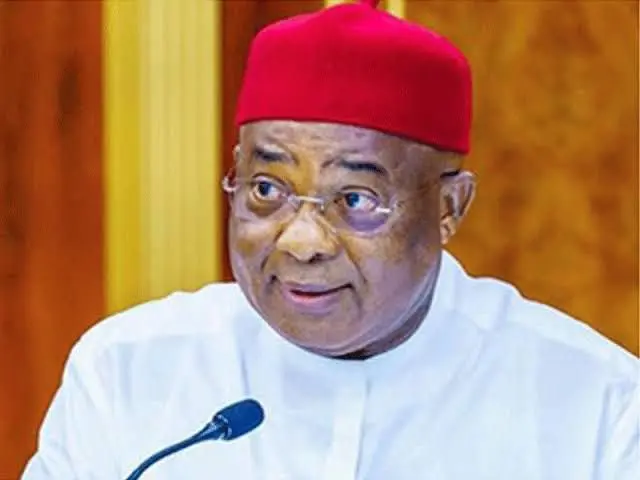
Governor Hope Uzodimma’s administration and ISIEC have an opportunity with the September 26 elections to demonstrate that Imo can conduct an exercise whose credibility does not depend upon which party wins.
The state government should start by explaining the 27 Local Government Prosperity Coordinators and 305 Ward Prosperity Officers.
There may well be an innocent and legitimate administrative explanation for the appointments. If so, it should be provided transparently.
But citizens also deserve categorical assurance that government-appointed political structures, personnel and public resources will not be deployed to confer electoral advantage on any political party or candidates.
ISIEC, for its part, must demonstrate through its conduct that it is an electoral commission for all Imo people, not an instrument of whichever political party controls Government House.
I have a stake in what happens
I raise these questions both as a human rights and accountability advocate and as an indigene of Imo State.
I want functional local governments in my state.
I want elected chairmen who understand that their authority comes from the people and who can, where necessary, respectfully disagree with the Governor in defence of the interests of their communities.
I want councillors whose primary constituency is the people who elected them, not political godfathers.
I want Imo’s local government allocations translated visibly into roads, primary healthcare, markets, sanitation, employment opportunities, community development and improved security.
And I want citizens to possess the real power to vote non-performing chairmen and councillors out of office.
That is democracy.
Twenty-six months after the Supreme Court judgment, we must resist the temptation to confuse elections with democracy or direct allocation with autonomy.
The real test of local government autonomy is not simply whether councils receive money directly.
It is whether citizens genuinely choose those who control that money and can hold them accountable for how they spend it.
The two materials that landed on my phone minutes after I read the THISDAY report therefore leave me with one overriding question:
Are we in Imo preparing to elect genuinely autonomous local governments, or are we merely perfecting a system in which councils are formally elected and financially autonomous on paper, while remaining politically beholden to the centre?
The answer will tell us whether the promise of the Supreme Court judgment is finally reaching the grassroots – or whether political control has simply found a new form.
Okechukwu Nwanguma is Executive Director of the Rule of Law and Accountability Advocacy Centre (RULAAC) and an indigene of Imo State.