



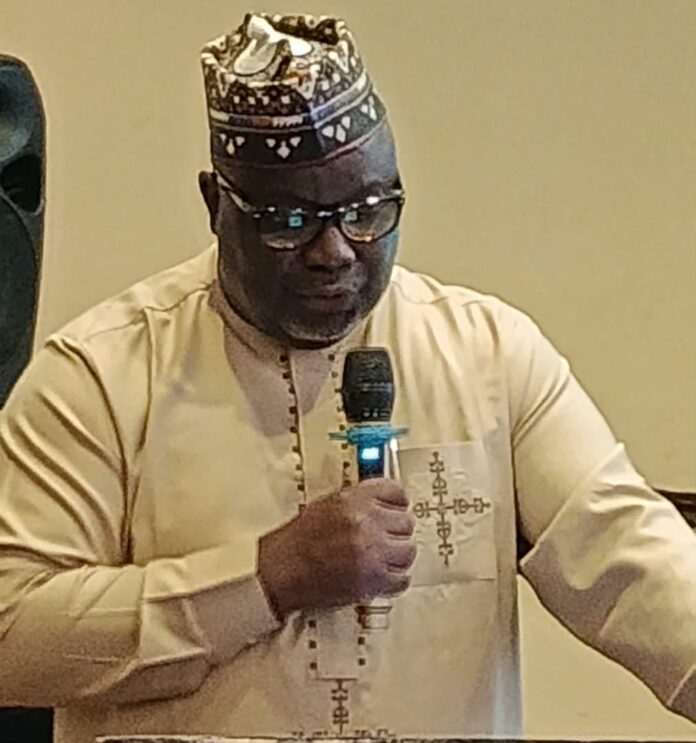
Without innovation, Nigeria’s ports risk losing global businesses, says Omole
By Uzor Odigbo
Nigeria risks losing a growing share of global maritime business if its ports fail to embrace innovation, digitalisation and cleaner technologies, the Managing Director, Ports Operations SBU, Dangote Industries Limited, Simeon Akin Omole, has warned.
He gave the warning while delivering the keynote address at the 2026 Maritime Training Summit and Awards of the Association of Maritime Journalists of Nigeria (AMJON) in Lagos, themed, “The Power of Innovation in a Future Maritime Industry.”
He said the future of the maritime industry would no longer be determined simply by the ability to move cargo, but by how fast, safely, efficiently, cleanly and intelligently ports and shipping operators could do so.
According to him, global shipping is already placing greater demands on ports, with vessels reaching about 400 metres in length, operators seeking turnaround times of less than 24 hours, regulators demanding zero incidents and customers expecting real-time visibility of their cargo.
“Tradition alone will not get us there. Innovation will,” he said.
Omole specifically warned that ports that fail to digitise their operations could become increasingly irrelevant as shipping moves towards artificial intelligence, automation and data-driven decision-making.
“Vessels will book berths with AI. Cargo will be cleared before it arrives. Turnaround time will be measured in hours, not days. Ports that digitise will win. Ports that don’t will be bypassed,” he said.
He said Nigeria must therefore begin preparing its ports and maritime infrastructure for the technologies and operational demands that will define the industry over the next decade.
He identified infrastructure, people and knowledge as three critical areas where innovation must be pursued.
Using the operations of the Dangote Refinery as an example, Omole said the company had to develop new solutions to operate its Single Point Mooring (SPM) complex, located 15 kilometres offshore and comprising five buoys for round-the-clock handling of Very Large Crude Carriers.
He said there had been no existing template in Nigeria for the operation, forcing the company to work with regulators to delineate the Lekki anchorage, mobilise high-bollard-pull tugs and develop marine safety protocols.
“Today that SPM has recorded over 1,100 tanker calls. That is innovation solving a problem that had no precedent,” he said.
Beyond infrastructure, Omole stressed the importance of developing indigenous maritime expertise, warning that Nigeria would continue to depend on foreign professionals if it failed to invest in the skills of its workforce.
“Technology is useless without competent people,” he said, adding that Dangote had invested in training indigenous Mooring Masters and crews to global SPM standards.
He recalled that the first crude vessel, MT OTIS, was berthed by Nigerians, describing the achievement as an example of what targeted investment in local maritime capacity could deliver.
“The future maritime workforce must be digital, safety-conscious, and commercially aware. If we don’t build them, we will import them,” Omole warned.
He also called for greater investment in maritime knowledge and data, noting that the industry must move beyond conventional practices to embrace port community systems, artificial intelligence for predicting vessel delays and alternative fuels for the next generation of ships.
Looking ahead, Omole said Nigeria must prepare for three major shifts in the maritime industry: the emergence of smart ports, the transition to greener shipping and the expansion of Africa’s maritime trade under the African Continental Free Trade Area (AfCFTA).
He said the ships calling at Nigerian ports in 2035 would increasingly rely on cleaner fuels and technologies, including LNG, methanol, ammonia and wind-assisted propulsion.
He warned that Nigeria could lose business if its terminals, tugs and bunkering infrastructure were not upgraded to accommodate the changing fleet.
On regional trade, Omole said AfCFTA presented an opportunity for Nigeria to emerge as a logistics gateway for West Africa, given its location and market size.
However, he said achieving that ambition would depend on the country’s ability to improve efficiency, reduce costs and strengthen maritime connectivity.
He acknowledged that innovation would require operators, regulators, financiers and other stakeholders to abandon some established processes and embrace new approaches.
But he said the alternative was a greater risk of losing relevance in a rapidly changing global industry.
Omole consequently urged the government to create regulatory sandboxes for emerging marine technologies and alternative fuels, while calling for greater investment in maritime academies and simulator training to global standards.
He also advocated stronger collaboration among regulators, terminal operators, shipping companies and academia, saying no single organisation could build the port of the future alone.
“The sea does not care about our history. It only responds to how well we prepare today,” Omole said.
He added that innovation could enable Nigerian ports to handle some of the world’s largest vessels, allow African operators to compete against global benchmarks and create a safer, faster and cleaner maritime industry for the next generation.


