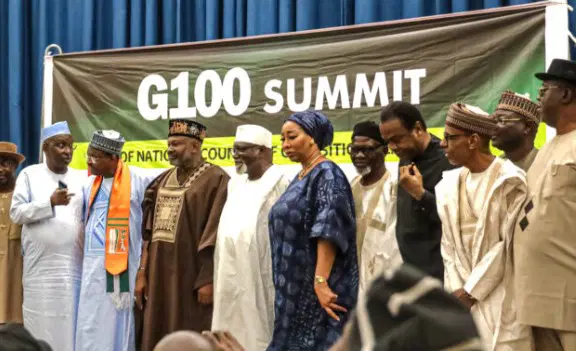
G-100: Opposition parties offer 4-year single term to stop Tinubu
Presidential candidates of the African Democratic Congress ADC, Alhaji Atiku Abubakar; his counterparts in the Nigeria Democratic Congress, NDC, Mr. Peter Obi; and Allied Peoples Movement APM and governor of Oyo State, Engr. Seyi Makinde, were absent as leaders of Nigeria’s six main opposition political parties converged in Abuja on Monday to firm-up coalition arrangements to beat President Bola Tinubu in the 2027 polls.
Although the three heavyweights were absent, the opposition summit was not short of presidential and vice-presidential candidates, with Prince Adewole Adebayo of the SDP, Donald Duke of Peoples Redemption Party, PRP, and the Allied Peoples Movement’s, APM, vice presidential candidate, Lawal Musa Daura, attending alongside National Working Committee, NWC, and some Board of Trustees, BoT, members of the participating parties.
Single four-year transition term
In his opening remarks delivered on behalf of the G-100, Mallam Salihu Lukman, proposed a Government of National Competence, GNC, anchored on a single four-year transition term, describing it as central to the broader framework being canvassed for opposition cooperation.
“The framework before you proposes something more demanding than a merger of ambitions: a Government of National Competence, built on competence, integrity, national inclusion, and fair representation of every party that contributes to the effort,” he said.
He added that such a government should be “secured by a political commitment to a single four-year term, written into an enforceable transition charter.”
Lukman stressed that any agreement reached at the summit must be binding, rather than symbolic, saying “we want to underline the word ‘enforceable.’
‘’This gathering does not need more sincerity. Nigerian politics has never suffered from a shortage of sincere promises. What it has suffered from is promises that nobody could enforce when the person who made them changed his/her mind.’’
He insisted that any resolution “must be written, witnessed, and have consequences.”
2023’s arithmetical lessons
Tracing the history of opposition politics in the Fourth Republic, Lukman recalled that the opposition contested the presidency divided in 2003, 2007 and 2011, but achieved victory in 2015 after parties agreed on rules of engagement, ahead of determining candidates.
He said discipline was abandoned in 2023 when opposition votes were split among candidates who jointly polled more than the eventual winner.
“The winner took just under nine million votes. One opposition candidate took close to seven million. Another took just over six million. Thirteen million votes on one side of the argument, under nine million on the other.
‘’The side with fewer votes formed the government, lawfully, constitutionally and entirely predictably,” he said, describing the outcome as self-inflicted, rather than the product of any conspiracy.
“Nobody stole thirteen million votes. We divided them ourselves in public, and we did it knowing exactly what the consequence would be,” he added.
Lukman cited similar precedents abroad, noting that a 39-year ruling party was removed in Kenya in 2002, and a 61-year coalition government ousted in Malaysia in 2018 by opposition forces that chose unity over fragmentation.
“In neither case did the opposition win because it had become more virtuous. It won because it had become one,” he said, describing the lesson as “arithmetical,” not moral.
On the architecture for cooperation, Lukman disclosed that three standing coalition bodies were being proposed: a Central Leadership Committee comprising national chairmen, national secretaries, and presidential and vice-presidential candidates, to provide political direction; a publicity and communication committee to co-ordinate joint messaging; and a legal committee to handle legal strategy and coalition-related advice, with the G-100 participating only as facilitators and observers.
He further disclosed that five working groups, each comprising one representative from every participating party, were to produce working papers within four weeks on a national covenant for democratic renewal, a single-term transition charter, a national reform programme, a framework for opposition unity, and a roadmap to a common presidential candidate, all to be presented to a second summit for adoption.
Lukman clarified that the summit was not asking any party to dissolve, merge or produce a presidential candidate on the day.
“It is not asking any party to dissolve. It is not asking any party to disappear into another party. It is not asking any candidate to stand down this morning. That question is not on the agenda of this summit, and any report that says otherwise will be wrong,” he said.
He explained that what was being sought was authorisation to build “the table” before negotiating “the seats” around it
Replicating APC’s 2015 success
Leading the Minority Caucus of the House of Representatives to the summit, its Leader, Fred Agbedi, urged opposition leaders to close ranks and replicate the electoral success recorded by the then-opposition All Progressives Congress APC in 2015.
He said the Minority Caucus had resolved to partner with the G-100 to help streamline the ambitions of opposition parties and pursue a collective victory in 2027. “In the spirit of creating a viable opposition and ensuring that we win collectively the 2027 election, the Minority Caucus of the House of Reps decided that we partner with the G-100 to see how opposition parties can come together, streamline our ambitions, and ensure that we take this government out,” he said.
Agbedi warned that Nigeria’s current leadership operates on the belief that “all is fair in politics,” and urged party leaders to note this disposition and act accordingly.
He appealed to opposition leaders to set aside personal ambitions for the collective good, cautioning that a fragmented opposition risked another outcome akin to 2023, when millions of votes cast for opposition candidates could not translate to victory because they were divided. “What will it benefit us when we are divided and scattered, and we go into an election, and we come back to collate the millions of votes we had divided amongst ourselves that could not give us victory? It will be like an exercise in futility, and we pray that we shouldn’t in 2027 go back to that,” he said.
I’m ready to forgo my ambition – Duke
Presidential candidate of the PRP, Donald Duke, said he is ready to forego his ambition and work with any candidate jointly agreed on by all the participating parties.
According to him, experience has shown that the ego of political leaders often stood in the way of victory for the opposition.
He said all leaders must put their egos aside and work together, adding that “if we think we can go it all alone, then we will fail.’’
National chairmen weigh in
Speaking on behalf of the ADC, its National Vice Chairman for the South-South, Usani Uguru Usani, who led some NWC members to the summit, expressed confidence that the coalition will succeed, arguing that the opposition’s judgment today was informed by actual performance indices, rather than speculation, unlike in 2023.
He, however, cautioned against internal strife among opposition ranks, saying “there is something that is happening among the opposition people or party. We seem to be attacking ourselves much more than we attack a common enemy, which is not correct.’’
Historic development
APM National Chairman, Yusuf Mamman Dantalle, described the summit as a historic development in Nigeria’s political history, urging party leaders to look beyond individual and party interests. “For us to achieve this will be remembered for what we do today, that we have the opportunity, or what we refuse to do today, that we have the opportunity,” he said, pledging his party’s full commitment to “the project Nigeria.”
Representing the Tanimu Turaki-led faction of the PDP, its Board of Trustees, BoT, Secretary, Dr Babangida Aliyu, commended the G-100 for an initiative, he said, had long been missing from Nigeria’s political process, blaming personal ambition and pecuniary interest for the country’s governance challenges.
He called for similar cooperation meetings to be replicated at state and local government levels to sustain momentum.
“We are not here to pick or nominate or tell other parties not to run. Now we are going to lay the foundation that when the time comes, we should be able to say this is the way to go,” he said.
PRP National Chairman, Dr. Hakeem Baba-Ahmed, described the summit as historic, and urged the presidential and vice-presidential candidates in attendance to recognise the weight of national expectation on them.
“Look back, see how serious Nigerians are watching this, because two things are going on right now,” he said, adding that all six parties represented at the summit are facing what he called “an existential threat” through litigation but pledged that the coalition would press on.
“Our back is against the wall but we’ll fight back. In 2027, we will together remove this government and put the Nigerian nation on a different trajectory,” he said.
Nigerians ready for good governance
SDP National Chairman, Prof. Sadiq Gombe, said the Nigerian electorate had consistently demonstrated readiness to vote for good governance, citing the 2023 presidential election where he said the three leading opposition candidates jointly polled about two-thirds of total votes cast,.
He noted that in Osun State election, the ruling party’s heavy deployment of security and financial resources failed to sway the outcome.
He pledged his party’s commitment to the coalition process, “irrespective of whatever,” while calling on sister parties to remain consistent with prior unity accords.
NDC National Chairman, Senator Moses Cleopas Zuwoghe, in his brief remarks on behalf of his party and its presidential candidate, commended organisers of the summit and affirmed his party’s support for the coalition-building process, describing it as necessary at a time he said the country is “in a comatose” state under the current leadership.
“It is a good thing when opposition political parties that are not pretending, but convinced that our country is comatose… think through and establish a pathway to rescue this nation,” he said.
Communiqué
At the end of deliberations, the six parties adopted a joint communiqué in which they agreed to commit to a structured process of negotiation on the framework for opposition cooperation ahead of 2027, and formally established the central leadership committee; publicity and communication committee; and legal committee.
They also resolved to constitute the five working groups mandated to produce, within four weeks, the National Covenant for Democratic Renewal, the Single-Term Transition Charter, the National Reform Programme, the Framework for Opposition Unity, and the Roadmap to a Common Presidential Candidate, ahead of a Second Summit whose date and venue are to be confirmed by the Central Leadership Committee.
The communiqué further called on the government of the United States of America to ensure the timely and lawful disclosure of all non-exempt official records concerning President Bola Ahmed Tinubu that bore on legitimate public interest.
The parties resolved to formally communicate this position to the ECOWAS Commission, and confirmed that the G-100 will continue to serve strictly as facilitator and observer without substituting itself for the authority of the political parties.
Atiku explains absence, denies boycotting parley
Meanwhile, Alhaji Atiku Abubakar late yesterday denied boycotting the summit, explaining that his absence from the parley was unavoidable and didn’t in any way reflect a lack of commitment to the coalition-building process being championed by the G-100.
Senior Special Assistant on Public Communication to the former vice president, Phrank Shaibu, gave the clarification when Vanguard asked if Atiku stayed away from the summit deliberately.
“No. Not at all. His Excellency Atiku Abubakar’s absence was unavoidable and should not be misconstrued as a boycott.
‘’He fully supports the objective of the G100 and remains committed to building a united, credible opposition capable of defeating the APC in 2027,” Shaibu said.
What happened in Osun should make political parties rethink their strategies ahead of 2027. The APC had federal backing and influential political figures, yet Adeleke prevailed. To me, this shows that national political strength does not necessarily translate into votes at the grassroots. Voters can make independent choices based on performance, local issues and trust.
- Vanguard