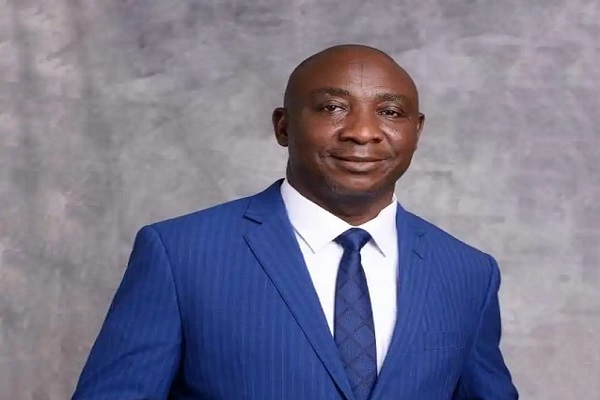
Gusau’s resignation is a miscalculation, says Gara-Gombe
By Uzor Odigbo
Former Gombe State Football Association Chairman Ahmed Shuaibu Gara Gombe has warned that the forced resignation of Nigeria Football Federation (NFF) President Ibrahim Musa Gusau is a “misfired calculation” that could plunge Nigerian football into an even deeper crisis.
Gombe, speaking in a chat, argued that removing Gusau and some members of the NFF leadership would not address the fundamental problems confronting the game, insisting that the crisis is systemic and requires a complete overhaul of the football administration structure.
He maintained that the authority to accept the resignation of the NFF president rests with the NFF Congress, which elected him, rather than the National Sports Commission (NSC).
“The power to accept the resignation of the NFF boss does not rest with the National Sports Commission; it rests with the Congress, because the Congress are those who elected them,” Gara Gombe said.
He also questioned how the resignation would be communicated to FIFA, noting that the world governing body deals primarily with the leadership and official communication of its member association.
“You also asked the secretary general to resign. FIFA doesn’t listen to anybody except the secretary general, and only communication from their member federation and maybe their Congress,” he said.
He warned that the appointment of an acting secretary general could create further complications, particularly over who would formally notify FIFA of the NFF president’s resignation.
He also challenged any attempt to postpone the forthcoming NFF election, stressing that the election date was fixed by Congress and could only be vacated through the same body.
“So many things are still to come. You think just removing the leadership to resign is it?” he asked.
“If you want to cleanse, you have to cleanse totally. You don’t remove a hand and fix it and think that is it. What of the other parts of the body?”
‘Football crisis is systemic’
The former Gombe state FA chairman said Nigeria’s football problems extend beyond the NFF leadership, pointing to the leagues, national teams, coaches’ union, players’ union, referees, sports writers, supporters’ clubs and other stakeholders.
According to him, removing individuals without addressing the wider system would achieve little.
“It’s systemic,” he stressed. “It’s just like a car that moves on wheels, engine, steering, all sorts of things, handbrake, signal, headlamp. Everyone has a function to perform. So you have to dismember and clean it.”
Gara Gombe was particularly critical of continued government involvement in football administration, calling for the complete abolition of the law establishing football under government authority.
“Why should government be involved in establishing football with an Act? Why?” he asked.
“That Act has to go completely. Let it be abolished. Let football be treated as an NGO.”
He argued that sporting organisations should be allowed to resolve their internal problems without excessive government involvement, drawing comparisons with organisations such as Rotary and the Red Cross.
The former football administrator also questioned the NSC’s involvement in football matters, including its reported search for a national team coach while, in his view, the football administration remains unsettled.
“You don’t even have a stable Congress or administrative system. You started shopping for a coach. Who does that?” he said.
Gara Gombe further questioned the management of public funds allocated to football, asking for greater transparency over how much taxpayers’ money has been spent on the sport and how much has reached the federation.
He insisted that his criticism was not motivated by any personal relationship with Gusau.
“It is not because Gusau is my friend. I’m not about it. But the issue is that there is a serious systemic problem,” he said.
‘The same system will remove you’
Reflecting on previous NFF administrations, Gara Gombe argued that attempts by leaders to reform the system have historically been resisted by the same structures that helped bring them to power.
He cited the brief tenure of Kojo Williams, saying the former NFF president attempted to clean up the system but was removed after about six months.
“Kojo is the only one that came and wanted to do the job we are looking for now in Nigeria. But he did not survive. Six months, he’s out,” he said.
According to Gara Gombe, Williams’ reform efforts brought him into conflict with the Ministry of Sports and members of his own board.
“They used the same board that they put together to remove him,” he alleged.
He said the lesson from previous administrations was that those seeking to reform Nigerian football could struggle to survive if they lacked sufficient political influence.
“If you come now, you want to clean that place, they will remove you. They only want to bring people they can easily control,” he said.
Gara Gombe also contrasted the political networks enjoyed by some former NFF presidents with Gusau’s perceived lack of influence in the corridors of power, arguing that political connections and an understanding of sports politics have historically played a major role in determining who survives at the helm of Nigerian football.
He therefore maintained that removing Gusau alone would not deliver the transformation being demanded by stakeholders.
“Let’s see. Let Nigeria win the World Cup,” he said sarcastically, questioning the expectation that a leadership change alone would automatically resolve Nigeria’s football problems.
For Gara Gombe, the solution lies not merely in changing personalities but in dismantling and rebuilding the system governing Nigerian football, beginning with the legal framework that gives government a direct role in its administration