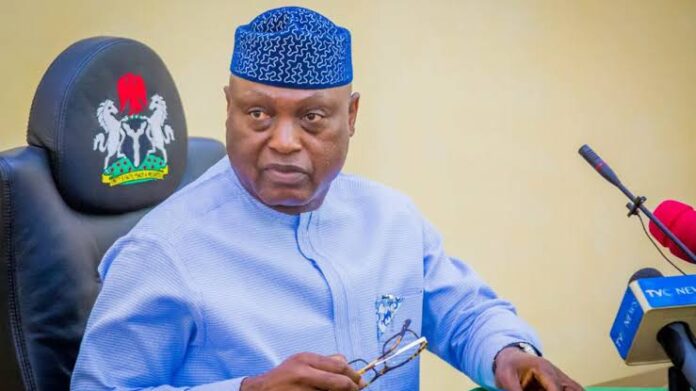
Ekiti governorship poll: INEC declares APC’s Oyebanji winner
The Independent National Electoral Commission (INEC) has declared Governor Biodun Oyebanji of the All Progressives Congress (APC) as the winner of the 2026 Ekiti State governorship election.
The Returning Officer for the election, Adenike Oladiji, announced the result at about 3:13 a.m. on Sunday, declaring that Oyebanji secured a total of 319,224 votes to defeat his closest rivals in the contest conducted across the state’s 16 local government areas.
Oladiji, a professor and Vice-Chancellor of the Federal University of Technology, said the candidate of the Peoples Democratic Party (PDP), Oluwole Oluyede, scored 40,543 votes, while Dare Bejide of the African Democratic Congress (ADC) polled 12,872 votes.
She further disclosed that 384,940 voters were accredited for the election, while 375,777 valid votes were recorded.
According to her, 6,332 votes were rejected, bringing the total votes cast to 382,109.
The declaration brought to a close a closely watched governorship election in which voters across Ekiti State turned out on Saturday to elect a governor amid a generally peaceful atmosphere, despite reports of technical challenges and allegations of irregularities in some locations.
BVAS complaints, irregularity allegations
Before the declaration of results, the election witnessed a mixture of orderly voting, technical challenges and allegations of irregularities, even as observers and many voters commended security agencies for maintaining peace throughout much of the exercise.
INEC reported that all 2,445 polling units designated for the governorship election opened for voting.
According to the commission, 2,257 polling units, representing 92.31 per cent, opened on schedule before 8:30 a.m., while 188 polling units, accounting for 7.69 per cent, experienced minor delays but commenced voting before 10:30 a.m.
The commission also commenced the upload of polling unit results to its Result Viewing Portal (IReV) after voting and counting ended in several locations.
During the election, the PDP candidate, Oluwole Oluyede, expressed dissatisfaction with developments at Ugele/Arokun Ward in Ikere Local Government Area.
Speaking to journalists after casting his vote at Polling Unit 006, he alleged that many voters were unable to vote because of problems associated with the Bimodal Voter Accreditation System (BVAS).
He also alleged voter harassment and intimidation at the ward.
Earlier, elderly voters at the same polling unit had expressed frustration after being unable to complete accreditation due to BVAS challenges and called on INEC to urgently rectify the situation.
The candidate of the African Democratic Congress (ADC), Dare Bejide, also alleged irregularities during the election.
However, Oyebanji rejected the allegations.
The governor told journalists after casting his vote at Polling Unit 003, Okelele, Ikogosi-Ekiti, in Ekiti West Local Government Area, that anyone making such allegations must substantiate them with evidence.
He described the conduct of the election as satisfactory and encouraged eligible voters who had not yet voted to come out peacefully and perform their civic duty.
Similarly, the Commissioner of Police in charge of the election, CP Abayomi Shogunle, said that no case of vote-buying was reported to the agency.
Voting ended before 3 p.m. in many polling units, after which sorting and counting of ballots commenced.
However, the exercise became rowdy as party agents and supporters disagreed over the validity of certain ballot papers.
At Polling Unit 006, where the PDP candidate voted, voting was still ongoing as of 4 p.m. because some voters insisted on exercising their franchise despite earlier delays.
The situation later became disorderly, prompting security personnel to intervene and restore calm.
Meanwhile, at Polling Unit 001, Ado D Ijigbo in Ado Local Government Area, party agents and security personnel closely monitored the voting process.
Observers commend turnout, question procedural issues
Election observers generally commended the conduct of the exercise while raising concerns about certain procedural issues.
An observer and First Vice President of the Nigerian Bar Association (NBA), Sebastian Anyia, said the process had remained peaceful and orderly, with voter turnout proving encouraging.
He expressed optimism that the smooth conduct witnessed during accreditation would be sustained throughout the state’s 16 local government areas until the conclusion of the exercise.
Similarly, the Chief Executive Officer of the Nigerian Women Trust Fund, Brenda Anugwom, praised the commitment shown by female voters.
“The women are so resilient; in front of me at the other polling unit, they are laying their blankets on the floor and placing their toddlers, which means they are here to stay; they mean business, and they really want to cast their vote,” she said.
However, election monitoring group Yiaga Africa raised concerns over what it described as discrepancies between ballot papers, result sheets and INEC’s published list of candidates.
But INEC explained that 19 parties were included on the ballot paper to avoid the cost of printing fresh ballot papers owing to court orders.
“Yiaga Africa is observing the Ekiti State governorship election, and our preliminary findings raise serious concerns about the consistency of the materials INEC has deployed.
“After INEC published its initial list of 12 candidates in January 2026, subsequent court rulings (notably on the PDP’s candidacy) and late administrative changes altered party and candidate participation,” the organisation said in a statement signed by Aisha Abdullahi, Chair of the 2026 Ekiti Election Observation Mission, and Yiaga Africa Executive Director, Samson Itodo.
“Also, the public may not have fully received information about these changes.
“These inconsistencies might create confusion during voting and collation. Where result sheets include parties that are not on the ballot, presiding officers may record zero votes for parties that voters did not see.
“Conversely, where voters cast ballots for parties not reflected on the result sheet, such actions could create uncertainty in recording, reconciliation, and collation,” the organisation further warned.
Yiaga Africa subsequently called on INEC to publicly clarify the final list of parties and candidates and provide written guidance to electoral officials handling collation and result documentation.
Ahead of the election, INEC repeatedly assured residents of its readiness to conduct a credible and transparent exercise.
Security agencies also stated that extensive preparations had been made for the poll.
The Nigeria Police Force led a multi-agency security operation involving scores of personnel deployed across the state to secure polling units, collation centres and other strategic locations.
The police imposed restrictions on vehicular movement during voting hours, intensified patrols and warned political actors against violence, vote-buying and other electoral offences.
Security authorities consistently assured residents that adequate measures had been put in place to guarantee a peaceful and credible election.
With the declaration of the final result by INEC, Oyebanji has secured another term as governor of Ekiti State after recording victory over his opponents in the governorship contest.
- Channels TV