



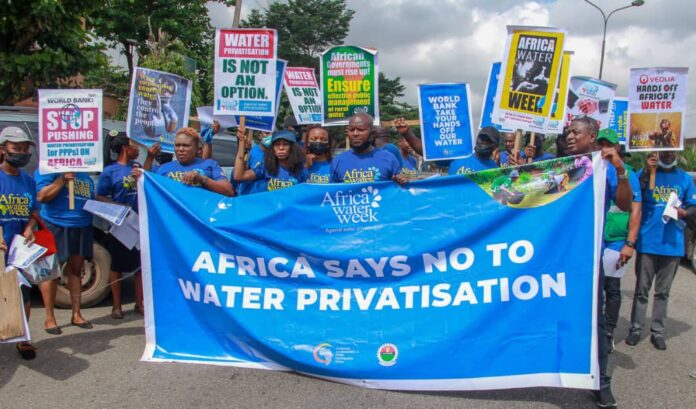
OWORAC warns against water privatisation, demands community control towards Africa Water Vision 2063
The Our Water Our Right Africa Coalition (OWORAC) has raised concerns about Africa’s growing push towards water privatisation and the seeming exclusion of affected communities and groups in the implementation of the Africa Water Vision (AWV) 2063, warning that such an approach could undermine public accountability and, ultimately, access to safe water across the continent.
The coalition’s concerns followed a recent regional consultation in Abuja hosted by the African Ministers’ Council on Water (AMCOW) as part of ongoing continental consultations on the First Implementation Plan (2026–2033) of the Africa Water Vision 2063 and Policy.
The meeting, which brought together representatives of the African Union (AU), the Economic Community of West African States (ECOWAS), development partners, and regional institutions, comes at a significant political moment following the African Union’s adoption of 2026 as the Year of “Ensuring Sustainable Water Availability and Safe Sanitation Systems to Achieve the Goals of Agenda 2063.”
In a statement, OWORAC warned that the growing emphasis on private sector participation, blended financing models, and public-private partnerships in the water sector opens the door to increased privatisation of water services across Africa.
“Across Africa, such models have often resulted in rising water tariffs, weak public accountability, deteriorating labour conditions, and unequal access to water services,” the coalition stated. “When essential public services are transferred to corporate actors, the human right to water risks being subordinated to profit-driven interests.”
OWORAC also noted that water workers across the continent are increasingly becoming marginalised, victimised, or pushed into precarious working conditions under privatised systems, warning that any serious African water vision must recognise not only communities but also workers as central stakeholders in public water governance.
The coalition acknowledged the importance of investing in water infrastructure but warned against treating water primarily as an economic commodity.
“Water is first and foremost a public good and a human right,” the coalition stated. “Policies that prioritise investor confidence over universal access and public accountability, risk deepening inequality and worsening water insecurity for poor and vulnerable communities.”
The coalition also expressed worry over the exclusion of communities directly affected by water shortages and sanitation challenges, civil society organisations, and water workers’ unions from the Abuja consultation.
OWORAC noted that although the AWV 2063 commits to the inclusion of civil society in the co-design and implementation of the policy framework, the Abuja consultation appeared to be dominated largely by government officials and regional institutions.
“The people most affected by water shortages and sanitation failures must not be sidelined from decisions about Africa’s water future,” the coalition said. “Community participation must be real, structured, and guaranteed.”
OWORAC further observed that the consultation offered little clarity on how the ambitious goals of AWV 2063 would be financed and implemented or what safeguards would exist to prevent rampant private sector control over public water systems.
The coalition said the concerns are particularly relevant given Senegal’s leadership role in continental water governance. Senegal currently chairs AMCOW and plays a central role in shaping Africa’s water policy direction.
OWORAC pointed to ongoing criticism surrounding urban water management in Senegal where water distribution is managed by Sen’Eau, a company largely controlled by the French multinational Suez, as an important case study for the rest of the continent.
Since the arrangement began in 2020, communities have raised concerns over rising water costs, poor service delivery, transparency issues, and the weakening of public oversight. This is coupled with allegations of aggressive intimidation and retaliation against unionised workers exercising their right to advocate for more humane working conditions, spurring international condemnation.
The coalition also referenced Nigeria’s own water challenges, noting that millions of Nigerians still lack reliable access to safe drinking water even with the country’s prominent role in regional policy discussions.
“Across Nigeria, many communities depend on private water vendors, boreholes, and other informal sources because public water systems have suffered years of neglect and underinvestment stemming from a dogmatic pursuit of the false solution of privatisation,” the statement noted. “Despite various privatisation and commercialisation drives within the sector over the years, water delivery has not significantly improved for ordinary people, while valuable public resources are diverted into creating an “enabling environment” for corporations. Instead, access challenges, inequality, and the financial burden on households have continued to deepen.”
OWORAC therefore called on African governments, regional institutions, and development partners to ensure that the implementation of the Africa Water Vision 2063 is guided by transparency, inclusiveness, public accountability, and a commitment to public control of water.
The coalition urged governments across the continent to strengthen public water systems, reject policies that encourage privatisation, and guarantee meaningful participation of communities, workers, civil society organisations in water governance decisions.
“Water is a public good,” OWORAC stated. “Its future must be determined by the people who depend on it for life and dignity, not by profit.”
OWORAC is a network of grassroots organisations, community movements, activists, trade unions, and civil society groups from nearly a dozen African countries united by the belief that access to clean, affordable water is a fundamental right, not a commodity for profit.


