



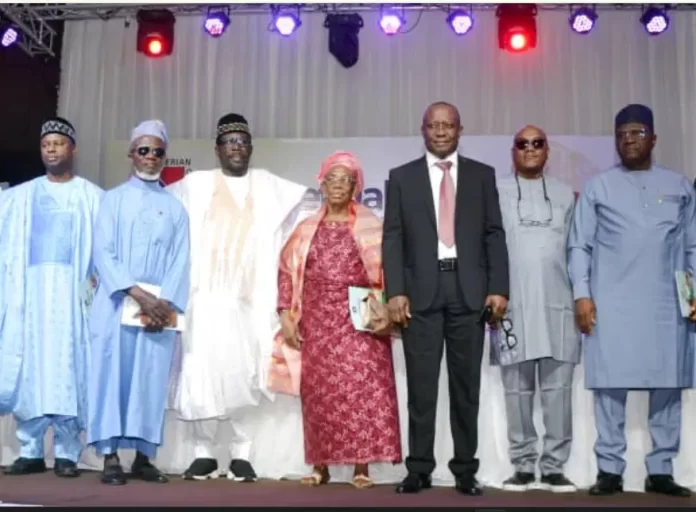
Ojikutu pushes for LASU renaming to honour Jakande, amidst tributes from Bala Mohammed, Onanuga, others
By Ishaya Ibrahim
A former Deputy Governor of Lagos State, Alhaja Sinatu Ojikutu, has strongly advocated for the renaming of Lagos State University (LASU) after its founder, the late Alhaji Lateef Jakande. Jakande, who served as Lagos State governor between 1979 and 1983, established the university in 1983.
Ojikutu, who was part of Jakande’s cabinet before the December 31, 1983 military coup, emphasized that if LASU were to be renamed after any individual, it should undoubtedly be Jakande due to his indelible impact on Lagosians. She recalled his egalitarian approach to governance, where “everyone – rich or poor, would be on the queue for an audience, a style that often put him at odds with the elite.”
Ojikutu made these remarks at the third annual Lateef Jakande Memorial Lecture, hosted by the Nigerian Guild of Editors in Lagos on Wednesday, July 23.
The lecture’s keynote address, delivered by Bauchi State Governor Bala Mohammed (represented by his Chief of Staff, Aminu Hassan Gemawa), focused on “Journalism and the Challenge of Nation-Building in a Multi-Ethnic Society.”
Mohammed lauded Jakande for governing Lagos with core journalistic principles: simplicity, honesty, accessibility, and efficiency. “Jakande governed with the pen still in his heart, even if not in his hand,” Mohammed stated.
Mohammed further noted that Jakande’s service under the Abacha government stemmed from a deep belief in unity, nationhood, and service to Nigerians, despite the challenging circumstances. He drew a parallel to his own experience in 2010 when he moved the motion for the Doctrine of Necessity to allow then Vice President Goodluck Jonathan to assume presidential powers during a constitutional crisis. Mohammed recounted the fierce backlash he faced, including accusations of betrayal and recall petitions, but stressed that the path of nation-building often involves misunderstanding.
On the theme of journalism and nation-building, Mohammed urged the media to foster national consciousness, moving beyond identities defined by language, religion, and geography. “We must not merely be a federation of ethnicities. We must be a nation of citizens,” he asserted, calling for the cultivation of a national ethos based on values like respect for life, the rule of law, dignity of labour, and “truth over tribe.”
He localized Martin Luther King Jr.’s dream, saying, “I dream of a Nigeria where children are not judged by their surname, their state of origin, or their place of worship, but by the content of their character and the strength of their service.”
Professor Lai Olorede, the event’s chairman, highlighted Jakande as a leader who could have united Nigeria’s diverse ethnic groups and resolved identity politics. He highlighted theories from scholars that identity disappears under globalization, modernization, and capitalism, arguing that many of Nigeria’s identity management challenges, which have led to conflict, stem from “poverty of leadership.”
Olorede praised Jakande’s inclusive approach, stating, “When Alhaji Jakande was the governor of Lagos State, he never asked anybody, where are you from? All Alhaji was doing was to deal with the public and groups in society, regardless of religion, regardless of your ethnicity.”
He noted that Jakande’s own family members sometimes “lost out in the competition for public goods” because of his commitment to serving all Nigerians equally.
Olorede concluded by reading a poignant poem written by Jakande in 1949, titled “A Broken Heart Speaks,” which lamented Nigeria’s disunity and questioned its future, reflecting a deep concern for national cohesion even at a young age.
Other notable speakers at the event included Eze Anaba, president of the Nigerian Guild of Editors; presidential spokesman Bayo Onanuga; former presidential spokesman Femi Adesina; former Managing Director of Guardian Newspaper, Emeka Ezeze; former Osun State Commissioner for Information, Funke Egbemode; and current Managing Director of Punch Newspaper, Joseph Adeyeye.
The poem, ‘A Broken Heart Speaks,’ is reproduced below.
What? Will this country ever unite? Will this country ever unite? Are we doomed to remain this way forever? Can we ever make a congenial whole? Whether Nigeria can make a whole? That we are not able to say this is Yoruba, this is Igbo, this is Fulani, this is this. Can we ever make a whole? Who was asking that question? Neither countrymen are being banned.
Which destination are we heading towards? Must we continue to pay the fiddler while Rome burns? Rome is already aflame, may be razed to the ground. Poor country.
Call me a peasant if you like; only my heart is broken. A broken heart speaks. My hopes are shattered, and the future smells of disaster.
Look around you, reader. Read through the newspapers and magazines, and you will see Nigerian unity a team-long dream of being sacrificed at the altar of the green-eyed monster.
A monster is about to consume Nigeria. Look around you and judge whether there is any prospect of a chance for the fulfilment of this lucky hope. Read and re-read the damnable articles in the dailies and weeklies.
Poor country. Time there was when I had a full confidence in the materialization of my daydreams in my lifetime. But lo, the rain fell and the flood came, and my hopes were swept away.
Look around you, poor me. What do I now see? I look and behold, Nigeria is split into three warring tribes. Will they unite now or never?


