



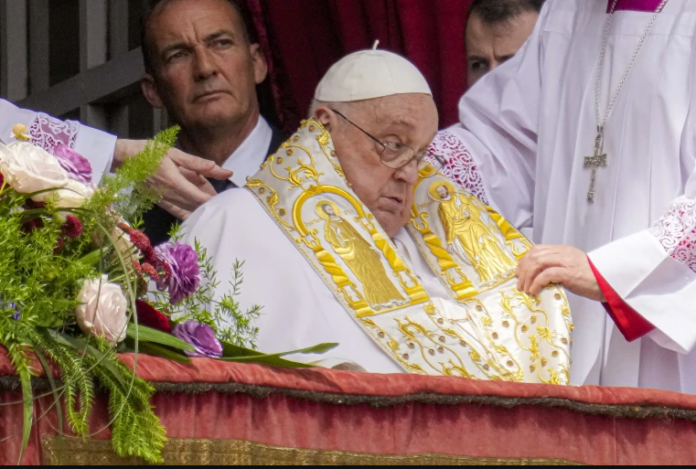
The death of Pope Francis on Easter Monday, April 21, 2025, draws the curtain on a life of a revolutionary era that often put to question some traditions of the church. The Poe died at the age of 88 at his residence in the Vatican’s Casa Santa Marta
By Emeka Alex Duru (With Agency Reports)
The death of Pope Francis on Easter Monday, April 21, 2025, draws the curtain on a life of a revolutionary era that often put to question some traditions of the church. The Poe died at the age of 88 at his residence in the Vatican’s Casa Santa Marta, according to Agency Reports.
At 9:45 AM, Cardinal Kevin Farrell, Camerlengo of the Apostolic Chamber, announced the death of Pope Francis from the Casa Santa Marta with these words:
“Dearest brothers and sisters, with deep sorrow I must announce the death of our Holy Father Francis. At 7:35 this morning, the Bishop of Rome, Francis, returned to the house of the Father. His entire life was dedicated to the service of the Lord and of His Church. He taught us to live the values of the Gospel with fidelity, courage, and universal love, especially in favor of the poorest and most marginalized. With immense gratitude for his example as a true disciple of the Lord Jesus, we commend the soul of Pope Francis to the infinite merciful love of the One and Triune God.”
READ ALSO:
BREAKING: Pope Francis is dead
Francis, who became the first Latin-American pontiff in 2013 and was one of the oldest popes in the church’s history, died weeks after he was discharged from a Rome hospital having battled a life-threatening case of pneumonia in both lungs.
The Pope was admitted to the Agostino Gemelli Polyclinic Hospital on Friday, February 14, 2025, after suffering from a bout of bronchitis for several days. Pope Francis’ clinical situation gradually worsened, and his doctors diagnosed bilateral pneumonia on Tuesday, February 18. After 38 days in hospital, the late Pope returned to his Vatican residence at the Casa Santa Marta to continue his recovery.
Widely seen as the voice for the poor who reshaped the Catholic Church, the late Pope faced fierce resistance for his revolutionary stance on critical issues.
In 1957, in his early 20s, Jorge Mario Bergoglio underwent surgery in his native Argentina to remove a portion of his lung that had been affected by a severe respiratory infection.
As he aged, Pope Francis frequently suffered bouts of respiratory illnesses, even cancelling a planned visit to the United Arab Emirates in November 2023 due to influenza and lung inflammation.
In April 2024, the late Pope Francis approved an updated edition of the liturgical book for papal funeral rites, which will guide the funeral Mass which has yet to be announced.
The second edition of the Ordo Exsequiarum Romani Pontificis introduces several new elements, including how the Pope’s mortal remains are to be handled after death.
The ascertainment of death takes place in the chapel, rather than in the room where he died, and his body is immediately placed inside the coffin.
According to Archbishop Diego Ravelli, Master of Apostolic Ceremonies, the late Pope Francis had requested that the funeral rites be simplified and focused on expressing the faith of the Church in the Risen Body of Christ.
“The renewed rite,” said Archbishop Ravelli, “seeks to emphasise even more that the funeral of the Roman Pontiff is that of a pastor and disciple of Christ and not of a powerful person of this world.”
Born Jorge Mario Bergoglio on 17 December 1936, he was the first pope from the Society of Jesus (the Jesuit Order), the first from the Americas and the Southern Hemisphere, and the first born or raised outside Europe since the 8th-century Syrian pope Gregory III.
He was ordained a Catholic priest in 1969; from 1973 to 1979, he was the Jesuit provincial superior in Argentina. He became the archbishop of Buenos Aires in 1998 and was created a cardinal in 2001 by Pope John Paul II. He led the Argentine Church during the December 2001 riots in Argentina.
Following the resignation of Pope Benedict XVI on 28 February 2013, a papal conclave elected Bergoglio as his successor on 13 March. He chose Francis as his papal name in honour of Saint Francis of Assisi. Throughout his public life, Francis was noted for his humility, emphasis on God’s mercy, international visibility as pope, concern for the poor, and commitment to interreligious dialogue.
He was known for having a less formal approach to the papacy than his predecessors by, for instance, choosing to reside in the Domus Sanctae Marthae (House of St. Martha) guest house rather than in the papal apartments of the Apostolic Palace used by previous popes.
Francis made women full members of dicasteries in the Roman Curia. He maintained that the Catholic Church should be more sympathetic toward members of the LGBTQ community, and stated that although blessings of same-sex unions are not permitted, the individuals can be blessed as long as blessings are not given in a liturgical context.
Francis was a critic of unbridled capitalism, consumerism, and overdevelopment, He made action on climate change a leading focus of his papacy. He is widely interpreted as denouncing the death penalty as intrinsically evil, stating that the Catholic Church is committed to its abolition. In international diplomacy, Francis criticized the rise of right-wing populism, called for the decriminalization of homosexuality, helped to restore full diplomatic relations between the United States and Cuba, negotiated a deal with China to define how much influence the Communist Party had in appointing Chinese bishops, and supported the cause of refugees.


