By Onyewuchi Ojinnaka
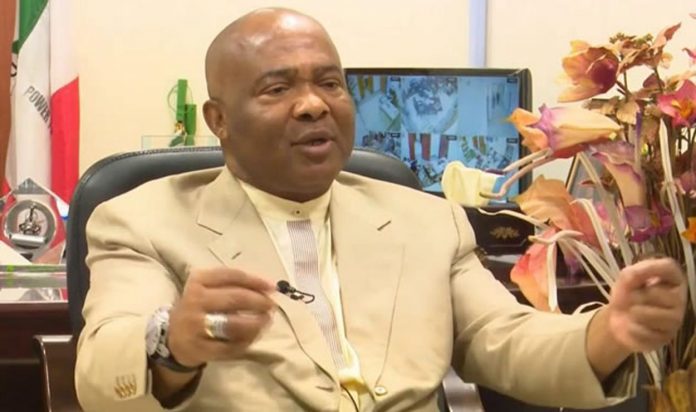
The Deputy Minority Leader, Imo State House of Assembly, Frank Ugboma, who purportedly sponsored the Imo State Administration of Criminal Bill No 2 of 2020 (ISACJL 2020) which was signed into law by Imo State Governor Hope Uzodinma has cried out that the bill was altered.
Governor Hope Uzodinma had signed into law the ISACJL 2020, empowering him to arrest and detain any resident of the state for as long as he wishes.
Since the bill was signed into law by Governor Uzodinma, it has attracted criticisms and condemnation by various sections of the society.
Reacting to the development, Frank Ugboma, said that some sections of the bill were sneaked in by some unknown individuals.
He described the development as a “rude shock”, stating that the bill had 372 sections.
He pointed out that the controversial section that empowers the governor to arrest and detain contravenes the fundamental rights guaranteed by the constitution.
The deputy minority leader said, “For the avoidance of doubt, the Bill I presented had about a total of 372 sections. How and where it was amended, recreated and reshaped into Section 484 and beyond remains a mystery and a legislative wonder of our time as what I presented and circulated to my colleagues during plenary, both in the first and second readings did not contain such obnoxious and embarrassing Section 484.
“Neither was it deliberated in the House Committee of the whole. It indeed never existed in the House.
“No one has been able to explain to the members of the 9th House how and at what stage the said Section 484 was inserted into the Bill. It smacks of an evil manipulation to throw Imo people into the dungeon.
“This particular provision is a nullity ab initio in view of the unambiguous provisions of Sections 1(1),(3),4,5,6 and 36 of the 1999 constitution of Nigeria (as Amended). This is very appalling.”
The lawmaker disclosed that he had implored the State Assembly to constitute a committee to ascertain how such horrendous act was done, adding that he has forwarded another bill to amend the one assented to by the governor.
“This was not the Bill I presented and sponsored.
“In the manuscripts that I received after each hearing and which I have compared with that given to my colleagues, there is no hand of Esau.
“This has informed my view and I have forwarded a Bill for the immediate amendment of those offensive and draconian sections,” he stated.
Recall that Governor of Imo State, Sen. Hope Uzodinma, recently assented into law, the Imo State Administration of Criminal Justice Law, No. 2 of 2020.
However, criticisms have continued to trail the legality or otherwise of the provisions relating to word “PLEASURE”, permitting the State Governor to detain suspects at his pleasure.
Section 484 of the Law provides:
“Where any person is ordered to be detained during the governor’s pleasure he shall notwithstanding anything in this law or in any other written law contained, be liable to be detained in such place and under such conditions as the governor may direct and whilst so detained shall be deemed to be in legal custody”.
Besides, the law provides that a detainee may only be discharged if granted license by the governor.
Section 485 provides:
(1) A person detained during the governor’s pleasure may at any time be discharged by the governor on license
(2) A license under subsection (1) of this section may be in such form and may contain such conditions as the Governor may direct.
(3) A license under this section may at anytime be revoked or varied by the Governor and where license has been revoked the person to whom the license relates shall proceed to such place as the Governor may direct and if he fails to do so, may be arrested without warrant and taken to such place.
Going by the above provision, it means that the Governor can detain a suspect at will and direct the custody in which such a person is to be kept. It abolished all forms of preliminary inquiry or preliminary investigation into a criminal charge by a magistrate or any court in the state and replaced them with preparation of proof of evidence.