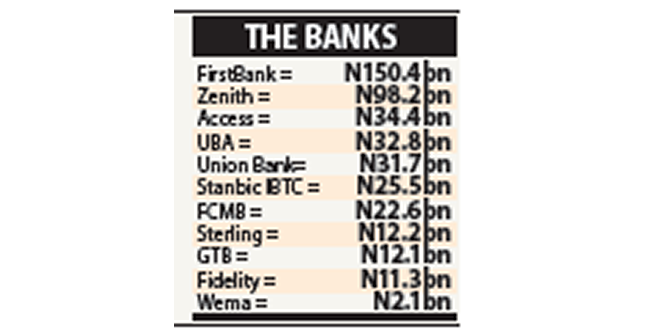
Despite the improving macroeconomic environment, the banking industry seems likely to continue to grapple with Non-Performing Loans (NPLs), in the short-term at least, as financial results of 11 Deposit Money Banks (DMBs) show that they provided a total of N433.8 billion as provision for bad loans in 2017.
The banks are Zenith Bank, United Bank for Africa (UBA), Guaranty Trust Bank, First Bank, Access Bank, Union Bank and Stanbic IBTC. Others include FCMB, Fidelity Bank, Sterling Bank and Wema Bank.
However, confirming predictions that the i proving macroeconomic environment will gradually lead to a reduction in banks’ NPLs, New Telegraph’s analysis of the 11 lenders’ 2017 full year financial statements, shows that the N433.8 billion figure is lower than the total of N477 billion provided by these DMBs for bad loans in the 2016 financial year.
Further analysis of the results reveals that FirstBank provided the highest amount as NPLs provision, followed by Zenith Bank.
Specifically, FirstBank reported a loan loss provision of N150.4 billion for last year, which was, however, an improvement on the N226 billion the Tier 1 lender announced for the same purpose in 2016.
Zenith Bank’s results indicate that the Tier 1 lender’s loan loss provision increased by 203.64 per cent to N98.2 billion from N32.3 billion in 2016.
Also, Access Bank reported an increase of 57 per cent in its loan loss provision to N34.4 billion in 2017 from N21.9 billion in the previous year.
Similarly, UBA’s loan loss provision rose by 18.83 per cent to N32.8 billion from N27.6 billion in 2016.
Another big lender, Union Bank, said its loan loss provision increased by 14.44 per cent to N31.7 billion in 2017 from N27.7 billion.
Tier 2 lender, Stanbic IBTC also reported a 29.16 per cent rise in its loan loss provision to N25.5 billion in 2017 from N19.8 billion in the previous year.
It was followed by another Tier 2 bank, FCMB, which, however, reported reduced loan loss provision of N22.6 billion for last year compared with the N35.5 billion it announced for 2016.
The other Tier 2 banks among the 10 lenders – Sterling Bank, Fidelity and Wema – all reported an increase in loan loss provisions for last year.
Sterling bank’s loan loss provision increased from N11.7 billion in 2016 to N12.2 billion last year, while Fidelity’s and Wema’s rose by N8.6 billion to N11.3 billion and N412.4 million to N2.1 billion respectively.
But perhaps, the most interesting figure was reported by leading Tier 1 lender, Guaranty Trust Bank, which announced 81. 36 per cent reduction in loan loss provision from the N65.2 billion it declared for 2016 to N12.1 billion last year.
Analysts point out that the significant increase in loan loss provision announced by some of these lenders last year was due to their exposure to the $1.2 billion syndicated loan that they granted telecoms firm, 9Mobile (formerly Etisalat Nigeria) in 2013.
Indeed, the Managing Director/CEO of Zenith Bank Plc., Mr. Peter Amangbo, had revealed in the middle of last year that his bank made a provision on 30 per cent on its loan to the telecoms company.
His counterpart at Access Bank, Mr. Herbert Wigwe, also disclosed that the Tier 1 lender had a direct exposure of N11 billion to 9Mobile, as well as an exposure of N35 billion-N39 billion to the telecoms firm’s suppliers.
Wigwe noted that Access Bank hoped to recover the debt once 9mobile was sold to new investors.
Significantly, in a research note issued at the end of an investor conference it held in Lagos last week, Renaissance Capital stated: “We are cautiously optimistic on the overall NPL outlook for the sector. On more specific NPL issues, we discussed the ongoing sale of 9Mobile, which also attended our conference.
“According to 9Mobile management, its $1.2 billion outstanding loan has been negotiated down to $800 million, of which $301 million is due to be paid by the new investor, Teleology, on June 30, 2018. We believe the sale will likely close, although the timeframe may stretch beyond 1H18.
“Our bigger concern is the sustainability of the business beyond the sale, given that the $500 million balance of the outstanding debt will be restructured over an eight-year period, including a two-year moratorium.”
Besides, the firm stated: “9Mobile has lost subscribers, its margins are under pressure and lack of capital investment has made it less competitive than peers. Repayment will, therefore, hang in the balance for some time, in our view. In the power sector, we believe continuing forbearance by the Central Bank of Nigeria (CBN) will likely prevent the banks from classifying some of these loans as NPLs in the short term.”
It will be recalled that in a chat with journalists early last year, Managing Director, Agusto & Co., Vivian Shobo, projected higher double digit NPLs in the Nigerian banking system of 12.5 per cent in 2017 from 7.5 per cent in 2016.
She said: “The macro affects the micro and banking systems usually will reflect what is happening in the macro-economic environment. The macro-economic environment has affected the banking industry on two fronts – asset quality and earnings. Asset quality has deteriorated with delinquent oil and gas, power and general commerce loans.
“Agusto & Co is projecting higher double digit non-performing loans in the banking system – 12.5 per cent in 2017 from 7.5 per cent 2016. Loan losses will impair earnings by up to 30 per cent. We believe that capital will be adequate for most of the banks. However, some banks will need to raise capital, to buffer the capital eroded from loan losses.”
According to the Central Bank of Nigeria (CBN)’s Financial Stability Report (FSR), the NPL ratio of Nigerian banks rose to a five-year high of 14 per cent at the end of December 2016, the worst ratio recorded by the country’s lenders since 2012 when the NPL ratio was just 3.7 per cent. The data showed that the NPL ratio more than doubled its December 2015 level of 5.3 per cent.
The CBN blamed the deterioration in asset quality to rising inflationary trend, negative Gross Domestic Product (GDP) growth and the depreciation of the naira.
.new telegraph