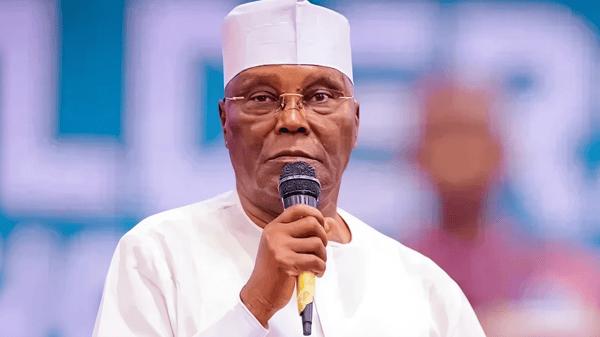
60% poverty rate shows Nigeria regressing under Tinubu – Atiku’s aide
Phrank Shaibu, Senior Special Assistant on Public Communication to former Vice President Atiku Abubakar, has said the latest World Bank report highlighting Nigeria’s deepening poverty crisis reflects the sharp economic decline under President Bola Tinubu’s administration.
He said in a statement on Friday that the report effectively indicts the government’s economic direction, noting that about 60 per cent of Nigerians are now living below the poverty line.
Shaibu described the increase in poverty levels from 40 per cent as “regression on a monumental scale.”
He further maintained that the worsening hardship facing citizens is not incidental but the “direct outcome of poorly conceived and harshly implemented policies.”
He cited the “abrupt removal of fuel subsidies” and the “chaotic devaluation of the naira,” asserting that these measures were “executed without adequate safeguards for the Nigerian people.”
According to the statement, the administration’s reliance on abstract macroeconomic indicators ignores the “far harsher reality” faced by the citizenry.

Shaibu noted that “food prices have spiralled out of control, inflation has wiped out incomes, small businesses are collapsing, and millions more Nigerians are being pushed into extreme poverty.” He described the government’s approach as “economic shock therapy imposed on a vulnerable population.”
“A government that presides over a situation where the majority of its people are poor, yet insists that progress is being made, has lost both moral authority and economic direction,” Shaibu stated.
He said the administration is “dangerously disconnected from the lived realities of its citizens.”
In contrast to the current “policy experiments,” the statement noted that Atiku Abubakar offers an alternative “rooted in experience, pragmatism, and compassion.”
Shaibu detailed a vision where “reform must be carefully sequenced, not recklessly imposed,” and where “social protection must be real, targeted, and transparent, not symbolic.”
He said Atiku’s proposed strategy focuses on stabilising the economy through the coordination of fiscal and monetary policy while “rebuilding productivity through support for small businesses, agriculture, and industry.”
Shaibu emphasised that “leadership is not about defending failure – it is about correcting it,” and called on the nation to embrace a path towards “restoring dignity, stability and shared prosperity.”